


 English
 Español


Three studies, 307 women, one pooled figure: a mean labia minora length of 53.23 mm — about 2.10 inches — with a 95% confidence interval running from 43.50 to 62.96 mm. Mean width came in at 18.28 mm (0.72 in), confidence interval 14.93 to 21.64 mm.
Those numbers come from a 2026 systematic review and meta-analysis of labia minora anatomy in premenopausal women, which screened 567 records and found seven cross-sectional studies covering 991 women that met its criteria.
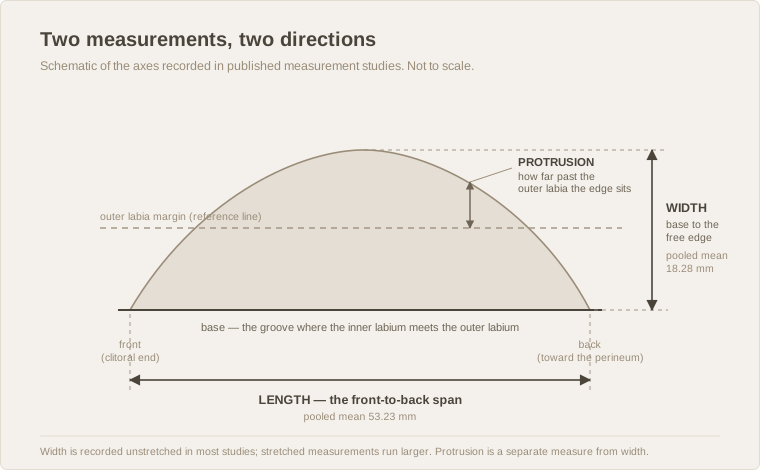
Before either figure means anything, it needs a direction attached to it — and this is where most readers, reasonably, go wrong. In this literature the two words point along different axes, and the everyday sense of the phrase "long labia" maps onto the one researchers call width, not the one they call length.
In Brief
- Researchers record two separate measurements. Length runs front to back along the whole structure. Width runs from the base out to the free edge — and width is the dimension most people have in mind when they describe labia as long.
- A 2026 systematic review pooling three studies and 307 women reported a mean length of 53.23 mm (2.10 in) front to back, and a mean width of 18.28 mm (0.72 in) base to edge.
- Across ten population-based studies, recorded length spans 5 mm to 100 mm (0.2–3.9 in) and recorded width spans 1 mm to 60 mm (0.04–2.4 in).
- Labia minora that protrude past the outer labia are documented as more common than labia minora that do not.
- Left-and-right differences are recorded in roughly half of measured samples.
- An experiment with 97 women found that viewing surgically modified images shifted what they rated as typical.
Two measurements, two directions
The convention is set out plainly in the largest study of its kind. Measuring 657 women, Kreklau and colleagues defined length of the labia minora as running from the clitoris to the lower margin — the front-to-back span of the whole structure, from where it begins near the clitoral hood to where it ends toward the perineum. Width, in the same study, was defined as the distance from the interlabial sulcus, the groove where the inner labium meets the outer labium, out to the margin of the free rim, recorded unstretched.
So the 53.23 mm average describes how far the structure extends front to back. The 18.28 mm average describes how far it projects out from its base. A woman looking down and estimating how far her inner labia hang or extend past the outer ones is estimating something closest to width, and possibly to a third measure entirely: protrusion, which one surgical review distinguishes from width as the distance the free edge sits past the labia majora, and describes as the more relevant figure of the two in that context.
Two practical notes follow. First, some studies record width stretched and some unstretched, and stretched values run larger — one dataset of pubertal females reported stretched widths averaging about 20 mm across a range of 5 to 62 mm (0.2–2.4 in). Second, the terminology is not perfectly consistent between fields; a 2024 study reported "exposed" labial length of roughly 10 to 11 mm alongside "total length from sulcus to edge" of roughly 32 to 33 mm, using the word length for what the gynecological literature would call width. Any figure quoted without its axis is close to meaningless. For the surrounding structures and their names, our guide to the external female anatomy and what each part is called covers the terminology used throughout this article.
What the full measured range looks like
Pooled averages come from a handful of studies with usable statistics. A wider view comes from scoping reviews, which count everything published rather than only what can be mathematically combined. A 2021 review in the Australian and New Zealand Journal of Obstetrics and Gynaecology identified ten population-based studies recording labial dimensions. Across those datasets, front-to-back length ranged from 5 mm to 100 mm (0.2–3.9 in) and base-to-edge width from 1 mm to 60 mm (0.04–2.4 in).
The same review recorded something an average is designed to hide. In the 2026 meta-analysis, the study means themselves ranged from 36.5 mm to 60.6 mm (1.44–2.39 in) for length and 14.7 mm to 21.8 mm (0.58–0.86 in) for width, with statistically significant heterogeneity between samples. Different clinics, different countries, different populations — and the numbers refused to converge.
A hundred millimetres is twenty times five millimetres. Both were measured in women attending routine gynecological care. Neither was an anomaly requiring explanation; both were entries in a dataset.
Each bar shows a span, not a value. Length bars run front to back; width bars run from the base to the free edge. The two shortest bars are the confidence intervals around the pooled averages; the two longest are the full spread of individual measurements recorded in the published literature.
Visible is not the exception
One of the most persistent assumptions is that labia minora tucked entirely inside the outer labia represent the standard configuration and anything visible represents a departure from it. Measurement data does not support that reading. The 2021 scoping review reported that protruding labia minora were more common than non-protruding across the studies it examined.
A separate cross-sectional study looking at both measurement and self-perception put figures on the same question, and its numbers are width figures — base to free edge, the dimension that determines whether the inner labia are visible at all. Median width was 15 mm (0.59 in), and 90% of measurements fell below 26.5 mm (1.04 in), meaning roughly one woman in ten measured at or above that. Fifty-six percent of the women in that sample had visible labia minora. The researchers' own summary was blunt: having visible labia minora is about as common as not having them.
The perception findings from the same study are worth sitting with. Of the women measured, 86.5% considered their own genitals typical. Among those who did not, 73.3% had visible labia minora. And among women with the largest measurements — above 26.5 mm in width — two thirds still described themselves as within the usual range. The measurement and the self-assessment were only loosely connected.
A hundred millimetres is twenty times five millimetres. Both were measured in women attending routine care. Neither was an anomaly requiring explanation.
On what the range actually contains
Asymmetry is documented, not incidental
Symmetry is rare anywhere in human anatomy, and the labia are no exception. The 2021 scoping review noted that asymmetry between right and left was common across the studies reviewed. A 2019 study of 44 adolescents aged 10 to 19 quantified it: front-to-back lengths differed between the two sides in 19 of 44 participants (43%), and base-to-edge widths differed in 55% of unstretched measurements and 61% of stretched ones, with differences ranging from 1 mm to 22 mm (0.04–0.87 in).
That study found no correlation between labial size or shape and age, height, weight, or race — and its authors concluded there is no established normal range in this population, which is why they urged particular caution about surgical intervention in adolescents. The same pattern holds in male anatomy, where the reference datasets used to define "average" were built in ways worth examining closely; our companion piece on the documented range of penile curvature in published studies follows the same evidence-first approach.
Did you know?
In the 2019 adolescent dataset, labial measurements showed no relationship to chronological age, pubertal stage, height, weight, or ethnicity. The researchers described the variability they found as wide enough that no normative range could be established from it — a rare instance of a study publishing the absence of a benchmark rather than inventing one.
The numbers move across a lifetime
Anatomical reference figures are often quoted as if they described a fixed adult state. The lifespan data says otherwise. The study of 657 women aged 15 to 84 found that front-to-back length was inversely correlated with age (r = −0.364, P < 0.001). The same study found labia majora length positively correlated with body mass index. The 2021 scoping review recorded that labia minora were wider — that is, projected further from the base — in premenopausal than postmenopausal women.
Childbirth appears in the data too. A pilot study using a standardized measurement chart reported that women with a history of vaginal delivery had significantly longer labia minora front to back than those without (56.8 mm versus 50.9 mm, or 2.24 in versus 2.00 in). Not every dataset agrees; one study of labia minora width found no statistically significant association with age, body mass index, or parity at all. What is consistent across the literature is that the figures are not static, and a measurement taken at 22 is not a prediction of a measurement at 62.
| Study | Sample | What was recorded — L = front-to-back length, W = base-to-edge width |
|---|---|---|
| Lloyd et al., BJOG, 2005 | 50 premenopausal women, UK | W mean 21.8 mm, range 7–50 mm (0.28–1.97 in); wide variation in length, width, color and texture |
| Kreklau et al., BJOG, 2018 | 657 women, ages 15–84 | L inversely correlated with age (r = −0.364, P < 0.001); defines the measurement convention used here |
| Cross-sectional size and perception study, 2017 | Women in routine gynecological care | W median 15 mm (0.59 in); 90% below 26.5 mm (1.04 in); 56% with visible labia minora |
| Brodie et al., 2019 | 44 adolescents, ages 10–19 | Left/right L differed in 43%; unstretched W differed in 55%; differences of 1–22 mm |
| Hayes & Temple-Smith, scoping review, 2021 | 10 population-based studies | L 5–100 mm; W 1–60 mm; protruding more common than not; asymmetry common |
| Mangla et al., 2025 | 207 women, South India | L mean 44.1 mm, range 15–80 mm (0.59–3.15 in); W mean 15.7 mm, range 5–48 mm |
| Systematic review and meta-analysis, 2026 | 7 studies / 991 women; 3 studies / 307 women pooled | Pooled L 53.23 mm (2.10 in); pooled W 18.28 mm (0.72 in) |
Where the mental picture comes from
If the measured range is that wide, the narrowness of the mental picture most people carry needs explaining. The research points at images rather than anatomy.
An experiment published in BJOG in 2014 randomly assigned 97 women aged 18 to 30 to view surgically modified images, unmodified images, or no images, then asked all of them to rate a mixed set for whether each looked normal and whether each represented society's ideal. Exposure changed the ratings. Women who had first seen modified images were measurably more likely to rate modified anatomy as normal and as the ideal than the control group was. The lead researcher noted alongside that work that requests for labial reduction on Britain's National Health Service had increased five-fold between 2001 and 2010.
Commercial imagery compounds the effect. A women's health service that maintains a non-commercial photographic reference points out that performers and models in mainstream adult material have often had cosmetic surgery, and that images are routinely airbrushed or filtered — making that material an unreliable baseline for anyone, men included, forming an idea of what is typical. Modesty norms have their own long history here: for most of recorded history, the material available to anyone forming an impression of this anatomy was art, not photography, and art followed convention rather than measurement. How that pattern plays out with body data generally is covered in our piece on how body statistics get framed and when they become a source of shame.
Two questions that keep getting merged
There is a habit in writing on this subject of answering a question about preference with a fact about anatomy, and it satisfies nobody. The two are separate questions and both are real.
The first is descriptive: what has been measured. That question has an answer, and it is the one above — a documented span from 5 to 100 mm front to back and 1 to 60 mm base to edge, with visible configurations at least as common as hidden ones, asymmetry in roughly half of measured samples, and figures that shift with age and childbirth. Nothing in that dataset ranks one configuration above another, because measurement does not rank.
The second is aesthetic: what an individual finds appealing, on themselves or on a partner. People hold those preferences, they are not erased by being told a range exists, and pretending otherwise tends to make readers trust the data less rather than more. What a preference cannot do is redefine the measurement range — and what a measurement range cannot do is dictate a preference. Trouble starts when a preference formed from a retouched, surgically selected, non-representative sample gets mistaken for a description of the population. That is not a matter of taste; it is a sampling error.
By the numbers
| 991 | women across the seven cross-sectional studies that met the 2026 review's criteria |
| 56% | of women in a measurement-and-perception study had visible labia minora |
| 86.5% | of the same sample considered their own anatomy typical |
| 43% | of a 44-participant adolescent sample had differing left and right lengths |
| 5× | increase in NHS labial reduction requests between 2001 and 2010 |
Where the literature draws a line
Educational content should be honest about the edges of its own subject, and there are three worth naming.
The first is that thresholds quoted in this field are almost always width figures. One review cites a transverse distance greater than 40 to 50 mm, measured from the interlabial groove to the widest point, as a proposed cut-off for labial hypertrophy. That is a base-to-edge measurement. It is not comparable to the 53 mm front-to-back average quoted at the top of this article, and the two should never be read against each other — a fact that is easy to miss when both appear as bare numbers in millimetres.
The second is terminology. A women's health service points out that "labial hypertrophy" has no agreed clinical definition and that larger labia minora, including labia minora extending past the outer labia, sit within the documented range. Both that position and the proposed surgical thresholds are in the published record. Readers encountering clinical-sounding language in advertising are entitled to know it does not rest on settled ground.
The third is the distinction between size and symptoms. A 2024 analysis compared labial measurements against patient-reported symptoms and found the correlation weak in both directions: women with longer measurements often reported few symptoms, and women with shorter ones sometimes reported many. Measurement, in other words, is a poor predictor of experience. Persistent discomfort, a change in color or texture that appears over time, or anything new and unexplained belongs in a conversation with a clinician — not because a measurement is unusual, but because those are different categories of observation entirely. Professional obstetrics and gynecology bodies have also issued position statements recommending caution around cosmetic genital procedures, particularly for patients under 16 to 18 years of age.

How common is this variation, actually
Common enough that it is the subject rather than the exception. Across ten population-based studies, the recorded span is 5 to 100 mm front to back and 1 to 60 mm from base to free edge. Protrusion past the outer labia was found to be more frequent than the alternative. Left-and-right differences appeared in 43% to 61% of measurements depending on the parameter. Roughly one woman in ten measured at or above 26.5 mm in base-to-edge width, and two thirds of that group described themselves as typical anyway.
Seven studies, 991 women, and a pooled mean that carries a confidence interval nearly 20 mm wide. When the average itself cannot be pinned down more tightly than that, the honest conclusion is not that most women fall near a center point. It is that the center point was never the finding.
Questions readers ask about the measurement data
Editorial note: This article reports what published measurement studies have recorded. It is educational reference material, not clinical assessment, and it does not offer diagnosis, treatment guidance, or a substitute for a conversation with a qualified clinician.
Disclaimer
- All content on this website—including articles, educational materials, and interactive calculators—is for informational, educational, and entertainment purposes only. The calculations, percentiles, and outputs generated by tools on this site are based on general statistical data and mathematical models; they do not constitute medical data, a clinical assessment, or a diagnosis.
- Nothing contained on this website is a substitute for professional medical advice, diagnosis, or treatment. Always seek the guidance of a qualified healthcare professional or urologist with any questions you have regarding physical development, anatomy, or health conditions. Reliance on any information or tools provided by this website is solely at your own risk.

