


 English
 Español


Every society has rules about the menstruating body. What varies — enormously — is what those rules say, who they bind, and what they are understood to accomplish.
In 1988 the University of California Press published Blood Magic: The Anthropology of Menstruation, an edited collection that set out to dismantle one of the most repeated claims in the discipline: that there exists a single, universal "menstrual taboo." Editors Thomas Buckley and Alma Gottlieb argued that the ethnographic record does not support it. What the record contains instead is a long catalog of specific, local rules — some restrictive, some protective, some barely commented on by the societies that hold them, and a few that treat menstruation as a source of power rather than a source of danger. Readers coming to this subject for the first time may find it useful to start with our overview of what anthropologists actually mean by taboo, because the word carries a technical sense that differs from everyday use.
What "taboo" means in the technical literature
The English word arrived from Polynesian tapu in the late eighteenth century and has been loosely applied ever since. In anthropological usage it describes a prohibition backed by a belief that breaking it produces consequences — spiritual, social, or both — rather than a simple preference or an inconvenience.
Mary Douglas's Purity and Danger (1966) remains the standard theoretical starting point. Douglas proposed that pollution beliefs are not primitive hygiene misunderstood but a form of classification: things become "dirty" when they fall between the categories a culture uses to order the world. Substances that cross the boundary of the body — blood, hair, milk, waste — are prime candidates precisely because they belong to neither the inside nor the outside. That framework applies directly to genital anatomy and to the way societies mark bodily edges, a theme covered at length in our piece on how cultures use the body to mark social limits.
Victor Turner's The Ritual Process (1969), building on Arnold van Gennep's earlier work on rites of passage, added a second tool. Turner described the liminal phase — the interval when a person is no longer what they were and not yet what they will be — as ambiguous and therefore treated as both hazardous and unusually charged with power. A menstruating woman, in many classificatory systems, occupies exactly that position: fertile but not pregnant, adult but temporarily set apart. The same logic governs the seclusion of initiates described in our survey of initiation rites and the body.
The documented range
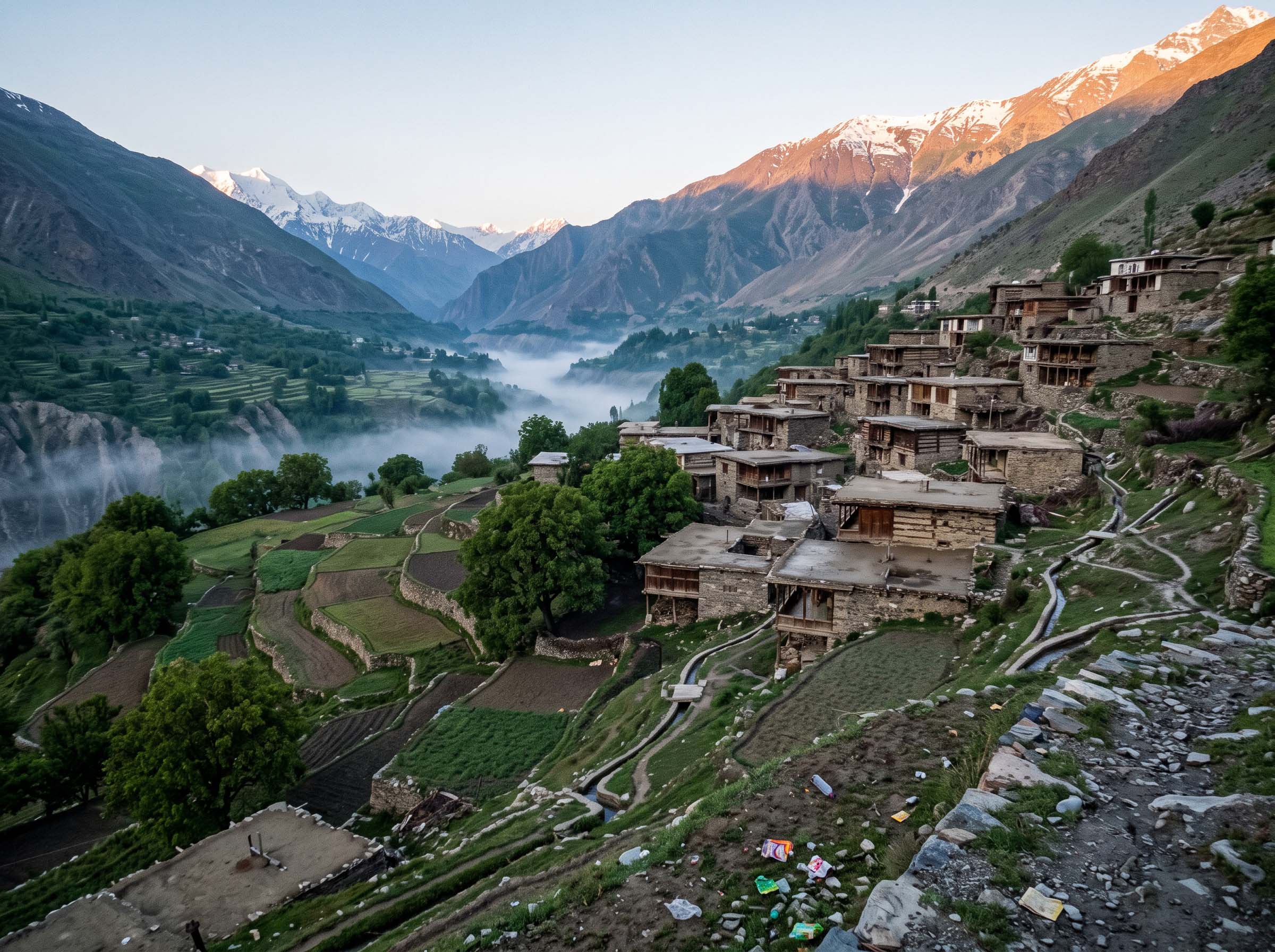
Ethnographers have recorded menstrual practices on every inhabited continent, and the variation is the finding. Among the Kalasha of the Chitral district in northern Pakistan, the cultural order divides the world into onjesta and pragata — categories usually translated as pure and impure. Menstruating women and women giving birth move to a communal building called the bashali, sited below the villages because upper ground carries the higher ritual value. Wynne Maggi's ethnography Our Women Are Free (University of Michigan Press, 2001) devotes a full chapter to the building and describes it as a space closed to men and organized by the women who use it, with its own spring purification ceremonies.
In northwestern California, A. L. Kroeber's early Yurok material was long read as evidence of exclusion. Buckley's re-examination, published in Blood Magic, drew on accounts from Yurok women describing seclusion as a period of concentration — time removed from ordinary labor and understood as a route to spiritual and even economic standing rather than a demotion.
Laura Appell's chapter in the same volume documents the opposite arrangement again. Among the Rungus of Borneo she found menstruation to be, in her phrase, an unmarked category: present, acknowledged, and attached to almost no ritual restriction. Alma Gottlieb's own chapter on the Beng of Côte d'Ivoire describes menstrual blood treated as a sign of fertility, with prohibitions attached to particular places — the forest and the fields — rather than to contact with people in general.
Nor is the pattern confined to small-scale societies. Carol Delaney's chapter on Turkish village life, Denise Lawrence's study of rural Portugal, and Vieda Skultans's work in South Wales all describe menstrual meaning systems inside twentieth-century European and Mediterranean communities. Emily Martin's contribution went further still, treating late-industrial understandings of premenstrual experience as a cultural system in its own right — one that regulates women's time and temper in an industrial work rhythm much as older systems regulated access to fields or shrines.
Longstanding textual traditions add another layer. The Hebrew Bible's Leviticus 15 sets out periods of separation connected to genital discharge for both men and women, and the rabbinic practice of niddah — separation followed by immersion — descends from that text. The symmetry is worth noticing: the biblical rules are not applied to women alone, though later practice developed them asymmetrically.
Table 1 — Selected ethnographic cases: what is restricted, and how it has been read
| Society / setting | What is restricted | Scholarly reading |
|---|---|---|
| Kalasha, Chitral, Pakistan | Residence: women move to the communal bashali, closed to men | Read both as ritual exclusion and, by Maggi, as an autonomous women's institution |
| Yurok, northwestern California | Ordinary labor and communal contact set aside | Buckley: described by some women as a route to spiritual standing, not a demotion |
| Rungus, Borneo | Very little | Appell: an "unmarked category" — the key counter-case to universality claims |
| Beng, Côte d'Ivoire | Access to forest and cultivated fields | Gottlieb: blood treated as a fertility sign; restriction is spatial, not social |
| Far-western Nepal (chhaupadi) | Household residence, food handling, contact with shrines and livestock | Tied by Cameron to a pure/impure binary and to fear of communal misfortune |
| Late-industrial societies | Public reference to menstruation; workplace disclosure | Martin: a meaning system organized around work discipline rather than ritual purity |
Cases drawn from chapters in Blood Magic: The Anthropology of Menstruation (1988), Maggi (2001), and published research on far-western Nepal.
Did You Know?
Several older ethnographies — of the Djuka of Dutch Guiana, the Warao of Venezuela and the Kaska of western Canada among them — recorded that menstrual seclusion gave women a degree of freedom from supervision. Buckley and Gottlieb noted the frequency of this observation and drew a dry conclusion from it: not all men, in these societies, treated the prohibitions as binding either.
Function: what the prohibition does
Cataloguing rules is the easy part. The analytical question is what the rule accomplishes for the people who hold it, and here the literature offers three broad answers that are not mutually exclusive.
The first is classificatory, following Douglas. A prohibition maintains a boundary that matters for reasons that have nothing to do with the substance itself. Where the Kalasha divide the valley into pure upper ground and impure lower ground, the placement of the bashali is not an isolated rule about women; it is one instance of a system that also governs where goats are pastured and where shrines are built.
The second is temporal, following Turner. Setting a period apart creates a marked interval — a recurring rhythm in which a woman is briefly outside her ordinary obligations. Whether that interval is experienced as banishment or as relief depends on what she is being removed from, which is why the same institution generates opposite ethnographic descriptions.
The third is social. Seclusion assembles women in one place, at intervals, away from men. Institutions of that kind tend to develop their own internal life, and researchers working in the Kalasha valleys have reported exactly that.
A prohibition tells you where a society has drawn a line. It does not, by itself, tell you who benefits from the line being there.
Who sets the rule, who enforces it, who it binds
Taboo and authority are difficult to separate, and two recent cases show why.
At the Sabarimala temple in Kerala, women between roughly ten and fifty were customarily excluded, a restriction the Kerala High Court upheld in 1991 on the grounds of long-standing custom. On 28 September 2018 a five-judge Constitution Bench of the Supreme Court of India held, 4:1, that the exclusion was unconstitutional. The Supreme Court Observer case record sets out the questions the bench considered and the review petitions that followed. Protests against the ruling were substantial, and many of the people who turned out to defend the restriction were women — a detail that complicates any simple account of taboo as something imposed by one sex on the other.
In Nepal, the practice known as chhaupadi — moving menstruating women out of the household, often into a separate shed — was declared unlawful by the Supreme Court in 2005 and made a criminal offense by parliament in 2017, with a penalty of three months' imprisonment, a fine of 3,000 rupees, or both. Research published in Health Policy and Planning examined how community members and police in the far west understood the criminal code and concluded that legislation on its own was unlikely to end the practice. Anthropologist Mary Cameron, quoted in coverage of the law, has connected the practice to a pure–impure binary and to a belief that ritual impurity angers local deities and brings misfortune on the whole settlement — which is the point about enforcement. When the perceived cost of a breach falls on the community, the community polices it, and the policing happens inside households rather than in courts.
Three mechanisms that are easy to confuse
Careful writing on this subject keeps three things apart, because they behave differently and respond to different interventions.
Legal prohibition is enforceable by the state and can be changed by statute. Nepal's criminal code is one direction of travel; Scotland's Period Products (Free Provision) Act 2021, which came into force on 15 August 2022 and obliges councils and education providers to supply products free of charge, is the other — law used to remove a barrier rather than to impose one.
Social norm is enforced by other people, not by courts, and it can survive the removal of the law entirely. Menstrual leave provisions are the clearest illustration. Japan introduced seiri kyuka, or physiological leave, in its 1947 Labour Standards Act; Indonesia followed in 1948, Vietnam and South Korea in 2001, Taiwan in 2002, Zambia in 2017, and Spain in February 2023, becoming the first European country to do so. Reporting on the Japanese provision has repeatedly noted very low uptake, with employer surveys finding that only a small fraction of eligible women take the leave, and studies attributing this to concern about how it will be received at work. The legal permission has existed for close to eighty years. The norm has outlasted it.
Individual shame is the residue: a feeling that persists in a person after both the law and the community rule have gone. It is the hardest of the three to document, because it leaves no institutional trace, and the easiest to mistake for the other two.
Chart 1 — Year national menstrual-leave provisions were introduced
Provisions differ substantially in length, pay and documentation requirements; the chart shows year of introduction only.
Taboos that changed inside a single generation
Stable taboos get most of the attention, but the shifting ones are more informative, because the mechanism of change is visible while it happens. Four of the cases above moved within living memory: a court in Kerala reversing a customary exclusion in 2018; a parliament in Kathmandu criminalizing a household practice in 2017; a parliament in Edinburgh legislating free provision in 2021; a parliament in Madrid recognizing menstrual pain as grounds for paid leave in 2023.
Two observations follow. First, the direction is not uniform — some of these changes remove a restriction, others create a new entitlement, and at least one has been contested since the day it passed. Second, in every case the legal instrument arrived after decades of argument inside the society concerned, which cuts against the assumption that taboo subjects are silent subjects. Prohibition and silence are different things. Communities that restrict menstruation most tightly frequently discuss it in great detail; the discussion simply happens in specific settings, among specific people.
Contemporary body taboos belong in the same literature
Emily Martin's chapter in Blood Magic made an argument that has aged well: industrial and post-industrial societies are not the neutral ground from which other people's taboos deviate. They have their own, and the analytical tools work on them.
Consider what is difficult to say out loud in a Western workplace, gym, or clinic waiting room. Anxiety about body size, silence around genital appearance, and the growth of cosmetic procedures aimed at bodily features that were rarely discussed a generation ago all fit the pattern Douglas described: attention concentrating on the parts of the body that mark boundaries, and rules about visibility that are enforced by other people rather than by law. Our examination of why men fixate on measurements traces one version of this, and the cross-cultural picture in what must be covered traces another. The point is not that contemporary norms are equivalent to ritual seclusion. It is that they are produced by the same kind of process and can be studied the same way.
Where the concept runs out
Honesty about the limits matters here. The boundary between taboo, norm and preference is not sharp, and researchers disagree about where to draw it. Appell's finding that Rungus menstruation was an unmarked category raises the awkward possibility that some "taboos" in the older literature were artifacts of the question being asked: an ethnographer who arrives looking for menstrual restrictions will usually find something that can be written down as one.
There is also the translation problem. Applying a Polynesian term to a Nepali household practice, a Levitical text and a Californian workplace convention flattens genuine differences between them. Buckley and Gottlieb's central recommendation was to stop treating "the menstrual taboo" as a single object of study and start asking, case by case, what a specific rule prohibits, who holds it, what breaking it is believed to cost, and who bears that cost. That is a slower method. It also produces a far more interesting map — one where the prohibitions of the Hindu Kush, rural Portugal and a modern open-plan office can be compared without any of them being cast as the strange one.
Editorial Glossary
- Taboo
- A prohibition understood to carry consequences if broken, rather than a simple preference or inconvenience.
- Pollution belief
- In Douglas's usage, the treatment of something as ritually contaminating because it sits between the categories a culture uses to order the world.
- Liminality
- Turner's term for the in-between phase of a transition, when a person is neither in their former state nor yet in the next one.
- Unmarked category
- Something present in a society but carrying no special ritual attention — the situation Appell recorded for Rungus menstruation.
Reader questions
Disclaimer
- All content on this website—including articles, educational materials, and interactive calculators—is for informational, educational, and entertainment purposes only. The calculations, percentiles, and outputs generated by tools on this site are based on general statistical data and mathematical models; they do not constitute medical data, a clinical assessment, or a diagnosis.
- Nothing contained on this website is a substitute for professional medical advice, diagnosis, or treatment. Always seek the guidance of a qualified healthcare professional or urologist with any questions you have regarding physical development, anatomy, or health conditions. Reliance on any information or tools provided by this website is solely at your own risk.


