


 English
 Español


There is a drawer in most large natural history collections that visitors never get to open. It holds bacula — penis bones — sorted by species, labeled in copperplate, and quietly astonishing. A weasel's is a hooked splinter. A raccoon's looks like a small crochet needle.
A walrus specimen in the Grant Museum at UCL measures 66 cm (26 in), and the walrus holds the verified record for the longest mammalian baculum at 75 cm (29.5 in), roughly the length of a human thigh bone, according to Guinness World Records.
Then you reach the tray for Homo sapiens, and there is nothing in it. Not because a curator misplaced it. Because there is nothing to collect. Humans are among a small set of mammals that build no bone there at all — a fact that sits alongside several other ways human genital anatomy stands out among primates, and one that has generated a genuinely interesting body of published research.
What a baculum is, and what it is not
The baculum, also called the os penis or os priapi, is a bone that sits within the tissue of the penis rather than connecting to the rest of the skeleton. It develops from connective tissue instead of forming as part of the axial or limb skeleton, which is one reason it behaves so unpredictably across species. Brassey and colleagues, writing in Proceedings of the Royal Society B, describe it as among the most variable bones in the mammalian body, and note that it has now been documented across nine modern orders: primates, carnivores, rodents, bats, hedgehogs, shrews and moles, colugos, tenrecs and golden moles, and — recently and unexpectedly — the American pika.
Two clarifications matter before going further. First, a mammal without a baculum is not a mammal without a functioning erection. In species that lack the bone, erection is achieved hydraulically, through blood pressure alone. Second, this is not a male-only structure. Females of many of the same species carry a homologous bone in the clitoris, called the baubellum or os clitoridis. Homologous means the two structures share a developmental and evolutionary origin — they are the same thing built in two configurations, which is exactly what you would expect given that male and female genital anatomy develops from one shared fetal template.
Where the bone sits on the mammal family tree
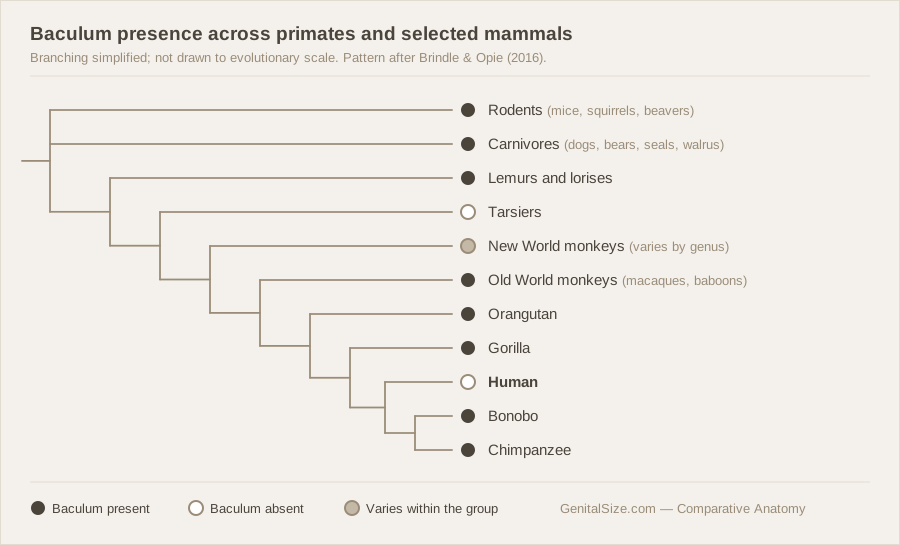
Here is the part that surprises most readers: the baculum is not a single ancient inheritance that a few lineages happened to drop. Reconstructing its history with Bayesian phylogenetic methods, Brindle and Opie estimated that the structure has arisen independently on at least nine occasions across placental mammal evolution, and has also been lost repeatedly. That makes it a case study in convergence — different lineages arriving at similar hardware from different starting points.
Within the primates, the distribution is patchy in an informative way. Strepsirrhines such as lemurs and lorises have it. Old World monkeys have it. Chimpanzees, bonobos and gorillas all have it, though in the great apes it is strikingly small — a few millimetres of bone rather than the substantial rod seen in many carnivores. Tarsiers lack it. Several New World monkeys lack it. And humans lack it entirely, as did Neanderthals and Denisovans so far as the genetic and skeletal record indicates.
Sexual selection, in plain language
Almost every published explanation for genital anatomy draws on sexual selection, so it is worth defining the terms before using them.
Sexual selection describes traits that spread because they improve mating success rather than survival. It has two classic components. Male competition covers traits that help males compete with other males — body size, weaponry, stamina. Female choice covers traits that spread because females preferentially mate with males that have them.
Sperm competition extends the same logic past the moment of mating. Where females of a species mate with more than one male within a fertile window, the sperm of rival males end up competing inside the female reproductive tract. Selection then favors males that can deposit more sperm, or better sperm. This idea was first formalized by Geoff Parker in 1970 working on insects, and has since been applied across the animal kingdom.
Operational sex ratio is the ratio of males ready to mate to females currently fertile in a population. When that ratio is heavily skewed toward males, competition intensifies, and the traits sexual selection favors get more extreme.
Keep those four terms in mind. Every hypothesis that follows is built from them.
The bone is not a curiosity of the deep past. It has been invented and abandoned repeatedly, which means its presence or absence is telling us something about how a species mates.
What the bone appears to do
The leading functional account is the prolonged intromission hypothesis. Dixson and colleagues reported a positive relationship between baculum length and extended copulation patterns across mammals, and Brindle and Opie tested this formally within a phylogenetic framework in work published in Proceedings of the Royal Society B. Their analysis found that prolonged intromission — which they defined as penetration lasting longer than three minutes — was correlated with the presence of a baculum across primate evolution, and predicted a longer bone in both primates and carnivores. Higher levels of postcopulatory competition between males also predicted longer bacula in primates.
Independent support arrives from an unusual direction. Brassey and colleagues ran finite-element analysis — engineering stress-testing software, applied to carnivore bacula — and reported results consistent with the same hypothesis, adding that the bone may also serve to protect the urethra during extended copulation.
The functional picture, then, is a structural aid for mating that lasts a long time under mechanical load, in species where males face serious competition after mating as well as before it.
Four published explanations for the human absence
So why don't humans have a penis bone? Several hypotheses appear in the literature, and they are not mutually exclusive.
1. A shift in mating system
Kit Opie, co-author of the 2016 Royal Society study, has suggested that after the human lineage separated from chimpanzees and bonobos and mating patterns shifted toward monogamy — probably after two million years ago — the evolutionary pressures that maintained the bone likely disappeared. Where a male is not competing with the sperm of several rivals, the payoff for structural hardware supporting long copulation falls away.
2. Copulation duration
This is the mechanically specific version of the same argument. The three-minute threshold identified by Brindle and Opie sits above typical human intromission duration as reported in the behavioral literature. On this reading, humans fall on the side of the line where the bone confers no measurable advantage, and structures that confer no advantage tend not to be maintained.
3. Hydraulic sufficiency
Human erection is entirely blood-pressure driven, and the human penis is large relative to body mass compared with other great apes. One line of argument holds that a sufficiently large, well-vascularized organ makes skeletal reinforcement redundant. This hypothesis is harder to test than the first two, since it predicts absence rather than a measurable correlation, and it should be treated with more caution as a result.
4. Regulatory genetics
The most concrete molecular evidence concerns a related structure rather than the bone itself. McLean and colleagues, writing in Nature, identified a set of highly conserved DNA sequences deleted specifically in humans. One of these removes an enhancer near the androgen receptor gene that drives development of sensory whiskers and keratinized penile spines — small surface projections present in chimpanzees, macaques and many other mammals, and absent in humans. Reno and colleagues later confirmed that this enhancer is missing in modern humans as well as in the Neanderthal and Denisovan genomes, while remaining present in chimpanzees, bonobos and other primates that retain those structures.
That finding does not explain the missing bone directly. It does establish something broader: human genital anatomy has been reshaped by identifiable deletions in regulatory DNA, and simplification of the structure appears to have happened on more than one front. The authors themselves are careful to note that the deletion may have followed anatomical change rather than caused it.
| Group | Baculum | Notes |
|---|---|---|
| Walrus, seals, bears, dogs | Present | Largest documented in the walrus, verified to 75 cm (29.5 in) |
| Rodents, bats, shrews, moles | Present | Often under a millimetre; shape varies sharply between close relatives |
| American pika | Present | Reported recently; the first confirmed lagomorph |
| Lemurs, lorises, Old World monkeys | Present | Length tracks copulation duration in comparative analyses |
| Chimpanzee, bonobo, gorilla, orangutan | Present, small | A few millimetres of bone, far shorter than in comparably sized carnivores |
| Tarsiers, several New World monkeys | Absent | Independent losses within the primate order |
| Humans | Absent | Also absent in Neanderthals and Denisovans |
| Whales, dolphins, horses, cattle, elephants | Absent | Erection achieved without skeletal support |
Compiled from Brindle & Opie (2016), Brassey et al. (2018) and Guinness World Records. Distribution within New World monkeys varies by genus.
What testis size adds to the picture
The baculum is one line of evidence. Testis size is another, and it points in the same direction.
In 1981, Harcourt, Harvey, Larson and Short published a short paper in Nature that has shaped the field ever since. Their reasoning was simple. In chimpanzees, several males mate with the same female during her fertile period, so each male's sperm competes with the sperm of others. Selection should favor the male who deposits the most. In gorillas, a single dominant male mates with the females in his group and faces no such contest. The prediction: primate species where females mate with several males should have larger testes relative to body weight than species with single-male breeding systems. They tested it across a broad range of primates and the results supported the hypothesis.
Humans sit in a genuinely interesting position on that scale — well above gorillas, well below chimpanzees. Not the anatomy of an species built around intense sperm competition, and not the anatomy of a strict single-male harem system either. Researchers generally read this as consistent with a mating system somewhere in between, though it is a hypothesis about ancestral selection pressure, not a description of how anyone behaves today.
Figure 1
Combined testes mass as a share of body mass, great apes
Approximate values compiled from published comparative datasets following Harcourt et al. (1981) and Dixson (2012). Exact figures vary between sources and samples; the ranking, rather than any single value, is what the comparison rests on.
The female side of the comparison
Comparative genital anatomy has a long history of studying males and assuming females were the uncomplicated half of the equation. That assumption has not survived contact with the data. A 2022 review in Integrative and Comparative Biology argued the opposite — that variation in female genital anatomy across mammals exceeds the variation seen in males.
Some documented examples give a sense of the range. In several New World monkey genera, including spider monkeys, woolly monkeys and capuchins, the clitoris is substantially enlarged; in the spider monkey Ateles geoffroyi, published descriptions record it as longer than the male penis and variable in length and coloration within the species. Among Old World monkeys and apes, females of many multi-male species develop conspicuous sexual swellings of the anogenital skin around ovulation — a signal that appears to have evolved independently at least three times, and that occurs mainly in species where females mate with several males within a cycle. Competing hypotheses treat these swellings as a reliable indicator of female quality or as a graded signal of fertility.
Cetaceans supply the most dramatic comparative material of all. Orbach and colleagues documented vaginal folds — protrusions of the vaginal wall into the vaginal canal — varying from one fold in bottlenose and common dolphins to thirteen in harbor porpoises, across 59 reproductive tracts examined. In follow-up work using CT scanning of specimens from deceased animals, the research team reported that in harbor porpoises and bottlenose dolphins the largest fold physically limits how far the male can penetrate, while in short-beaked common dolphins and harbor seals no comparable barrier exists. Their conclusion was that male and female genitalia in these species appear to have closely coevolved.
That work matters for a theoretical reason. It supplies physical evidence for cryptic female choice — the idea, developed by William Eberhard and discussed extensively in Alan Dixson's comparative work on primates, that female anatomy and physiology influence which male's sperm succeeds after mating has already occurred. Female choice, in other words, does not stop at the point of mate selection. For readers who want the human structures named and mapped first, our guide to female external genital anatomy covers the terminology used above.
What comparative anatomy can and cannot tell us
A caution is owed here, because this field is unusually easy to abuse. Evolutionary explanations are cheap to construct and expensive to verify. Any anatomical feature can be given a plausible-sounding adaptive story after the fact, and the history of this particular subject is littered with confident narratives that did not survive phylogenetic testing.
Three distinctions keep the reasoning honest. Homology means shared ancestry — the baculum and the baubellum are homologous. Analogy means similar function from different origins — the repeated independent evolution of the baculum in unrelated orders is analogy, not inheritance. And ancestral versus derived describes which state came first, carrying no implication that either is better built. Having a penis bone is not a more primitive condition in any meaningful sense, and lacking one is not an upgrade. They are different solutions matched to different selection pressures.
One more distinction is worth stating plainly. Relative testis size and baculum presence are evidence about the selection pressures that shaped a lineage over hundreds of thousands of years. They are not evidence about the behavior of any individual, and they do not prove anything about how human beings ought to conduct their relationships. Comparative anatomy offers hypotheses about the past. It does not issue instructions about the present.
What it does offer is a way of reading the body as a historical document. The absence in that museum drawer is not a gap in the collection. It is a record of something that happened to our lineage — a shift in how our ancestors mated, competed and paired, written into the anatomy of every human being alive. The evidence suggests we lost the bone because we stopped needing it. Which is, when you sit with it, a reasonably interesting thing to know about yourself.
Editorial glossary
- Baculum
- A bone within the penis of many mammals, developing from connective tissue rather than the main skeleton. Also called the os penis.
- Baubellum
- The homologous bone in the clitoris, also called the os clitoridis.
- Sperm competition
- Competition between the sperm of different males inside the female reproductive tract, arising where females mate with more than one male in a fertile window.
- Cryptic female choice
- Influence of female anatomy or physiology over which male's sperm succeeds, occurring after mating rather than before it.
- Operational sex ratio
- The ratio of males ready to mate to females currently fertile in a population at a given time.
- Homology / analogy
- Homology is shared structure by common descent. Analogy is similar function arrived at independently.
Questions readers ask
Sources
- Brindle, M. & Opie, C. (2016). Postcopulatory sexual selection influences baculum evolution in primates and carnivores. Proceedings of the Royal Society B, 283: 20161736.
- Harcourt, A. H., Harvey, P. H., Larson, S. G. & Short, R. V. (1981). Testis weight, body weight and breeding system in primates. Nature, 293: 55–57.
- Brassey, C. A., Behnsen, J. & Gardiner, J. D. (2018). Testing hypotheses for the function of the carnivoran baculum using finite-element analysis. Proceedings of the Royal Society B.
- McLean, C. Y., Reno, P. L., Pollen, A. A. et al. (2011). Human-specific loss of regulatory DNA and the evolution of human-specific traits. Nature, 471: 216–219.
- Reno, P. L. et al. (2013). A penile spine/vibrissa enhancer sequence is missing in modern and extinct humans but is retained in multiple primates. PLOS ONE.
- Dixson, A. F. (2012). Primate Sexuality: Comparative Studies of the Prosimians, Monkeys, Apes, and Humans, 2nd edn. Oxford University Press.
- Dixson, A. F., Nyholt, J. & Anderson, M. J. (2004). A positive relationship between baculum length and prolonged intromission patterns in mammals.
- Orbach, D. N., Marshall, C. D., Mesnick, S. L. & Würsig, B. (2017). Patterns of cetacean vaginal folds yield insights into functionality. PLOS ONE, 12: e0175037.
- Orbach, D. N., Kelly, D. A., Solano, M. & Brennan, P. L. R. (2017). Genital interactions during simulated copulation among marine mammals. Proceedings of the Royal Society B, 284.
- Blackburn, D. G. et al. (2022). Female genital variation far exceeds that of male genitalia. Integrative and Comparative Biology, 62(3): 581.
- Parker, G. A. (1970). Sperm competition and its evolutionary consequences in the insects. Biological Reviews, 45: 525–567.
- Gilbert, S. F. & Zevit, Z. (2001). Congenital human baculum deficiency. American Journal of Medical Genetics, 101: 284–285.
- Guinness World Records — Longest baculum.
Disclaimer
- All content on this website—including articles, educational materials, and interactive calculators—is for informational, educational, and entertainment purposes only. The calculations, percentiles, and outputs generated by tools on this site are based on general statistical data and mathematical models; they do not constitute medical data, a clinical assessment, or a diagnosis.
- Nothing contained on this website is a substitute for professional medical advice, diagnosis, or treatment. Always seek the guidance of a qualified healthcare professional or urologist with any questions you have regarding physical development, anatomy, or health conditions. Reliance on any information or tools provided by this website is solely at your own risk.


