


 English
 Español


Hand one man to six different researchers and you can collect six different numbers, none of them wrong. That is not a flaw in the men being measured. It is a property of the measurement itself, and it explains most of the confusion that surrounds published size data.
A number without a protocol attached to it is not data — it is a rumor with a decimal point. If you have ever wondered why two credible studies report different averages, the answer usually sits in a single sentence buried in a methods section.
This guide walks through the six measurements that appear most often in the published literature, in the order researchers take them, with the reasoning behind each step. The purpose is record-keeping and comprehension: knowing what a figure represents, and being able to read someone else's figure critically. Nothing here is an assessment of anything.
Quick Start
Before you record a single figure
Tools
- One rigid ruler with millimeter graduations, for length
- One flexible, non-stretching tape, for circumference
- A written log — date, time, room temperature, method
Conditions
- A private room held at a steady temperature
- Standing, with the shaft held horizontal
- Three readings per measurement, averaged
Do & don't
Do write down which protocol you used every single time. Do measure along the dorsal surface — the upper side of the shaft. Don't include foreskin beyond the tip of the glans. Don't compare a figure taken one way against a published average taken another way.
Why one body produces six numbers
Three variables decide what a tape or ruler reports: the state of the tissue, the starting landmark, and the surface being followed. Combine two tissue states with two starting landmarks and you have four length figures. Add circumference in each state and you have six. Researchers do not collect all six because they enjoy paperwork — they collect them because each answers a different question, and because the relationship between them is weaker than people assume.
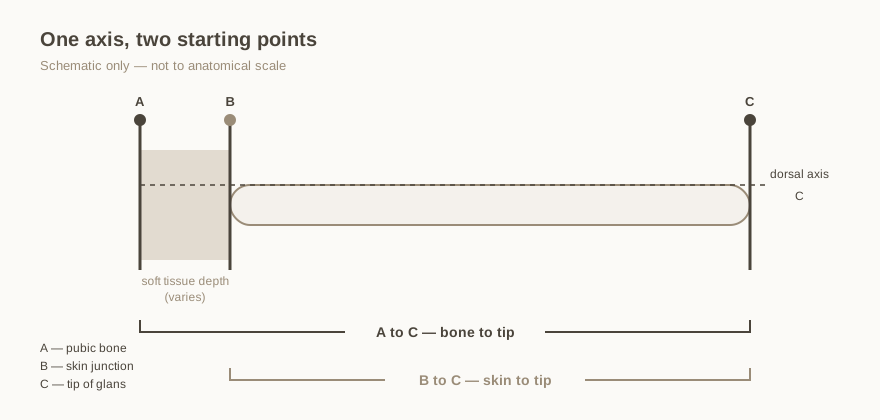
The starting landmark does most of the damage. A measurement can begin at the penopubic skin junction, where the shaft visibly meets the body, or at the pubic bone underneath, reached by pressing the end of the ruler through the soft tissue above the shaft. The first is what a person sees. The second is what the anatomy actually is. The gap between them is the thickness of the suprapubic soft tissue at that moment, which varies between men and within the same man over time — the mechanics of which are set out in our explainer on how pelvic anatomy affects apparent length.
Terms used in this guide
- Skin-to-tip (STT)
- Length measured from the penopubic skin junction to the tip of the glans. Also written as non-bone-pressed, or NBP.
- Bone-to-tip (BTT)
- Length measured from the pubic bone, reached by pressing the ruler through the soft tissue above the shaft, to the tip of the glans. Also written as bone-pressed, or BP.
- Dorsal surface
- The upper side of the shaft, facing the abdomen. Every protocol in this guide measures along it.
- Stretched flaccid length
- A flaccid measurement taken with the shaft drawn out to gentle resistance. Common in research, distinct from a resting flaccid figure.
- Circumference
- The distance around the shaft at a stated point, taken with a flexible tape. Sometimes called girth. Not the same as diameter.
The six measurements, step by step
1. Flaccid length, skin to tip
Stand. Hold the shaft horizontal, without traction. Rest the zero end of the rigid ruler against the skin at the penopubic junction and read along the dorsal surface to the tip of the glans, excluding any foreskin extending past it. Record to the nearest millimeter.
This is the least stable of the six. Resting flaccid dimensions respond to ambient temperature, recent activity and arousal state, which is why the review team behind the largest pooled analysis of penile measurements recommended taking readings in a private, temperature-controlled room held near 21 °C (70 °F) at sea level, and why they flagged flaccid figures as more dependent on the surroundings and on the practitioner than erect ones (Veale et al., BJU International, 2015).
2. Flaccid length, bone to tip
Same posture, same dorsal line, one difference: press the end of the ruler firmly through the soft tissue above the shaft until it meets the pubic bone, then read to the tip of the glans. The figure will be larger than the skin-to-tip reading, and the difference between the two is not fixed — it tracks the amount of soft tissue over the bone, which is why the two protocols diverge most in men carrying more weight.
A multicenter study of 201 men, measured by seven andrology specialists in a room held at 21 °C, found bone-to-tip measurement to be the more accurate and more reliable of the two, with the largest discrepancy appearing in heavier participants (Habous et al., International Journal of Impotence Research, 2018). Bone-to-tip is the figure most clinical datasets are built on. Skin-to-tip is the figure most casual conversation is built on. That mismatch is the single most common source of confusion in this subject.
3. Erect length, skin to tip
Taken at full rigidity, standing, with the shaft held horizontal and the ruler along the dorsal surface, starting at the skin junction. Record the method used to reach full erection alongside the figure: the internet-based study of 1,661 sexually active American men that reported a mean erect length of 14.15 cm (5.57 in) and a mean erect circumference of 12.23 cm (4.81 in) found that the way a man became erect for self-measurement was associated with the dimensions he then reported (Herbenick et al., The Journal of Sexual Medicine, 2014). Method is a variable, not a footnote.
4. Erect length, bone to tip
The reference figure. Full rigidity, dorsal surface, ruler pressed to the pubic bone, read to the tip of the glans. This is the measurement that most closely corresponds to the erect lengths reported in clinical datasets, and the only one of the four lengths that can be compared with them without an asterisk.
Two practical notes. First, a curve changes what a straight ruler can tell you; where the shaft does not lie flat against the rule, a flexible tape following the dorsal line records a different quantity, and the studied range of curvature is wider than most people expect. Second, flaccid readings are a poor substitute for this one. In the multicenter study cited above, stretched and flaccid measurements underestimated the erect figures by roughly 20 percent on average, and the size of that error shifted with the observer.
How far flaccid readings fell short of erect readings
Mean underestimate of the erect measurement, 201 men, seven observers (Habous et al., 2018)
5. Flaccid circumference
Wrap the flexible tape around the shaft, snug but without compressing the tissue, and read where the tape meets itself. The critical detail is the position: circumference varies along the shaft, so a figure means nothing unless the point is stated. Published protocols most often specify the mid-shaft, though some record the base or the widest point instead. Whichever you choose, choose once and stay with it.
6. Erect circumference
Same tape, same stated position, taken at full rigidity. This is the thinnest part of the published record. The 2015 pooled review drew on far fewer erect measurements than flaccid ones — only four samples totaling 692 men supplied erect length, and only two samples totaling 231 men supplied erect circumference — which is a useful thing to remember whenever an erect girth average is quoted with more confidence than its underlying sample supports.
The six side by side
| Measurement | Tool | What it captures | Comparable with published data? |
|---|---|---|---|
| Flaccid, skin to tip | Rigid ruler | Visible resting length | Weakly — highly sensitive to temperature and state |
| Flaccid, bone to tip | Rigid ruler | Resting length independent of soft tissue depth | Partly — check whether the study stretched the shaft |
| Erect, skin to tip | Rigid ruler | Visible erect length | Mostly with self-report datasets, not clinical ones |
| Erect, bone to tip | Rigid ruler | Erect length independent of soft tissue depth | Yes — the closest match to clinical reference data |
| Flaccid circumference | Flexible tape | Resting girth at a stated point | Only if the study names the same point |
| Erect circumference | Flexible tape | Erect girth at a stated point | Cautiously — the published sample base is small |
What the published protocols actually say
Putting recommendations side by side is more instructive than reading any one of them. Four widely cited sources have proposed how this should be done, and the areas where they agree are as telling as the areas where they don't.
| Source | Preferred landmark | Position taken |
|---|---|---|
| Wessells, Lue & McAninch, Journal of Urology, 1996 | Dorsal, pressed to the pubis | Established reference figures for flaccid, stretched and erect states, and reported that flaccid length is a poor predictor of erect length |
| Veale et al., BJU International, 2015 | Not resolved; protocol conditions specified instead | Included only studies where a health professional measured to a standard procedure; called for future studies to report method in detail, with practitioner training and inter-rater reliability |
| Habous et al., Int. J. Impotence Research, 2018 | Bone to tip | Tested landmarks against erect readings across multiple observers; found bone to tip more accurate and reliable, and flaccid readings significantly observer-dependent |
| Greenstein, Dekalo & Chen, Int. J. Impotence Research, 2020 | No single winner declared | Reviewed the literature, reported no consensus on preferred method and no definitive evidence favoring one over another, then proposed their own recommendations for future work |
Two studies can be equally careful, equally honest, and still disagree by a centimeter — because they were never measuring the same thing.
Why decades of research never produced one protocol
The obvious question is why a field this old still measures this many ways. Part of the answer is inherited purpose, as the note alongside sets out. Part of it is that the evidence for one landmark over another arrived late: the multi-observer comparison that put bone-to-tip ahead of skin-to-tip was published in 2018, more than two decades after the reference paper most commonly cited.
The rest is a gap between what protocols prescribe and what gets done. A 2021 systematic review in The Journal of Sexual Medicine examined 70 studies of penile length and found that measurement techniques varied widely enough to produce nonstandardized results, even though 90 percent of those studies reported that measurements had been taken by health care practitioners in clinical settings (Cakir et al., 2021). Having a professional hold the ruler is not the same as having a protocol, and reporting that a standard procedure was followed is not the same as describing it.
None of this means the research is worthless. It means the reader's job is to check three things before accepting a figure: the tissue state, the landmark, and who took the reading. Studies that state all three can be compared with each other. Those are the ones worth building on — a point developed at length in our breakdown of what the largest pooled analysis actually established.
The female side of the record
Everything above concerns a body of research that at least argues about protocol. On the female side, the argument barely started.
The reference point most often cited is a 2005 cross-sectional study of 50 premenopausal women at a London hospital, which used digital photography and direct measurement to record clitoral dimensions, labial length and width, color and texture, vaginal length and two inter-landmark distances — and reported wide variation across every one of them (Lloyd et al., BJOG, 2005). Fifty women is a starting point, not a reference range.
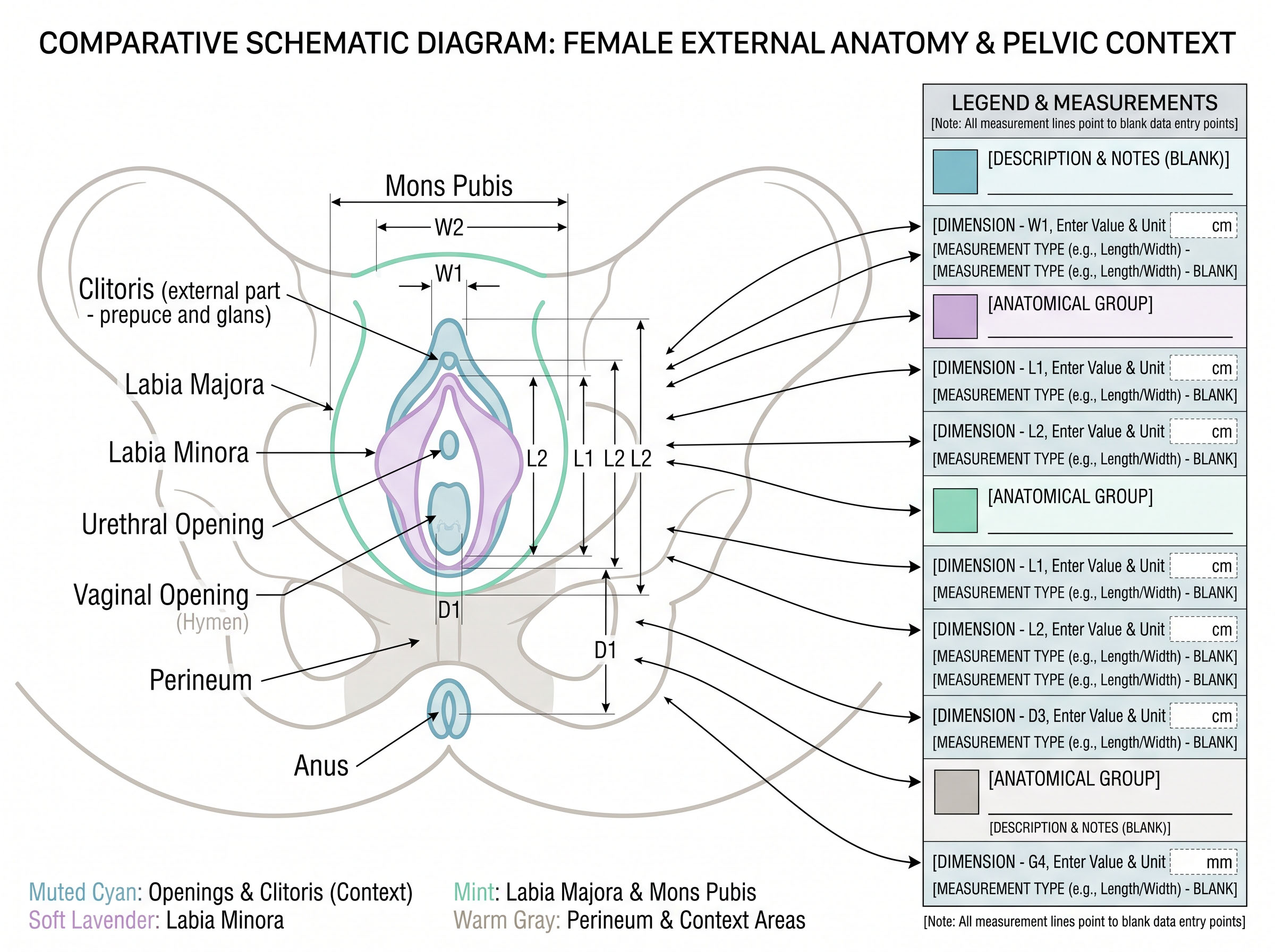
The largest single cohort came thirteen years later: 657 women aged 15 to 84 at a Swiss hospital, measured to standardized definitions the authors had to specify themselves, precisely because accurate description of a typical vulva was scarce and the existing literature contained no agreement on how labial dimensions should be classified (Kreklau et al., BJOG, 2018). The thresholds circulating at the time illustrate the problem: different published sources had proposed 5 cm (2.0 in), 4 cm (1.6 in) and 3 cm (1.2 in) as the point at which labial width was considered enlarged. Three numbers, three papers, one anatomy.
A later review pooling normative datasets across more than 1,400 postmenarcheal girls and women reported labia minora length spanning 5 to 100 mm (0.2 to 3.9 in) and width spanning 1 to 60 mm (0.04 to 2.4 in) — a range so wide that any single average carries little descriptive weight on its own. Our companion piece on the documented range in published research works through what those figures do and do not establish.
The methodological lesson runs deeper than sample size. Female external anatomy has more landmarks, and landmarks that are harder to define consistently — where a labial edge begins, which axis counts as length, whether a measurement is taken at rest or under gentle traction. Male measurement disputes are about two starting points on one axis. Female measurement disputes are about which quantities exist at all. That absence of an agreed vocabulary, more than any missing dataset, is what keeps the female record thinner than the male one.
Did you know?
The 2015 pooled review that produced the most widely quoted male reference figures screened 16,678 publications and kept 17. Everything the popular version of that number rests on comes from those seventeen studies — and only two of them supplied erect circumference data.
Consistency is the whole exercise
Accuracy, in this context, is mostly repeatability. A single reading tells you very little; the same reading taken the same way on ten occasions tells you something real. Three habits do most of the work.
Take three readings and average them. Small differences in ruler angle and pressure are unavoidable. Averaging absorbs them instead of hiding them.
Log the conditions, not just the number. Date, time of day, room temperature, posture, tool used, landmark used, and — for erect readings — the method. The Herbenick data suggest that last item is associated with the figure itself, which makes it part of the measurement rather than context around it.
Never mix protocols within one record. A log that switches between skin-to-tip and bone-to-tip is not a record of change; it is a record of two different quantities interleaved. This is the same error that makes cross-study comparison unreliable, reproduced at the scale of one notebook.
Done this way, the exercise stops being about the number and becomes about the method — which is the more durable skill. Someone who can name the tissue state, the landmark, and the observer behind a published figure can read almost any size study critically. Someone who cannot is at the mercy of whichever number was quoted most loudly.
Common questions about measurement method
Sources
- Veale D, Miles S, Bramley S, Muir G, Hodsoll J. Am I normal? A systematic review and construction of nomograms for flaccid and erect penis length and circumference in up to 15,521 men. BJU International, 2015;115(6):978–986.
- Habous M, Muir G, Soliman T, et al. Outcomes of variation in technique and variation in accuracy of measurement in penile length measurement. International Journal of Impotence Research, 2018;30(1):21–26.
- Greenstein A, Dekalo S, Chen J. Penile size in adult men — recommendations for clinical and research measurements. International Journal of Impotence Research, 2020;32(2):153–158.
- Cakir OO, Pozzi E, Castiglione F, Alnajjar HM, Salonia A, Muneer A. Penile Length Measurement: Methodological Challenges and Recommendations, a Systematic Review. The Journal of Sexual Medicine, 2021;18(3):433–439.
- Herbenick D, Reece M, Schick V, Sanders SA. Erect Penile Length and Circumference Dimensions of 1,661 Sexually Active Men in the United States. The Journal of Sexual Medicine, 2014;11(1):93–101.
- Wessells H, Lue TF, McAninch JW. Penile length in the flaccid and erect states: guidelines for penile augmentation. Journal of Urology, 1996;156:995–997.
- Lloyd J, Crouch NS, Minto CL, Liao LM, Creighton SM. Female genital appearance: "normality" unfolds. BJOG, 2005;112(5):643–646.
- Kreklau A, Vâz I, Oehme F, et al. Measurements of a 'normal vulva' in women aged 15–84: a cross-sectional prospective single-centre study. BJOG, 2018;125(13):1656–1661.
Disclaimer
- All content on this website—including articles, educational materials, and interactive calculators—is for informational, educational, and entertainment purposes only. The calculations, percentiles, and outputs generated by tools on this site are based on general statistical data and mathematical models; they do not constitute medical data, a clinical assessment, or a diagnosis.
- Nothing contained on this website is a substitute for professional medical advice, diagnosis, or treatment. Always seek the guidance of a qualified healthcare professional or urologist with any questions you have regarding physical development, anatomy, or health conditions. Reliance on any information or tools provided by this website is solely at your own risk.


