


 English
 Español


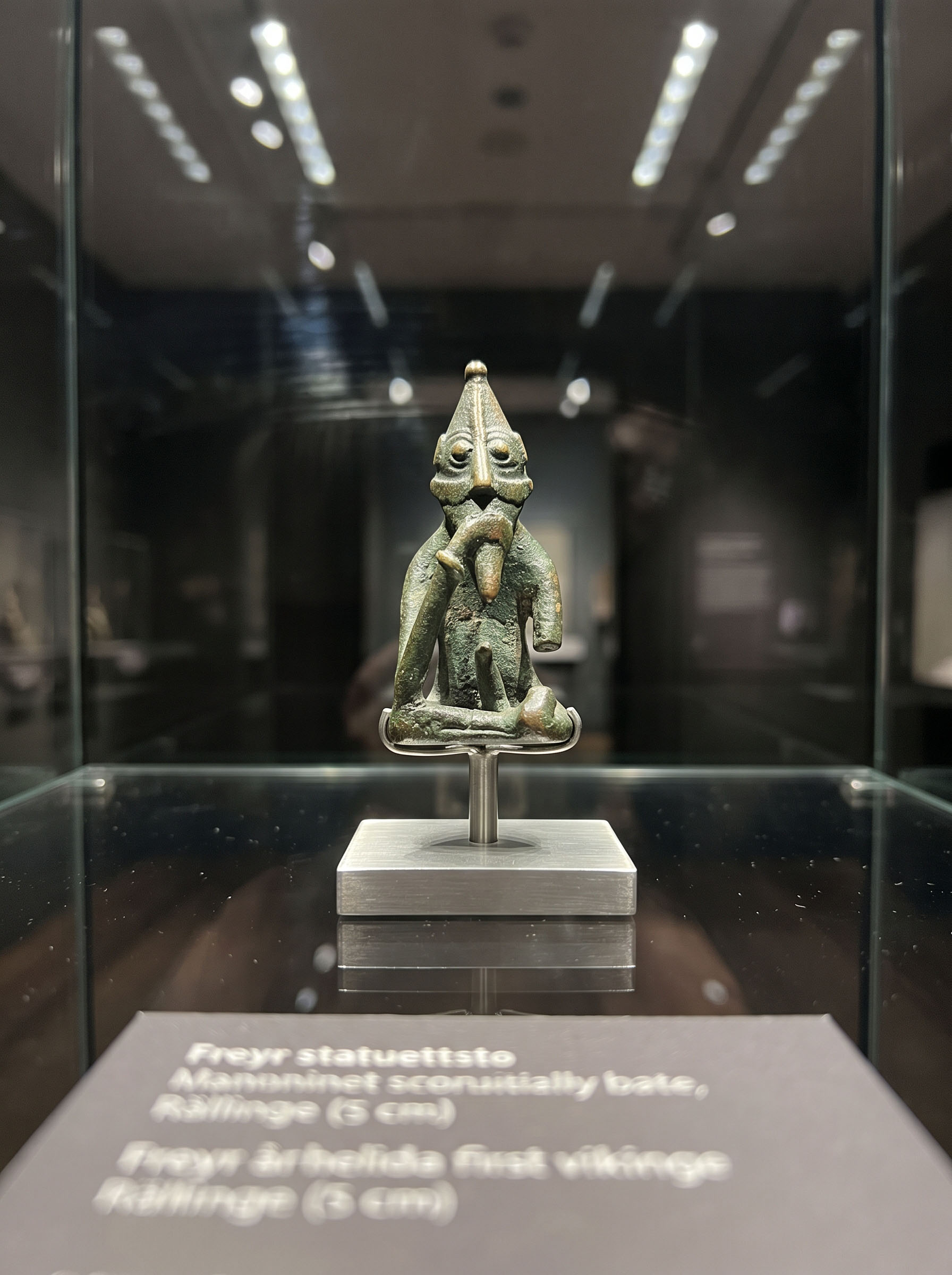
In the spring of 1904, on a farm called Rällinge in the Swedish province of Södermanland, a twelve-year-old boy turned up a small bronze man in a potato field. The figure sits cross-legged, wears a pointed cap, tugs at a pointed beard, and has an unmistakable erection. He is seven centimetres tall (2.75 inches). He sold for twenty-five öre.
Today he is one of the most-reproduced objects in the collection of the Swedish History Museum, and he appears on book covers, tattoos, and museum posters under a confident caption: Freyr, Norse god of fertility.
The caption is a guess. A good guess, made for defensible reasons, but a guess — and the reasons behind it lead straight into one of the more interesting problems in the study of Old Norse religion. What the Eddas and the archaeology of Scandinavia actually record about the body is far stranger, funnier, and more argued-over than the popular version suggests. Anyone who has read our account of what phallic symbolism meant in Greek religion will recognize the shape of the problem: the ancient evidence is thin, the later commentary is thick, and the two are constantly mistaken for each other.
Three kinds of story, three kinds of evidence
Folklorists have long separated three narrative genres that popular writing tends to blend. A myth is a sacred narrative — a story a community holds as true in some meaningful sense, usually involving gods and usually explaining how the world came to be arranged as it is. A legend is a narrative set in historical time, told as though it happened, and open to belief or disbelief. A folk tale is entertainment, understood as fiction by teller and listener alike.
The distinction matters enormously here, because the Norse material sits across all three categories and almost none of it was written down by people who believed it. Iceland converted to Christianity around the year 1000. The Poetic Edda survives in the Codex Regius, a manuscript copied in the 1270s. Snorri Sturluson wrote the Prose Edda around 1220 as a handbook for poets, explaining a mythology his own culture had abandoned two centuries earlier. Every Norse myth we have reaches us through a Christian scribe with his own reasons for writing.
| Source | Approx. date | Genre | What it can reasonably support |
|---|---|---|---|
| Adam of Bremen, Gesta Hammaburgensis | 1073–1076 | Church chronicle | What an informed outsider believed Swedes worshipped — not what they said about it themselves |
| Rällinge statuette | c. 1000 | Material object | That such figures were made and kept; not who they represent |
| Þrymskviða (Poetic Edda) | Disputed: 9th–13th c. | Mythological poem | Norse ideas about masculinity, marriage, and outsiders |
| Snorri, Prose Edda | c. 1220 | Poetic handbook | A systematized, Christian-era account of the gods and their attributes |
| Vǫlsa þáttr (Flateyjarbók) | c. 1380s | Conversion tale | How late medieval Icelanders imagined pagan practice; contested as evidence of real ritual |
Freyr, described but never measured
Around 1073, a canon of the cathedral at Bremen named Adam sat down to write a history of his archbishopric and included a description of the great pagan sanctuary at Uppsala in Sweden. Three gods stood inside, he reported: Thor in the middle, with Wodan and Fricco on either side. Thor governed weather and crops. Wodan was fury and gave men strength against enemies. The third, Fricco, dispensed peace and pleasure to mortals — and, Adam adds, his image was fashioned cum ingenti priapo: with an enormous phallus.
That single clause is the load-bearing wall of nearly everything popularly said about Norse anatomy. Fricco is generally identified with Freyr, the Vanir god whom Snorri describes as governing rain and sunshine and the produce of the earth, invoked for good harvests and peace. The description fits. It also arrives from a churchman writing in Latin, in Germany, about a temple he never visited, drawing on informants and on classical vocabulary — priapus is a Roman word for a Roman garden god, not a Norse one. Readers who have looked at how Rome used Priapus at the threshold of the house will notice that Adam has reached for a familiar Mediterranean category to explain an unfamiliar northern one.
Scholars have not therefore thrown the passage out. The historian of religion Olof Sundqvist has argued that Adam's Uppsala description reflects a real cultic topography rather than a purely literary invention, supported by comparison with West Slavic material. But "reflects something real" is a long way from "describes a statue accurately." The honest position is that we have a secondhand Latin note about a lost wooden image, and that this note has been doing the work of an eyewitness for nine hundred years.
The statuette problem
Which brings us back to the little bronze man from the potato field. He is routinely labelled Freyr, and the reasoning is circular in a way worth spelling out: Adam of Bremen said Freyr's image had a large phallus, therefore a Viking Age figure with a large phallus is Freyr. No inscription accompanies him. No comparable object survives to build a series from.
Alternative readings have been proposed and never fully retired. The figure has been suggested as a gaming piece, as a flute player, and even as Thor blowing into his beard to raise wind. If he is a god, he may be one of the small household images that Old Norse sagas mention men carrying. Any of these could be right. The Swedish History Museum, which has held the object since 1904, presents the Freyr identification as probable rather than settled — and museums have a professional interest in confident labels, so the hedge is telling.
"A secondhand Latin note about a lost wooden image has been doing the work of an eyewitness for nine hundred years."
Þrymr, and the arithmetic of giants
If Freyr is the Norse material's clearest fertility figure, the giant Þrymr is its clearest lesson in what size actually means in these stories. Þrymskviða, "The Lay of Þrymr," is among the best-known poems in the Poetic Edda and among the funniest. Thor wakes to find his hammer gone. Þrymr has taken it and buried it eight leagues underground, and names his price: the goddess Freyja as his bride. Freyja's refusal is emphatic enough to break her necklace. Heimdallr proposes the solution — dress Thor as the bride instead. Loki comes along as the maid.
The comedy runs on physical incongruity. The disguised Thor eats an ox and drinks three casks of mead at his own wedding feast; Loki explains that the bride has been too excited to eat for eight days. Þrymr lifts the veil, meets a pair of eyes burning like coals, and recoils; Loki explains that the bride has not slept. Then the hammer is brought out to consecrate the marriage, laid in the bride's lap, and the joke ends the way Norse jokes usually end.
Note what the poem does not do. Þrymr is a giant, and the poem shows no interest whatsoever in the dimensions of his body. His threat is entirely social: he wants a goddess, and he cannot be allowed to have one. Margaret Clunies Ross's influential reading of the poem places it inside the honour-and-shame logic of medieval Icelandic society, where the exchange of women between groups is the mechanism of alliance — and the gods systematically take wives from the giants while never giving any in return. Þrymr's demand is not lust so much as a bid to be treated as an equal partner in exchange. He is refused, and killed for asking.
"Giant" in Old Norse (jötunn) is therefore closer to a category of outsider than a measurement. Elsewhere in the mythology, giant size is explicitly an illusion: Thor spends a night sleeping in what he takes for a hall and finds it was a giant's glove, and the whole encounter turns out to have been staged by magic. Physical scale in these narratives is a statement about who belongs inside the fence and who does not. This is the same logic our survey of why societies have linked physical size with power traces across other cultures, and the Norse case is unusually explicit about it.
Did You Know?
Thor's bridal disguise was not a harmless gag in its own society. Medieval Icelandic law — the Grágás compilation — treated a man wearing women's dress as a serious matter, and the accusations of ergi (unmanliness) and níð (public dishonour) were among the gravest insults available in Old Norse. The scene is funny precisely because the audience knew what it would have cost a mortal man.
Vǫlsi: the ritual we cannot quite verify
The most detailed account of a Norse phallic ritual is also the least trustworthy, and the tension between those two facts is instructive. Vǫlsa þáttr survives in one place only: the great Icelandic codex Flateyjarbók, compiled in the 1380s, where it is inserted into the saga of Saint Óláfr. The story is set in 1029, on an isolated farm in northern Norway.
A horse is slaughtered. A member of the household preserves its severed member, names it Vǫlsi, wraps it, and each evening it is passed from hand to hand around the household while each person speaks a verse over it. The verses invoke a figure called Mǫrnir. King Óláfr arrives in disguise, the object is destroyed, and the family is baptized.
The scholarly edition of the Vǫlsa þáttr verses in the Skaldic Poetry of the Scandinavian Middle Ages project sets out how much remains unresolved — including what Mǫrnir means, with proposals ranging from a term for the phallus itself to a divine name, and with Freyr frequently proposed as the deity behind it. Some scholars, notably in the Scandinavian tradition of religious history, have read the tale as preserving genuine memory of household fertility practice. Others have read it, since Andreas Heusler's work in 1903, as a conversion anecdote built to make paganism look absurd, and recent work has argued that the tale assembles an imagined paganism for a 14th-century Christian audience — a performance of what heathens were supposed to have been like, rather than a record of what they did.
Both readings cannot be right, and the field has not settled the question. That is worth saying plainly, because popular retellings almost always present the ritual as documented fact.
What the northern material has in common with everyone else
Set the Norse evidence beside the fertility material of other traditions and a pattern emerges that has little to do with anatomy as such. Across widely separated cultures, the reproductive body in sacred narrative tends to stand for continuity — of the harvest, of the household, of the line. The Roman garden god guarded a boundary. Greek herms marked crossroads and doorways. Indian temple sculpture, as our reading of the carved walls at Khajuraho discusses, places the body inside a cosmological scheme rather than an erotic one. The Norse case sits comfortably in that company: a god asked for good season and peace, a small bronze figure kept in a house, a hammer laid in a bride's lap to bless a marriage.
What makes the northern material distinctive is how little of it survives and how loudly the gaps have been filled. One Latin sentence, one seven-centimetre figurine, one comic poem of disputed date, one conversion tale that may be satire. It is a thin file, and it has supported an enormous amount of confident assertion. Reading it properly means holding two things at once — real enthusiasm for stories that are genuinely funny and genuinely strange, and real caution about how much they can be asked to prove.
The boy in the potato field found an object. Everything after that is interpretation.
Questions Readers Ask
Primary sources referenced: Adam of Bremen, Gesta Hammaburgensis Ecclesiae Pontificum (1073–1076), Book IV and scholia; the Poetic Edda (Codex Regius, c. 1270); Snorri Sturluson, Prose Edda (c. 1220); Vǫlsa þáttr in Flateyjarbók (c. 1380s); Rällinge statuette, Swedish History Museum. Secondary discussion draws on Olof Sundqvist on the Uppsala sanctuary, Margaret Clunies Ross on Þrymskviða, and the Skaldic Poetry of the Scandinavian Middle Ages editorial commentary.
Disclaimer
- All content on this website—including articles, educational materials, and interactive calculators—is for informational, educational, and entertainment purposes only. The calculations, percentiles, and outputs generated by tools on this site are based on general statistical data and mathematical models; they do not constitute medical data, a clinical assessment, or a diagnosis.
- Nothing contained on this website is a substitute for professional medical advice, diagnosis, or treatment. Always seek the guidance of a qualified healthcare professional or urologist with any questions you have regarding physical development, anatomy, or health conditions. Reliance on any information or tools provided by this website is solely at your own risk.


