


 English
 Español


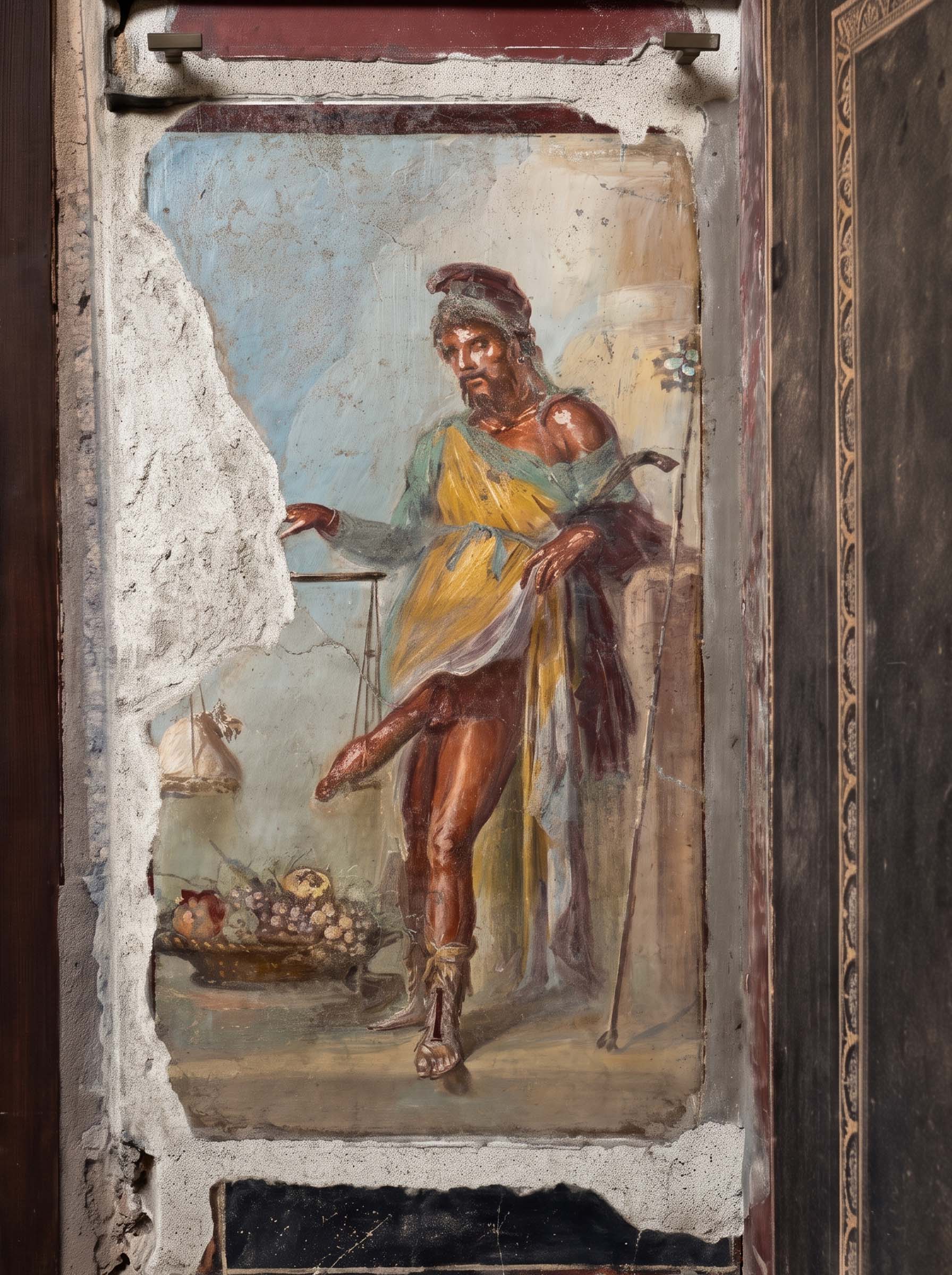
Visitors filing into the House of the Vettii at Pompeii tend to stop about two paces inside the door. On the right-hand wall of the entrance passage sits a painted figure weighing part of his own body against a sack of coins on a set of scales. Modern tourists laugh, or blush, or take a photograph they will not show their mother.
The Romans who commissioned the fresco were doing something else entirely: they were installing a security system. The image sat at the threshold of a wealthy household, and the Archaeological Park of Pompeii's own site notes that the house stood under Priapus's protection as a signal of the owners' prosperity. That gap — between what we see and what they meant — is the whole subject of this article, and it is one this magazine has approached before in our study of Dionysus, the Athenian herms and what phallic symbolism actually signified in the ancient world.
Priapus is worth the attention because he is an outlier. Greek and Roman religion is full of gods whose bodies matter, but Priapus is the only major documented figure whose entire iconography is organized around a single anatomical feature. Hans Herter's monograph De Priapo (1932) remains the foundational catalogue of the evidence, and W. H. Parker's edition of the Priapea (1988) gathers the poetry. Between them, a surprisingly ordinary god emerges: a rural, working deity with a job to do.
In Brief
- Priapus was a minor Greco-Roman deity whose cult center was Lampsacus on the Hellespont, and whose images were the most anatomically direct in the documented classical pantheon.
- Scholars read his exaggerated form as apotropaic — protective — rather than erotic: a sign meant to repel theft, envy and misfortune from gardens, doorways and orchards.
- His literary life survives mainly in the Carmina Priapea, a collection of eighty anonymous Latin poems, and in two comic episodes in Ovid's Fasti.
- Comparable guardian and fertility figures appear in Norse, Japanese, West African, Indigenous American, Hindu and Polynesian traditions — several of them still living religious practice today.
A god from the edge of the Greek world
Priapus does not appear in Homer or Hesiod. He surfaces later, in the Hellenistic period, and the ancient sources agree that his cult radiated outward from Lampsacus, a Greek city on the Asian shore of the Hellespont. Pausanias, writing his Description of Greece in the second century AD, records that Priapus was honored especially by men who kept goats and sheep or worked with bees (Description of Greece 9.31.2) — a detail that places him squarely among the practical concerns of farmers rather than the grand theology of the Olympians.
His parentage is inconsistent across sources, which is itself informative. Pausanias makes him the son of Dionysus and Aphrodite. Diodorus Siculus offers alternative genealogies (Library of History 4.6). A later tradition, preserved in scholiastic and commentary material, has Hera curse him in the womb out of resentment toward Aphrodite, so that he was born misshapen and was rejected by his own mother. When a figure's family tree cannot be pinned down, it usually means the figure was absorbed into an existing pantheon from outside rather than growing up within it — a pattern comparative mythologists observe repeatedly.
Three Kinds of Story — and Why the Difference Matters
Folklorists do not treat all traditional narratives as one category. In a widely used framework set out by William Bascom in The Forms of Folklore: Prose Narratives (Journal of American Folklore, 1965), three genres are distinguished:
Myth — a sacred narrative, held as true by its community, usually set in a remote or primordial time and explaining how the world came to be as it is.
Legend — also held as true, but set in the historical past and populated by human beings rather than gods.
Folk tale — told as fiction, for entertainment, with no claim on belief.
Priapus straddles the line. The cult was religion; the poems written about him were entertainment. Reading the jokes as though they were scripture — or the scripture as though it were jokes — produces most of the confusion that surrounds him.
The scarecrow with a legal personality
The ordinary Priapus of the Roman countryside was not marble. He was a rough wooden figure, often cut from fig wood, set among the vegetables and painted red — Ovid describes exactly this red-painted garden guard in the Fasti. He was, functionally, a scarecrow. But he was a scarecrow that talked.
The Carmina Priapea is a collection of eighty short Latin poems, most likely assembled in the first century AD, in which the statue speaks in the first person to anyone approaching the garden wall. The poems are threats. They warn thieves what will happen if they help themselves to the fruit. They are crude, repetitive, frequently very funny, and — as W. H. Parker's commentary sets out — carefully literary in their construction despite the coarse surface. You can read Ovid, Pausanias and much of this material in the original and in translation through the Perseus Digital Library at Tufts University.
Amy Richlin's The Garden of Priapus: Sexuality and Aggression in Roman Humor (revised edition, Oxford University Press, 1992) argues that this speaking-statue posture is a template for a whole mode of Roman humor: the aggressive, boundary-defending, socially subordinate speaker who uses obscenity as a weapon against intruders. On this reading, Priapus is less a fertility god than a personification of property rights with a very memorable delivery.
"He was, functionally, a scarecrow. But he was a scarecrow that talked — and everything he said was a threat aimed at the man reaching over the garden wall."
Protection, not provocation
The interpretive key most classical scholars now use is the concept of the apotropaic — an object or image whose purpose is to turn away harm. Christopher Faraone's Talismans and Trojan Horses: Guardian Statues in Ancient Greek Myth and Ritual (Oxford University Press, 1992) documents the wider Greek practice of placing figures at entrances and boundaries precisely to absorb or deflect danger.
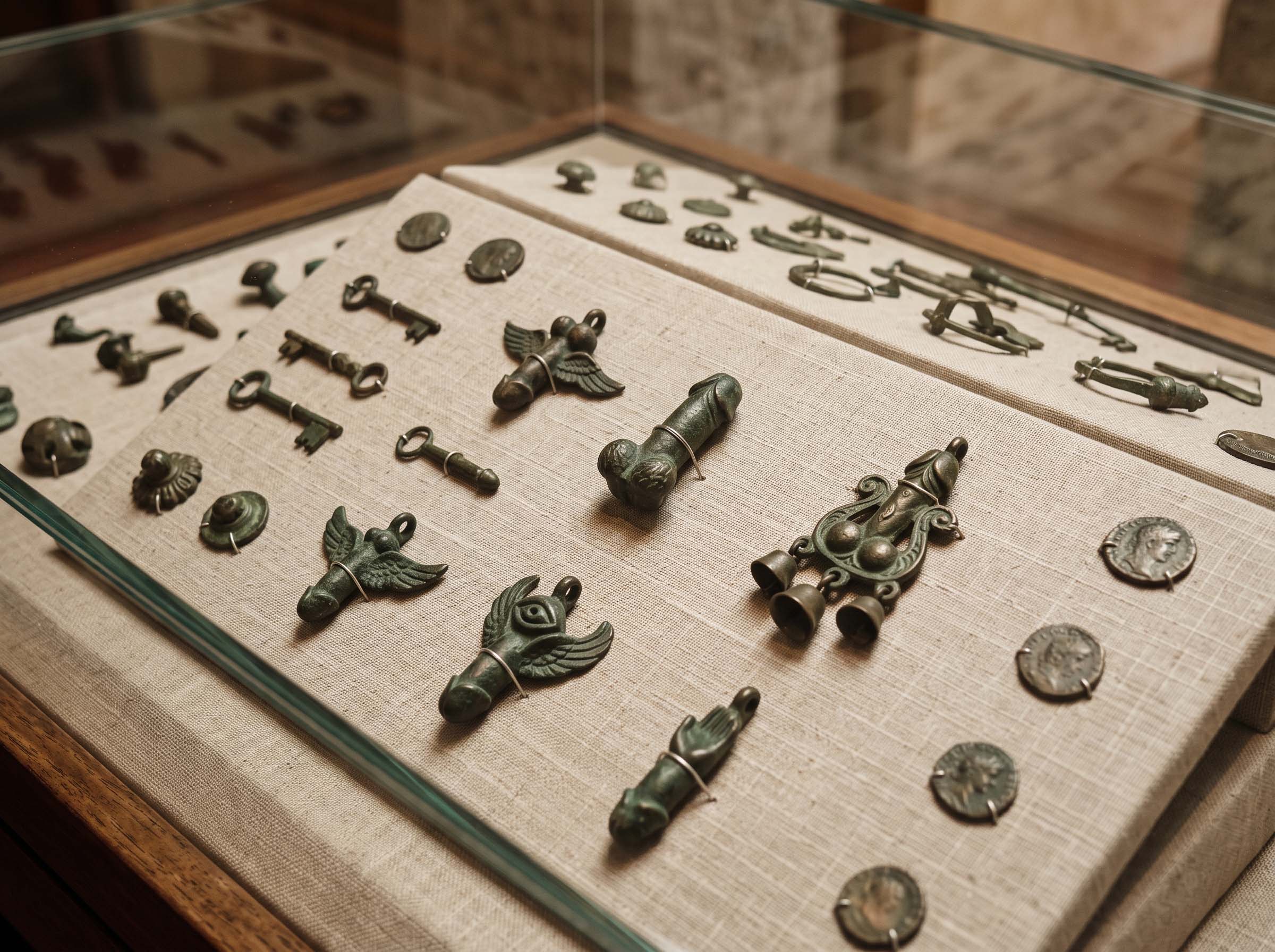
Roman evidence points the same way. Pliny the Elder, in his Natural History (28.39), records that the fascinus — a phallic charm — was hung around the necks of infants and mounted on the chariots of generals celebrating a triumph, as a guard against envy. Catherine Johns, in Sex or Symbol: Erotic Images of Greece and Rome (British Museum Publications, 1982), surveys the surviving amulets and makes the argument plainly: these were protective devices, and the great majority of them are small — many surviving pendant examples measure only around 2 to 5 cm (roughly 0.8 to 2 in), sized to be worn rather than displayed. John R. Clarke's work on Roman domestic decoration, including Roman Sex: 100 BC to AD 250 (2003), extends the same logic to painted thresholds like the one at the House of the Vettii.
The point is not subtle once you see it. The sign is placed where a boundary is crossed — a doorway, a garden wall, a child's neck, a road. It is aimed outward, at whatever might come in. Readers interested in how this logic of boundary-marking works more broadly will find it developed in our article on what taboo actually means in anthropological terms.
Ovid, a donkey, and the funniest story in the Fasti
Any account of Priapus that leaves out the comedy is misrepresenting the material. Ovid tells essentially the same story twice in the Fasti, his calendar-poem of Roman festivals. In Book 1 (lines 391–440), Priapus creeps toward the sleeping nymph Lotis during a rustic festival; in Book 6 (lines 319–348), the target is the goddess Vesta herself. In both versions the approach is ruined at the last moment when a donkey belonging to Silenus brays and wakes the entire company, who fall about laughing at the exposed god.
The structure is the structure of farce. Ovid is not recording a solemn sacred narrative; he is writing an origin story for a ritual detail — why donkeys were garlanded at certain festivals — and he is enjoying himself enormously. Read against Bascom's genre distinctions, these episodes sit much closer to entertainment narrative than to sacred myth, even though they are attached to a real cult. The willingness of Roman religion to accommodate a god who is simultaneously venerated and mocked is one of its genuinely interesting features.
The same idea, arrived at separately
Guardian and fertility figures with pronounced anatomical features are documented across an unusually wide range of unconnected traditions. That independence matters: it suggests we are looking at a recurring human solution to a recurring problem — how do you mark a boundary, or ask for a good harvest — rather than a single idea diffusing outward from the Mediterranean.
The Norse material is a good example. Adam of Bremen, writing in the eleventh century, described a statue at the temple at Uppsala representing the god he calls Fricco (generally identified with Freyr), noting its conspicuous form (Gesta Hammaburgensis Ecclesiae Pontificum, Book 4). More striking is Völsa þáttr, a short narrative preserved in the fourteenth-century Flateyjarbók, which describes a household ritual centered on a preserved horse phallus passed among family members with a spoken verse. John McKinnell discusses the text's reliability and function in Meeting the Other in Norse Myth and Legend (D. S. Brewer, 2005) — noting, as scholars generally do, that a Christian author recording a pagan rite is not a neutral witness.
Table 1 — Guardian and fertility figures across traditions, with their documented function
| Tradition | Figure | Documented function | Principal source |
|---|---|---|---|
| Greek / Roman | Priapus | Garden and orchard guardian; threshold protection; prosperity sign | Herter (1932); Parker (1988); Richlin (1992) |
| Greek (Athenian) | Herms | Boundary and roadside markers; civic protection | Thucydides 6.27; Faraone (1992) |
| Norse | Freyr; the Völsi rite | Agricultural fertility; household ritual | Adam of Bremen, Bk 4; McKinnell (2005) |
| Japanese folk religion | Dōsojin | Protection of roads, village boundaries and travelers | Czaja (1974) |
| Yoruba / Fon (West Africa) | Eshu-Elegba / Legba | Crossroads and gateway deity; opener of paths; divine messenger | Thompson, Flash of the Spirit (1983) |
| Ho-Chunk (Winnebago) | Wakdjunkaga (trickster) | Narrative subversion of social order; body as comic instrument | Radin, The Trickster (1956) |
| Hawaiian | Kamapuaʻa | Fertility and agricultural abundance; shape-shifting demigod | Kameʻeleihiwa (ed.), He Moʻolelo Kaʻao o Kamapuaʻa (1996) |
| Hindu | Shiva linga | Aniconic focus of devotion; understood by most practitioners as a symbol of formless divinity | Doniger O'Flaherty, Śiva: The Erotic Ascetic (1973) |
Categories are the researchers' own. Several of these traditions are living religious practice and are not reducible to a single comparative label.
The trickster's body
Trickster figures deserve separate mention, because they use the body differently. Paul Radin's The Trickster: A Study in American Indian Mythology (1956) presents the Ho-Chunk (Winnebago) trickster cycle, in which Wakdjunkaga's body behaves as an unruly, semi-detached thing with its own agenda — episodes that are simultaneously ribald comedy and serious commentary on the difference between a person and an appetite. Lewis Hyde's Trickster Makes This World (1998) reads such cycles as a culture's way of licensing, within narrative, the very behavior it forbids in life.
Eshu-Elegba, the Yoruba deity of crossroads and thresholds, is a related but distinct case. Robert Farris Thompson's Flash of the Spirit (Random House, 1983) describes his role as the opener of paths and the messenger between worlds, and documents the iconography — including the projecting carved coiffure that Western observers have frequently misread. This is an important caution: much nineteenth-century writing about "phallic worship" abroad tells us more about the anxieties of the observers than about the traditions observed.
The same caution applies to two examples often cited carelessly. The Shiva linga is treated by the overwhelming majority of Hindu practitioners as an aniconic representation of the formless divine, not as an anatomical image, and scholarly treatments — Wendy Doniger O'Flaherty's included — are careful to say so. And the figure marketed worldwide as "Kokopelli" is, as Ekkehart Malotki demonstrates in Kokopelli: The Making of an Icon (University of Nebraska Press, 2000), a modern commercial composite that conflates ancient rock-art imagery with the distinct Hopi katsina figure Kookopölö. Getting these distinctions right is part of taking the traditions seriously.
Did You Know?
In 415 BC, on the eve of Athens' great naval expedition to Sicily, unknown persons went through the city overnight and defaced the herms — the stone boundary markers standing outside houses and at crossroads. Thucydides records the event and the panic that followed (History of the Peloponnesian War 6.27). The city treated it not as vandalism but as sacrilege and a possible conspiracy against the democracy, and launched a formal investigation. Whatever these markers meant to the Athenians, they were not decorative.
What the body is doing in the story
The anthropologist Mary Douglas argued in Natural Symbols (1970) that the human body is almost never simply itself in ritual and symbolism; it functions as a small-scale model of the society that produces the image. Applied to Priapus, that framework does most of the interpretive work. The exaggerated figure at the garden wall is not a statement about anatomy. It is a statement about boundaries, ownership, the fear of loss, and the hope of a good harvest — expressed through the most immediately legible sign available to a largely non-literate rural population.
This is also why reading these images as claims about human proportion misses the point entirely. Classical sculpture aimed at the idealized human body generally moved in precisely the opposite direction, a tension explored in our piece on what Greek sculpture, philosophy and technical writing actually say about body ideals. The god at the gate and the athlete in the gymnasium were doing different jobs, and the Greeks and Romans saw no contradiction in that.
Priapus eventually faded, as minor cults do. But the reasoning behind him — put a sign at the threshold, make it impossible to ignore, and let it do the worrying for you — turns out to be one of the more durable ideas human beings have had. It shows up on Japanese village paths, at West African crossroads, in Norse farmsteads and in Roman kitchen gardens, invented separately each time. That is not a story about size. It is a story about doors.
Questions Readers Ask
Sources & Further Reading
Bascom, W. "The Forms of Folklore: Prose Narratives." Journal of American Folklore 78 (1965).
Clarke, J. R. Roman Sex: 100 BC to AD 250. Harry N. Abrams, 2003.
Czaja, M. Gods of Myth and Stone: Phallicism in Japanese Folk Religion. Weatherhill, 1974.
Doniger O'Flaherty, W. Śiva: The Erotic Ascetic. Oxford University Press, 1973.
Douglas, M. Natural Symbols: Explorations in Cosmology. Barrie & Rockliff, 1970.
Faraone, C. A. Talismans and Trojan Horses: Guardian Statues in Ancient Greek Myth and Ritual. Oxford University Press, 1992.
Herter, H. De Priapo. Giessen, 1932.
Hyde, L. Trickster Makes This World. Farrar, Straus and Giroux, 1998.
Johns, C. Sex or Symbol: Erotic Images of Greece and Rome. British Museum Publications, 1982.
Kameʻeleihiwa, L. (ed.). He Moʻolelo Kaʻao o Kamapuaʻa. Bishop Museum Press, 1996.
Malotki, E. Kokopelli: The Making of an Icon. University of Nebraska Press, 2000.
McKinnell, J. Meeting the Other in Norse Myth and Legend. D. S. Brewer, 2005.
Parker, W. H. Priapea: Poems for a Phallic God. Croom Helm, 1988.
Radin, P. The Trickster: A Study in American Indian Mythology. Routledge & Kegan Paul, 1956.
Richlin, A. The Garden of Priapus: Sexuality and Aggression in Roman Humor. Rev. ed., Oxford University Press, 1992.
Thompson, R. F. Flash of the Spirit: African and Afro-American Art and Philosophy. Random House, 1983.
Primary texts: Ovid, Fasti 1.391–440, 6.319–348; Pausanias, Description of Greece 9.31.2; Pliny the Elder, Natural History 28.39; Thucydides, History of the Peloponnesian War 6.27; Diodorus Siculus, Library of History 4.6; Adam of Bremen, Gesta Hammaburgensis Ecclesiae Pontificum, Bk 4.
Disclaimer
- All content on this website—including articles, educational materials, and interactive calculators—is for informational, educational, and entertainment purposes only. The calculations, percentiles, and outputs generated by tools on this site are based on general statistical data and mathematical models; they do not constitute medical data, a clinical assessment, or a diagnosis.
- Nothing contained on this website is a substitute for professional medical advice, diagnosis, or treatment. Always seek the guidance of a qualified healthcare professional or urologist with any questions you have regarding physical development, anatomy, or health conditions. Reliance on any information or tools provided by this website is solely at your own risk.


