


 English
 Español


In 1777, on the third of his Pacific voyages, Captain James Cook watched a group of Tongan hosts refuse to sit or eat in his presence and explain, by way of apology, that they were "taboo." He wrote the word down. It was one of the few Polynesian terms to pass into global vocabulary, and Cook recorded that it signified, in general, that a thing was forbidden (Cook, A Voyage to the Pacific Ocean, 1784).
What he had stumbled onto was not a quaint island rule but a concept that anthropologists would spend the next two centuries turning into one of the sharpest tools available for reading any culture, including our own.
The word is often used loosely today, as a synonym for "shocking" or "off-limits." Used precisely, taboo is a technical term with a specific job: it names the prohibitions a society places around certain acts, objects, people, and above all bodies. Studying which bodily things a culture forbids, and why, turns out to be one of the most reliable ways to read what that culture values. This is the same logic behind our survey of how different cultures define a "typical" body: the rule reveals the standard behind it.
A word borrowed from the Pacific
The Tongan tabu (Māori tapu, Hawaiian kapu) fused two ideas that English keeps apart: the sacred and the forbidden. Something tapu was set apart from ordinary use because it was charged with power, and therefore dangerous to handle carelessly (Steiner, Taboo, 1956). That double meaning is the concept's most useful feature. A taboo does not simply mark something as bad. It marks something as special in a way that requires care, whether that thing is a chief, a corpse, a food, or a stage of a person's own body.
Sigmund Freud borrowed the term for Totem and Taboo (1913), reading prohibitions as the return of buried desire; his interpretation is now more historical curiosity than working theory, but it fixed the word in academic language. The anthropologist A.R. Radcliffe-Brown reset the question in his 1939 lecture "Taboo," arguing that the interesting thing about a prohibition is not its psychological origin but its ritual value: what social feeling the rule expresses and keeps alive (Radcliffe-Brown, "Taboo," 1939). That move, from content to function, is where the modern study of taboo begins.
Mary Douglas and the logic of "matter out of place"
The theory most people reach for first belongs to the British anthropologist Mary Douglas. In Purity and Danger (1966), she offered a definition of dirt that reorganized the whole field: dirt, she wrote, is essentially "matter out of place." Shoes are not dirty in themselves, but shoes on the dining table are. Food is not dirty, but food smeared on clothing is. Nothing is polluting on its own; things become polluting when they cross a line the culture has drawn (Douglas, Purity and Danger, 1966).
If dirt is matter out of place, then every pollution taboo is a map of the order a society is trying to protect. The prohibited items are the ones that fall between the culture's categories, or that break out of the box assigned to them. That is why bodily substances draw so many rules across the world: fluids and matter that cross the boundary of the skin belong to neither the inside nor the outside, and things that belong to no category are treated as dangerous almost everywhere (Douglas, 1966).
“Where there is dirt there is system. Dirt is the by-product of a systematic ordering and classification of matter.” Mary Douglas, Purity and Danger (1966)
Douglas extended the idea to the body itself in Natural Symbols (1970), where she argued that the physical body is a model that can stand for any bounded system. The way a society guards the openings of the body — mouth, skin, and the rest — tends to echo how anxious it is about the boundaries of the group. Rules about the body are rarely only about the body. They are a society talking to itself about what it wants to keep whole.
Victor Turner and the danger of the threshold
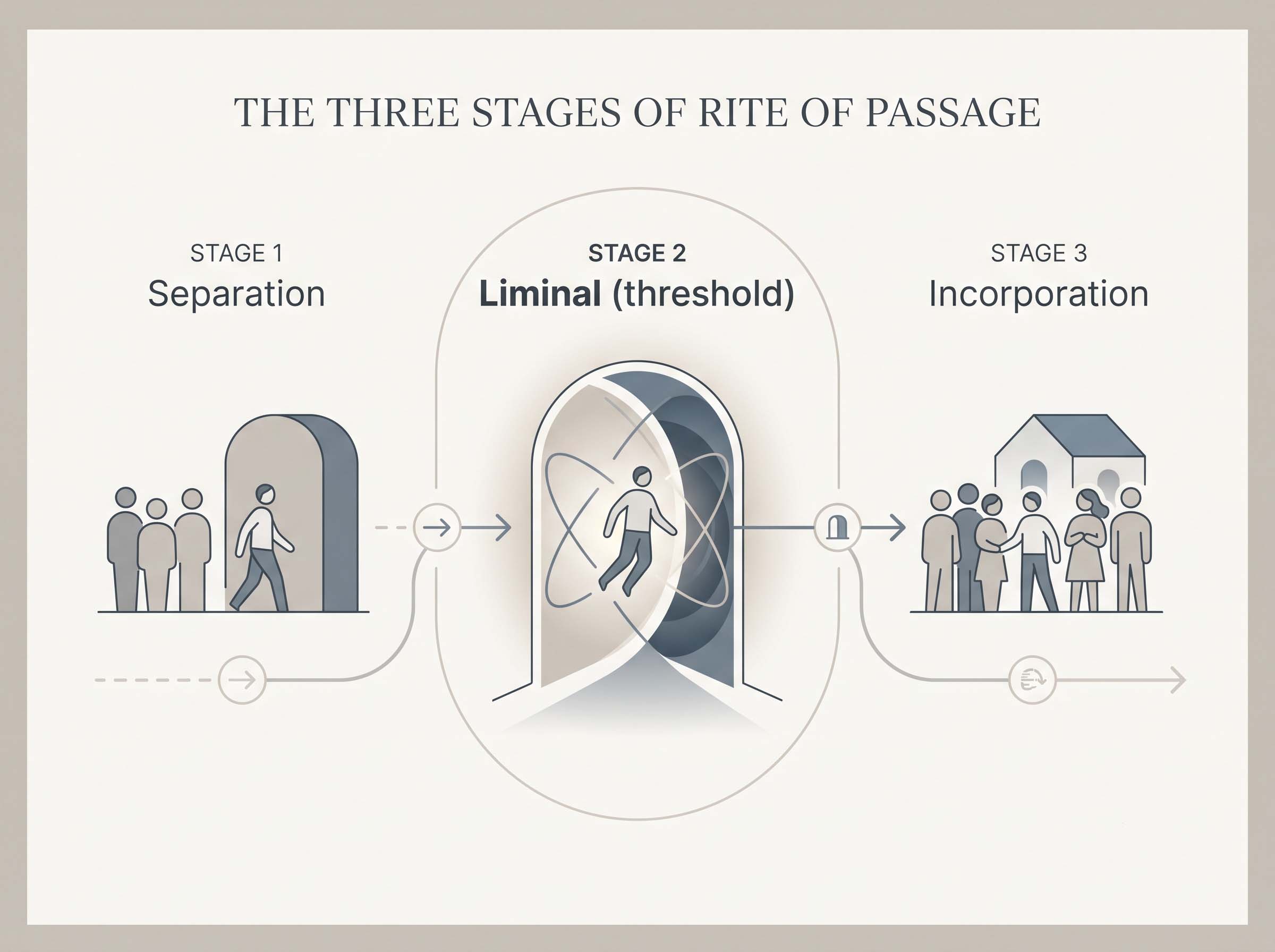
If Douglas explained what gets prohibited, Victor Turner explained when the rules grow most intense. He built on Arnold van Gennep, whose The Rites of Passage (1909) showed that ceremonies marking a change of status — birth, initiation, marriage, death — share a three-part shape: separation from the old role, a transition, and incorporation into the new one. Turner concentrated on the middle stage, which he called the liminal phase, from the Latin for threshold (Turner, The Ritual Process, 1969).
People in the liminal phase are, in his phrase, "betwixt and between." A boy in the middle of an initiation is no longer a child and not yet a man; a body in that in-between condition fits no category, and so, by Douglas's logic, it becomes charged and hedged with rules (Turner, The Forest of Symbols, 1967). This is why the heaviest body taboos cluster around thresholds: puberty, childbirth, illness, and death. The same pattern shows up wherever societies stage the passage into adulthood, a subject we trace across the ancient world in our look at initiation rituals and the male body. The transitional body is powerful, unclassifiable, and therefore ringed with restriction.
The function, not the content
The lasting lesson of this tradition is to stop asking whether a given taboo is strange and start asking what it does. A prohibition can serve several purposes at once: it marks the edges of a category, encodes the social order in a form people feel in their bodies, manages whatever the culture treats as dangerous, and quietly distributes power over who may do what. No culture's system is more "irrational" than another's; each is a coherent answer to the question of where the lines should fall.
It also helps to separate three mechanisms that often target the same behavior but work very differently. A legal prohibition is enforced by the state and carries formal penalty. A social norm is enforced by the group through approval and disapproval. Individual shame is enforced by a person on themselves, often long after any law or onlooker has gone. The anthropological literature is careful about this distinction because the same act — say, being seen unclothed — may be legal, socially awkward, and privately mortifying all at once, and each layer can shift without the others.
| Mechanism | Enforced by | Felt as | Body example |
|---|---|---|---|
| Legal prohibition | The state; formal penalty | Risk of punishment | Public nudity statutes |
| Social norm | The group; approval & disapproval | Awkwardness, exclusion | Norms about modest dress |
| Individual shame | The self, internalized | Private discomfort | Anxiety about one's own body |
Who sets the taboo?
Because prohibitions govern behavior, they are also instruments of power, and asking who sets a taboo, who enforces it, and whom it most constrains is a central anthropological question. Polynesian tapu is a clear case. The system did not only restrain commoners; the most sacred chiefs were so heavily tapu that ordinary contact with them was dangerous in both directions, and in some accounts their status carried burdensome restrictions of its own (Steiner, 1956). A taboo can bind those at the top and those at the bottom in different ways, and mapping that difference tells you how a society is organized.
The point is not that taboo is a trick played by the powerful, and it is not always drawn from above. Many bodily prohibitions are maintained from within a community, by consensus, and passed between generations without anyone in charge. What the anthropological record shows is only that prohibition and social structure move together. Change one and you tend to change the other.
Taboos change
Stable taboos are interesting; changing ones are more so, because the shift exposes the machinery. Bodily practices routinely cross the line between forbidden and ordinary. Tattooing — itself a Polynesian loanword, tatau — was long treated as marginal in much of Europe and North America before becoming commonplace. Public breastfeeding has moved, in many places within living memory, from something concealed toward something openly accepted. The direction is not fixed and not always toward permission; some behaviors once tolerated later become restricted. What drives the movement is usually a change in the underlying category — a new idea about what the body is — rather than a simple loosening of the rules.
The body's contemporary taboos
None of this is confined to the past or to distant societies. The framework built by Douglas and Turner applies just as well to the prohibitions modern men and women live under now, which have quietly migrated from the legal and religious column into the column of private shame. Few laws today govern how a body should be shaped, yet anxiety about body image, about size, and about whether one measures up against a circulated ideal operates with much of the force of an older taboo — mostly self-enforced, largely unspoken, and therefore hard to see.
Read through this lens, size anxiety is a taboo in the technical sense: a rule about a bounded body, enforced by shame rather than statute, that reveals what the surrounding culture treats as valuable. The discomfort many people feel discussing their own measurements is not a personal failing but the modern shape of a very old pattern — the body ringed with restriction because it sits at a boundary that matters. We look at how numbers themselves become a source of that discomfort in how body data gets framed as shame. Naming the mechanism is the first step to seeing around it.
Why the concept still matters
Taboo endures as an idea because it answers a question every society has to settle: where do the lines fall, and what happens to whatever crosses them. The prohibited is worth studying not because it is shocking but because of what it reveals — the forbidden is the shadow cast by the valued. Whether the rule surrounds a Tongan chief in 1777 or a person avoiding a mirror in 2026, the same structure is at work. Learn to read the prohibition, and you learn to read what a culture is trying to protect.
Terms in this article
- Taboo
- A cultural prohibition that sets a person, object, act, or bodily state apart as requiring special care.
- Liminal
- From the Latin for "threshold" — the in-between stage of a transition, when a person fits no fixed category.
- Rite of passage
- A ceremony marking a change of status, structured as separation, transition, and incorporation.
- Sacred / profane
- The distinction between what is set apart and what is ordinary — the pairing Polynesian thought captures as tapu and noa.
Common Questions About Taboo
Did you know?
"Taboo" is one of only a handful of Polynesian words in everyday global English. Two others — "tattoo," from Tahitian tatau, and "tapa," a type of bark cloth — also came back with Cook's expeditions.
References & further reading
- James Cook, A Voyage to the Pacific Ocean (1784).
- Arnold van Gennep, The Rites of Passage (1909).
- Sigmund Freud, Totem and Taboo (1913).
- A.R. Radcliffe-Brown, "Taboo" (Frazer Lecture, 1939).
- Franz Baermann Steiner, Taboo (1956).
- Mary Douglas, Purity and Danger (1966) and Natural Symbols (1970).
- Victor Turner, The Forest of Symbols (1967) and The Ritual Process (1969).
- Encyclopaedia Britannica, "taboo (sociology)" — overview of the concept.
Disclaimer
- All content on this website—including articles, educational materials, and interactive calculators—is for informational, educational, and entertainment purposes only. The calculations, percentiles, and outputs generated by tools on this site are based on general statistical data and mathematical models; they do not constitute medical data, a clinical assessment, or a diagnosis.
- Nothing contained on this website is a substitute for professional medical advice, diagnosis, or treatment. Always seek the guidance of a qualified healthcare professional or urologist with any questions you have regarding physical development, anatomy, or health conditions. Reliance on any information or tools provided by this website is solely at your own risk.


