


 English
 Español


On the sacred island of Delos, a theatre producer once celebrated a winning play by erecting a monument to a body part. The Stoivadeion, the island's sanctuary of Dionysus, still holds the base of two pillars that each once carried an outsized marble phallus. An inscription records that the southern pillar was dedicated around 300 BCE by a Delian named Carystios, in thanks for a victorious theatrical performance he had sponsored.
The pillar's reliefs show Dionysus, a maenad, a small Silenus, a figure of Pan — and a cockerel whose head and neck stretch into a phallus. It is, in modern terms, a sports trophy. It is also religion, and the two were not separate categories in the Greek world. Understanding why is a useful corrective to the assumption that ancient societies were simply cruder than ours, an assumption examined further in our piece on why societies linked size with power.
In Brief
- Phallic imagery in Greek religion was overwhelmingly about boundaries, protection and generative power — not about anatomy or comparison.
- The herm, a square pillar carrying a head and a phallus, functioned as a marker of doorways, crossroads and civic space.
- Athenian colonies were legally required to send a phallos to the City Dionysia, making the object a piece of civic obligation.
- Similar figures appear in Norse, Japanese, West African and Puebloan material — but the meanings are not interchangeable, and several traditions are still practiced today.
Three Kinds of Story, and Why the Difference Matters
Before going further, a distinction that folklorists take seriously and popular writing usually collapses. In a widely cited 1965 essay in the Journal of American Folklore, William Bascom separated prose narratives into three categories: myth, legend and folk tale. Myth is regarded within its own culture as truthful and sacred, set in a remote past, with gods or first ancestors as its actors. Legend is also regarded as truthful, but it is set in a more recent past and its actors are human. Folk tale is understood by its own audience as fiction, told for entertainment.
The categories matter here because the same image behaves very differently in each. A myth about a fertility god's body is a statement about how the world works. A legend about a night of vandalism in Athens is a statement about politics. A rude folk tale about a trickster is a joke — and jokes have their own kind of seriousness. Reading all three as though they were the same genre is the fastest route to misunderstanding what any of them meant.
The Herms: Athens' Strangest Street Furniture
The herm was a rectangular stone pillar, roughly at human scale, with a bearded head of Hermes on top and an erect phallus carved at mid-height. It had no arms, no legs and no torso. Walter Burkert, in his standard survey Greek Religion, connects the object to the older practice of marking a route or a grave with a heap of stones — herma — from which the god's own name appears to derive. Hermes was the deity of boundaries, roads, travelers, messages, trade, luck and theft: everything that happens at an edge or in transit.
Herms stood at doorways, at crossroads, at the entrances to sanctuaries and in the Athenian Agora. The pseudo-Platonic dialogue Hipparchus records that Hipparchus, son of Peisistratos, set up herms along the roads between Athens and the outlying demes, each inscribed with a short moral maxim for travelers to read. It is a detail worth sitting with: a phallic pillar dispensing improving advice to men walking home from the fields. Nothing about that arrangement struck the sixth-century Athenians as contradictory, which is precisely the point.
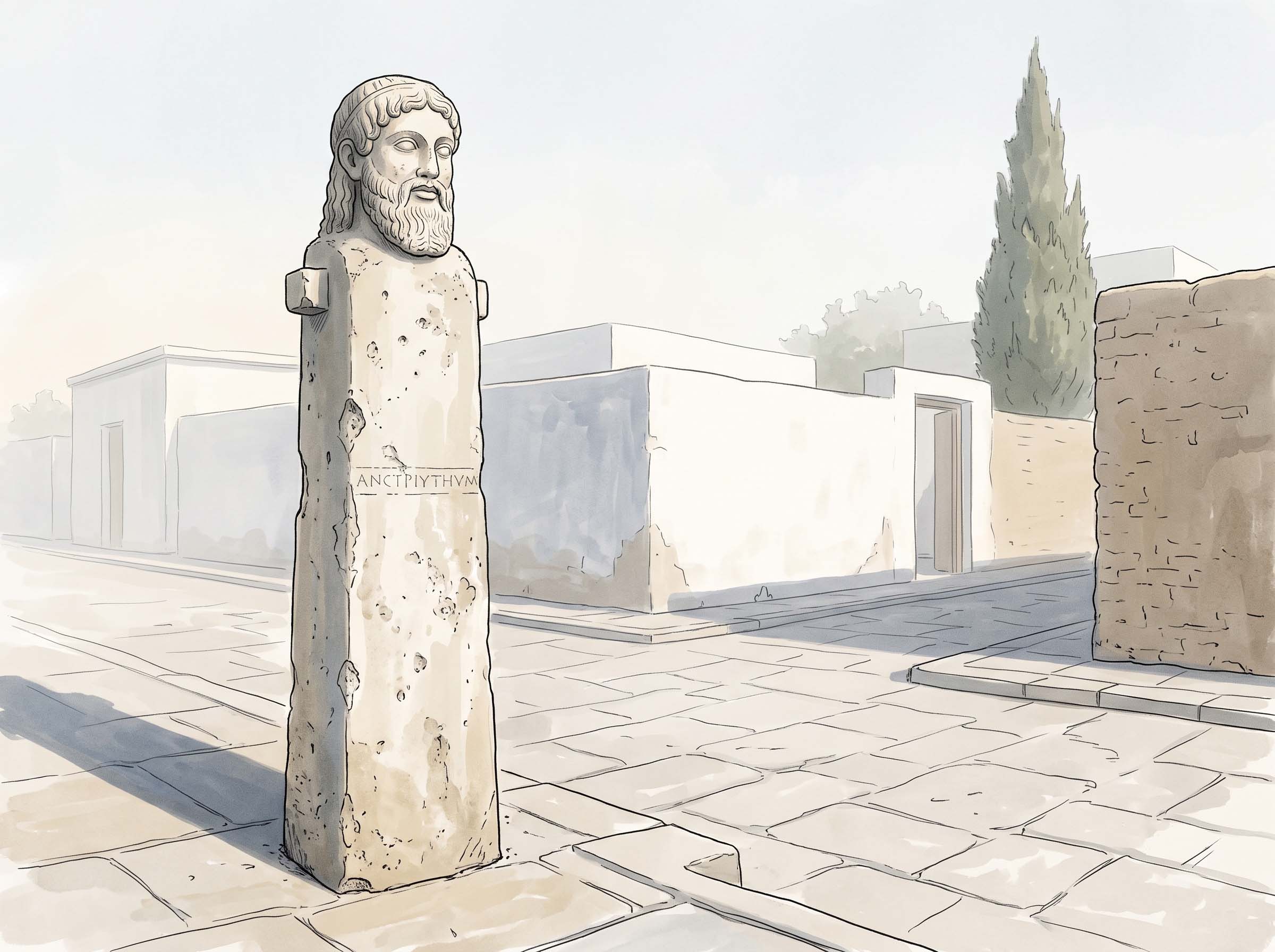
How seriously the objects were taken becomes clear from what happened in 415 BCE. On the night before the Athenian fleet sailed for Sicily, most of the herms in the city were mutilated. Thucydides reports the event in Book 6 of his history, and describes the reaction: not amusement, but a political panic that produced denunciations, trials and the recall of Alcibiades from command. Robin Osborne, writing in the Proceedings of the Cambridge Philological Society in 1985, argued that the shock came from what the herms represented — the identity and integrity of individual households and of the community as a whole. This is legend in Bascom's sense: a historical narrative, human actors, and a moral about the fragility of civic order.
The Procession: A Symbol the City Paid For
Cultural Insight
A symbol written into law. When Athens founded the colony of Brea in Thrace in the mid-fifth century BCE, the founding decree spelled out the settlers' ritual obligations to the mother city. They were to bring a cow and a suit of armor to the Great Panathenaia — and a phallos to the Dionysia.
The requirement sits in the same clause as land distribution and military defense. Ritual objects were administrative business, and the phallos was a unit of civic tribute rather than a private indulgence. Read the decree at Attic Inscriptions Online's translation of the Brea foundation decree.
Dionysiac festivals carried these objects through the streets. The procession, or pompe, that opened the City Dionysia in Athens brought citizens, resident foreigners and delegations from the colonies to the theatre on the south slope of the Acropolis, escorting the wooden statue of Dionysus Eleuthereus and carrying phalloi mounted on poles. The Rural Dionysia did the same at village scale; Aristophanes stages a miniature version in the Acharnians, where the hero Dikaiopolis conscripts his daughter as basket-carrier, hands the pole to a slave and sings a hymn to Phales, the personified phallus. It is broad, cheerful, slightly ridiculous — and it is a religious act.
Aristotle, in the Poetics, traces the origin of comedy itself to the leaders of these phallic songs. Greek comic drama, in his account, is not a secular form that later borrowed religious trappings; it grows directly out of the procession. The connection between the sacred, the fertile and the funny was structural, not accidental.
The symbol was public property. It was carried by delegations, funded by sponsors, legislated by decree and sung about in the street — everything, in other words, that a private symbol is not.
The Paradox at the Center of the Cult
Here is where the material becomes genuinely interesting. Dionysus, the god whose festivals were full of these objects, is almost never shown in Greek art as sexually aroused himself. Michael Jameson took up this problem in a chapter titled "The Asexuality of Dionysus," published in Masks of Dionysus (Cornell University Press, 1993). Jameson set the robust obscenity of the cult against the soft, languid, sometimes beardless figure of the god as artists depicted him, and argued that the phallic imagery works as a set of signs mediating between male and female rather than as a portrait of the god's own appetite.
The processional phallos is detached. It sits on a pole, on a cart, on a pillar, on a column. It is carried, not worn. That grammatical difference — object rather than attribute — is the whole interpretive key. What the Greeks were parading was generative force in the abstract: the thing that makes vines fruit, herds increase and cities continue. It was no more a comment on individual men than a harvest sheaf is a comment on individual farmers.
Greek art reinforces the reading from the opposite direction. As Kenneth Dover observed in Greek Homosexuality (1978), the idealized male body in classical sculpture and vase painting is consistently given modest genitals, while exaggeration is reserved for satyrs, comic actors, barbarians and figures of low status. Restraint signified sophrosyne — self-command, the mark of a citizen. Exaggeration signified its absence. The visual language of the herms and the visual language of the Parthenon frieze were doing entirely different jobs, a divergence traced in our article on how culture shaped the ideal male body.
Did You Know?
Roman households used small phallic charms called fascina as protective amulets. Pliny the Elder, in his Natural History, records that the fascinus was hung on infants as a guard against envy and was carried beneath the chariot of a general celebrating a triumph. The object's job was to absorb the evil eye — the same defensive logic that put a herm outside an Athenian front door.
The Same Idea, Told Differently
Comparable figures turn up across unrelated traditions, and the temptation is to flatten them into one universal fertility symbol. That flattening is a mistake. What the comparison actually shows is a recurring structural position — the threshold, the crossroads, the turn of the agricultural year — filled by very different theologies.
| Tradition | Figure or object | Recorded function | Key source |
|---|---|---|---|
| Greek (Athens) | Herm | Boundary marker, protection of doorways and roads | Burkert, Greek Religion (1985) |
| Greek (Dionysiac) | Processional phallos | Civic ritual offering; origin point of comic drama | Aristotle, Poetics; IG I³ 46 |
| Roman | Fascinum | Personal amulet against the evil eye | Pliny, Natural History 28 |
| Norse | Freyr (Fricco) | Deity of peace, good seasons and abundance | Adam of Bremen, Gesta IV.26 |
| Japanese (Shinto) | Dōsojin; Tagata offering | Roadside boundary guardians; harvest petition | Czaja, Gods of Myth and Stone (1974) |
| Hindu | Shiva linga | Aniconic column of divine presence — see caution below | Kramrisch, The Presence of Śiva (1981) |
| West African (Yoruba, Fon) | Eshu-Elegba; Legba | Crossroads and threshold deity; divine messenger | Thompson, Flash of the Spirit (1983) |
| Hopi / Ancestral Puebloan | Kokopölö and related rock-art figures | Fertility katsina; distinct from the modern commercial icon | Malotki, Kokopelli (2000) |
The Norse case shows how much depends on who is holding the pen. Writing around 1080, the German cleric Adam of Bremen described the temple at Uppsala and its three statues, noting that the image of Fricco — generally identified with Freyr — was fashioned cum ingenti priapo. Adam was a hostile Christian outsider who never visited the site, and Rudolf Simek and others have cautioned that his details vary considerably in reliability and may borrow from biblical temple descriptions. Olof Sundqvist's discussion for Harvard's Center for Hellenic Studies analysis of the Uppsala temple account sets out the source problems in detail. That the small Rällinge figurine, found in Sweden in 1904, matches Adam's description is suggestive — but a single account written by an opponent of the religion is thin evidence for what worshippers themselves believed.
The Hindu case calls for a different kind of care, because the tradition is a living one with more than a billion adherents. Nineteenth-century European scholarship routinely described the Shiva linga as a phallic image. Most Hindu theology does not read it that way. Stella Kramrisch and later scholars such as Gavin Flood describe it as an aniconic form — a pillar of light, a sign of unmanifest presence, deliberately without anatomical features. Listing it beside a Greek herm is defensible as a study in the visual grammar of columns and thresholds. Presenting it as the same kind of object would be an error, and one that many practitioners find offensive.
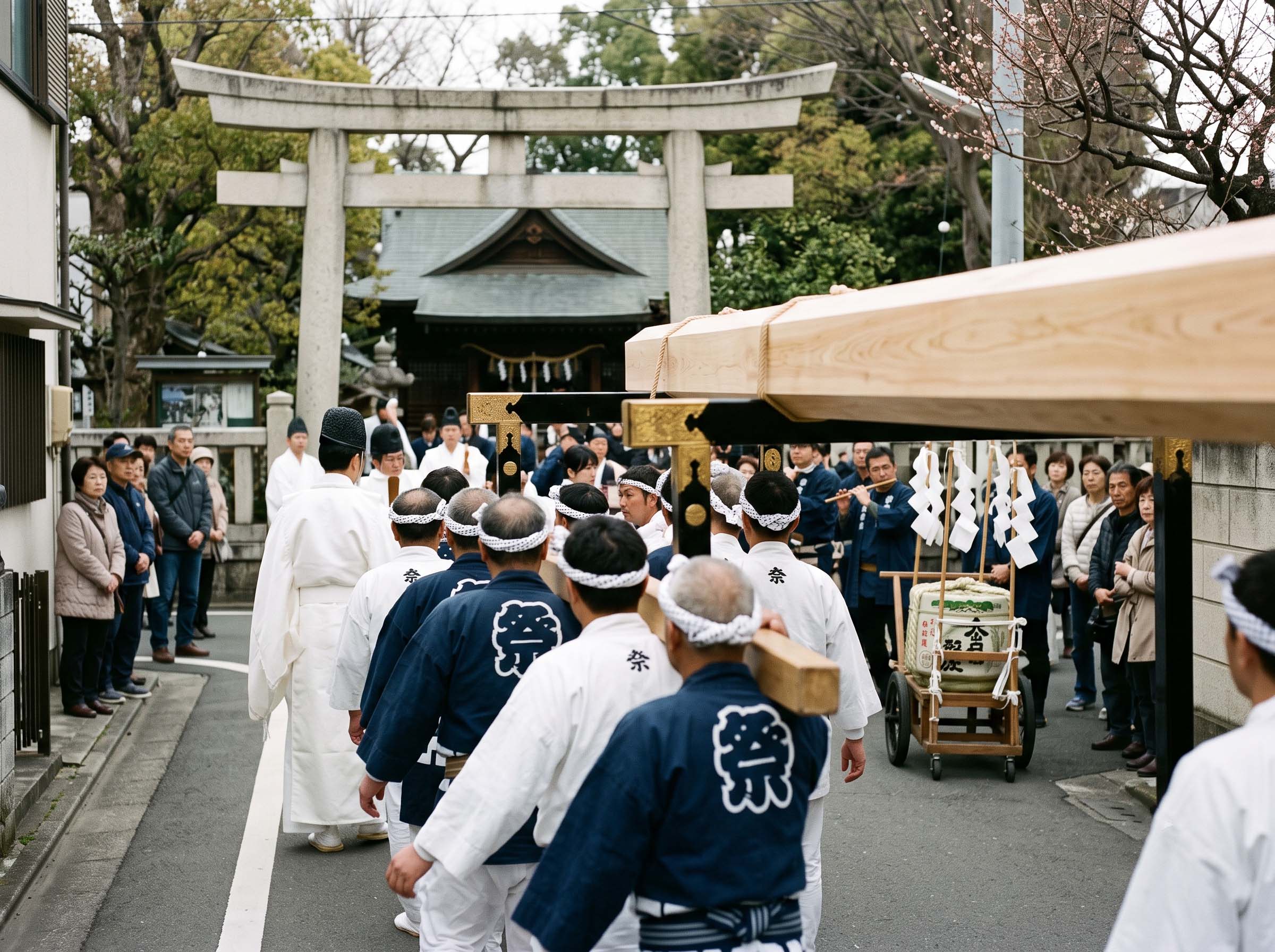
That festival is worth describing precisely, because it is the closest surviving analogue to the Dionysiac pompe. Each year, artisans carve a new offering from a single Kiso cypress trunk. According to the Japan National Tourism Organization's account of the Hōnen Matsuri and Aichi Prefecture's official tourism records, the finished carving measures roughly 2 m (about 6.5 ft) in length and around 60 cm (about 24 in) in diameter, weighing approximately 280 kg (about 620 lb) on its own. Men of an age considered inauspicious in Japanese custom carry it on a mikoshi to Tagata Shrine on 15 March, with prayers for a good grain harvest and prosperous descendants. Nearby Ōagata Shrine holds a corresponding festival honoring female generative power. The pairing is the point: two halves of one agricultural petition, not a spectacle.
Tricksters and the Body That Breaks the Rules
One category of figure deserves separate attention. Tricksters — Hermes in Greece, Loki in Scandinavia, Eshu and Legba in West Africa, Coyote across much of North America, Māui in Polynesia — use the body to violate norms that everyone else observes. Their stories are frequently funny, and the humor is doing analytical work rather than merely entertaining.
Snorri Sturluson's Skáldskaparmál preserves an episode in which Loki, tasked with making the giantess Skaði laugh, ties one end of a cord to a goat's beard and the other to himself, and the resulting tug-of-war ends with both of them shrieking. It is slapstick of the crudest kind, and it appears in a serious mythological compendium. Robert Farris Thompson's work on Yoruba and Fon religion describes Eshu-Elegba in comparable terms: a divine messenger who governs the crossroads, who is often shown with phallic attributes, and whose stories turn on reversal and mischief. These figures occupy the boundary, and boundaries in mythology are where the ordinary rules stop applying.
The trickster's body, then, is a device for talking about the limits of the social order without directly attacking it. The joke is a permitted place to say the unpermitted thing — which is more or less exactly what Aristotle claimed the phallic songs became when they turned into comedy. Similar patterns in how ancient cultures constructed masculine identity through story are examined in our article on male sexuality in mythology.
What the Symbol Was Actually About
Pull the material together and a consistent pattern appears — one that has very little to do with the modern reading of these objects. Across the Greek evidence, phallic imagery clusters around three functions: it marks a boundary, it wards off harm, and it petitions for increase. Doorways, crossroads, city gates, the turn of the season, the opening of a festival. It is threshold equipment.
What it almost never does is invite comparison. There is no ancient Greek discourse of measurement attached to the herms, no ranking, no anxiety of the kind that would be legible to a modern reader. The one place the Greeks did make a comparative visual statement, they made the opposite one from what a modern audience expects: the citizen ideal in sculpture was restraint, and exaggeration marked the figure who could not govern himself. The symbol on the street corner and the standard in the sculpture workshop were answering different questions entirely.
That gap between the symbol and the self is probably the most useful thing this body of material offers. Historically, societies have used the image of the body to think about harvests, borders, luck, laughter and the continuation of the community. The private, comparative, personal reading is a much later invention — and recognizing it as an invention is the beginning of understanding what these objects meant to the men and women who carved them, carried them and prayed beside them.
Editorial Glossary
- Apotropaic
- Intended to turn away harm or bad luck. Used of amulets, doorway carvings and boundary markers.
- Aniconic
- A sacred form deliberately made without representational features — a pillar, a stone, a flame.
- Herm
- A square Greek pillar carrying a head of Hermes, used to mark roads, doorways and civic space.
- Pompe
- The formal opening procession of a Greek festival.
- Katsina
- In Hopi religion, a spirit being represented in ceremony and in carved figures. A living religious category, not a folklore motif.
Common Questions
Disclaimer
- All content on this website—including articles, educational materials, and interactive calculators—is for informational, educational, and entertainment purposes only. The calculations, percentiles, and outputs generated by tools on this site are based on general statistical data and mathematical models; they do not constitute medical data, a clinical assessment, or a diagnosis.
- Nothing contained on this website is a substitute for professional medical advice, diagnosis, or treatment. Always seek the guidance of a qualified healthcare professional or urologist with any questions you have regarding physical development, anatomy, or health conditions. Reliance on any information or tools provided by this website is solely at your own risk.


