


 English
 Español


In 1810 an English officer of the East India Company named Edward Moor published The Hindu Pantheon, a compendium of Indian religious imagery assembled for a European readership. Among the plates was a smooth, rounded stone column set into a lipped circular base. Moor described it plainly as a phallic emblem, and for the next century most English-language writing followed him.
What that description left out was everything a worshipper standing in front of the same object would have said about it. The gap between those two accounts — the outsider’s description and the insider’s explanation — has shaped the study of the lingam ever since, in much the same way it shaped early European responses to Indian temple sculpture and the sacred body.
The lingam is among the most thoroughly documented religious objects on earth. It appears in Sanskrit texts spanning two millennia, in temple ritual manuals, in sculpture from Kashmir to Cambodia, in colonial-era engravings, and in a substantial body of modern Indological scholarship. That documentation makes it an unusually good case for a question worth asking of any body-related ritual: what does the practice actually consist of, what do the participants say it means, and what have scholars proposed about how it works socially? Those three answers are not the same answer, and treating them as interchangeable is where most popular writing on the subject goes wrong.
In Brief
- The Sanskrit word liṅga means “mark” or “sign” long before it means anything anatomical.
- The oldest documented example, at Gudimallam in Andhra Pradesh, is unmistakably anatomical; most later ones are not.
- Ritual practice, devotee meaning, and scholarly interpretation are three separate things, and they frequently disagree.
- The question “is it a phallus?” has a longer and more political history than most readers expect.
The word before the object
Sanskrit liṅga is an ordinary word with an ordinary range of meanings: mark, sign, emblem, characteristic, distinguishing feature. Monier Monier-Williams’s Sanskrit-English Dictionary (1899) lists it under exactly those senses, and the term appears in the Upanishads and epic literature carrying no specifically anatomical weight (Monier-Williams 1899). In logic texts it means the evidential sign from which an inference is drawn — smoke is the liṅga of fire. Stella Kramrisch, whose The Presence of Śiva (Princeton University Press, 1981) remains a standard reference on Shaiva iconography, builds her reading around this sense: the lingam is the sign by which an otherwise formless deity is made present and available (Kramrisch 1981).
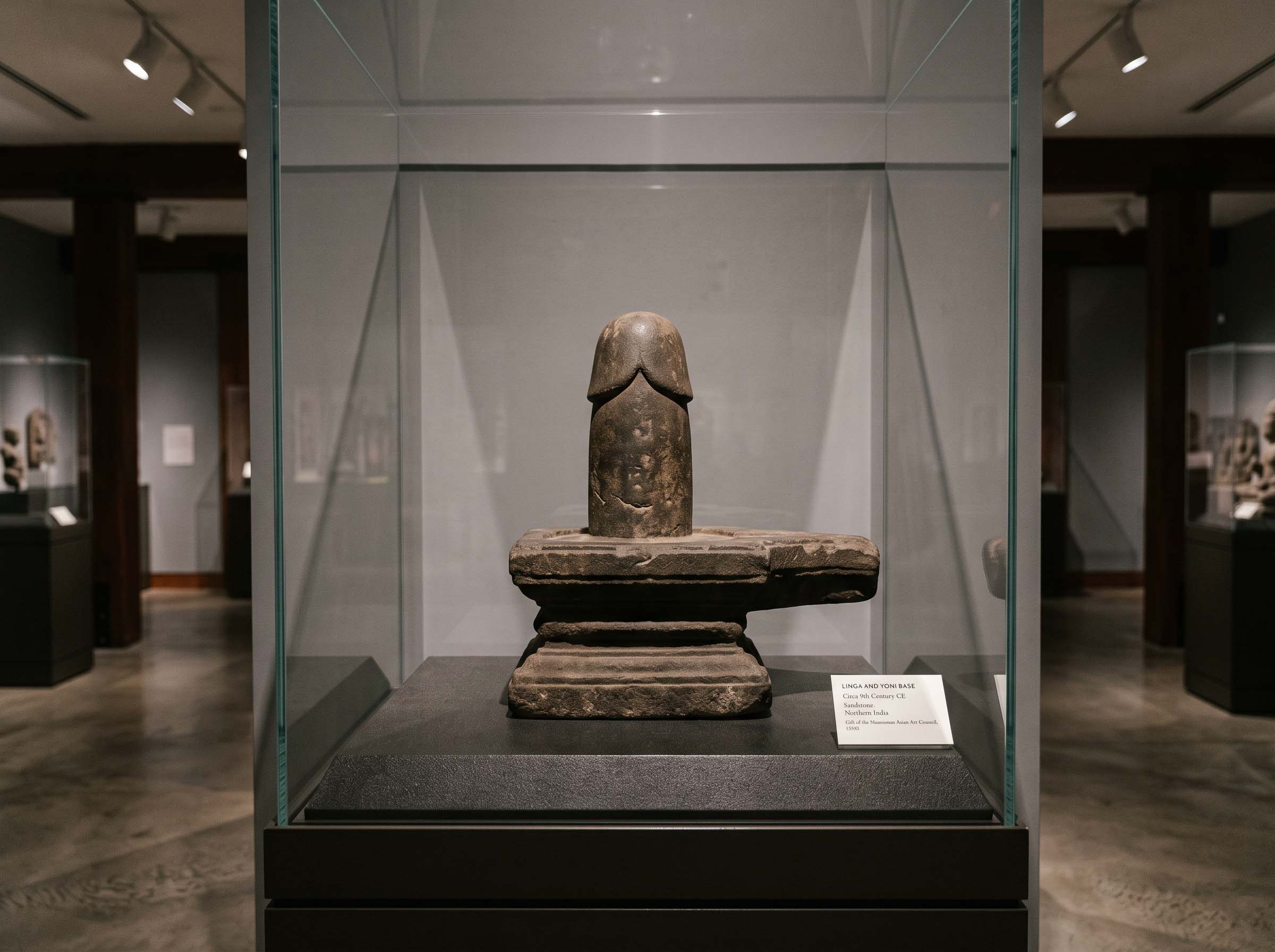
That etymology matters because it explains something that puzzles visitors. The overwhelming majority of lingams in active worship are not anatomically shaped in any obvious way. They are smooth cylinders with rounded tops, often plain to the point of austerity, sometimes nothing more than a water-worn river stone. Diana Eck, in Darśan: Seeing the Divine Image in India (1981), places the lingam in the category of aniconic images — forms that hold divine presence without depicting a figure — alongside the marked stones and pillars found across South Asian religious practice (Eck 1981).
“The overwhelming majority of lingams in active worship are not anatomically shaped in any obvious way. Some are nothing more than a water-worn river stone.”
What the ritual actually consists of
Begin with the practice itself, because it is the least disputed part of the record. In a Shaiva temple the lingam typically stands in the garbhagṛha, the innermost sanctum, seated in a lipped pedestal known as the pīṭha or yoni, which is grooved so that liquids poured over the stone drain away through a spout. The central daily act is abhiṣeka: the pouring of water, milk, clarified butter, honey, and other substances over the stone, followed by cleaning, the application of ash or sandalwood paste, and the offering of flowers, leaves, and lamps.
Richard H. Davis reconstructed the medieval version of this sequence in Ritual in an Oscillating Universe: Worshiping Śiva in Medieval India (Princeton University Press, 1991), working from Shaiva Siddhanta ritual manuals that specify the order of acts in considerable detail (Davis 1991). C. J. Fuller’s ethnography The Camphor Flame: Popular Hinduism and Society in India (Princeton University Press, 1992) documents the contemporary temple version, including the domestic worship performed by householders on small portable lingams (Fuller 1992). Twelve sites across India are recognized as jyotirliṅga shrines and form a pilgrimage network described by Eck in India: A Sacred Geography (2012), while the annual festival of Mahashivaratri concentrates lingam worship into a single night of vigil and repeated bathing of the stone (Michaels 2004).
Participants’ own accounts of what this means vary by tradition and by person, which is exactly what one would expect of a practice followed by hundreds of millions of people. A widely offered explanation holds that the column and its base together represent the inseparability of the divine masculine and feminine principles, Shiva and Shakti, and the completeness of existence — a reading summarized in Encyclopaedia Britannica’s entry on the lingam. Another, common in philosophical Shaivism, treats the form as deliberately empty of likeness: a shape chosen because it depicts nothing, and therefore does not limit what it points to. Many devotees hold both at once. A great many simply describe the stone as Shiva, present and available, and consider the question of what it resembles beside the point.
Three questions, three different answers
What does the ritual do? A stone is bathed, dressed, and honored on a daily cycle. This is observable and largely uncontested.
What do participants say it means? Answers range from the union of cosmic principles to the deliberate absence of likeness to the simple presence of the deity. All are held sincerely, and they differ.
What do scholars propose it does socially? Anthropologists have argued for functions the participants themselves do not claim — organizing pilgrimage geography, encoding cosmology in built space. These are interpretations, not descriptions, and they carry no authority over what worshippers believe.
The evidence that complicates the picture
Here the record refuses to be tidy. The earliest securely identified lingam, recovered at Gudimallam in present-day Andhra Pradesh and first described by T. A. Gopinatha Rao in Elements of Hindu Iconography (1914), is explicitly anatomical. It stands roughly 1.5 meters (about 5 feet) tall with a shaft around 0.3 meters (about 1 foot) in diameter, and carries a high-relief standing figure of Shiva as a hunter on its front face. Scholarly dating has ranged widely, from the third century BCE to the second century CE, with recent assessments favoring the earlier end on stylistic grounds (Gopinatha Rao 1914; Srinivasan 1997).
So the oldest example is anatomically explicit and nearly all the later ones are not. That pattern is the single most important fact in the debate, and it cuts against both simple positions. It undermines the claim that the anatomical reading is purely a colonial invention, and it equally undermines the claim that the form has always and only been understood that way.
The textual record is similarly mixed. Passages in the Mahabharata and in Puranic literature narrate episodes in which the lingam is identified with the body of Shiva, and the Liṅga Purāṇa and Śiva Purāṇa devote extended sections to its worship. Set against these is the lingodbhava narrative, widespread in South Indian temple sculpture, in which Shiva appears as an endless column of fire whose top and bottom Brahma and Vishnu are unable to find. In that story the form is a pillar of light, and its meaning is the deity’s limitlessness. Wendy Doniger’s Śiva: The Erotic Ascetic (Oxford University Press, 1973) traced how Shaiva mythology holds ascetic withdrawal and generative power together rather than choosing between them (Doniger O’Flaherty 1973).
A further claim deserves careful handling. Sir John Marshall, excavating Mohenjo-daro, proposed in Mohenjo-Daro and the Indus Civilization (1931) that certain stone objects were lingams and that a seated figure on a seal was a “proto-Shiva.” Both identifications have been contested at length. Doris Srinivasan’s analysis of the seal (Archives of Asian Art, 1975–76) found the iconographic case unsupported, and Asko Parpola’s Deciphering the Indus Script (1994) reviews the difficulty of assigning religious function to Indus artifacts in the absence of a readable script. The honest summary is that a continuous line from the Indus Valley to historical Shaivism has been proposed and has not been demonstrated.
Why the interpretation became contested
Reading the lingam as a phallic emblem is not, in itself, a hostile act. It is the reading given by a great deal of Sanskrit textual evidence. What made it contentious was the frame that surrounded it in nineteenth-century European writing, where the identification typically arrived attached to judgments about the moral condition of the people who worshipped it. The response from Hindu reformers was to press the alternative reading hard. Swami Vivekananda, addressing the Congress of the History of Religions in Paris in 1900, argued that the lingam derived from the Vedic hymn to the cosmic pillar skambha and rejected the phallic origin outright — an argument preserved in his collected works and repeated widely since.
That disagreement has not closed. Doniger’s later general history, The Hindus: An Alternative History (2009), drew sustained objection in India over its handling of sexual themes in Hindu tradition, and in 2014 Penguin India agreed to withdraw the book from circulation there as part of a legal settlement. Whatever one makes of that outcome, it demonstrates something worth stating plainly: interpretations of this object are not academic in the dismissive sense. They are live matters for people whose religious lives are the subject under discussion.
| Line of evidence | What it shows | What it cannot settle |
|---|---|---|
| Gudimallam sculpture, Andhra Pradesh | The earliest identified lingam is anatomically explicit; roughly 1.5 m (5 ft) tall | Whether this was typical of its period, or already exceptional |
| Sanskrit lexicon and logic texts | Liṅga means “mark, sign, evidence” across a broad literature | Which sense was primary in ritual usage at any given date |
| Puranic narrative material | Both anatomical identification and the pillar-of-fire account are attested | Whether the narratives explain the form or were composed to explain it later |
| Indus Valley artifacts | Cylindrical stones exist at Harappan sites | Whether they had any religious function at all; the script is unread |
| Contemporary ethnography | What worshippers today do and say they mean by it | What worshippers two thousand years ago understood by it |
Where the lingam sits in the wider record
Body-related religious symbolism is documented across virtually every region anthropologists have studied, and it takes strikingly different forms. Classical Greek cities placed carved herms at boundaries and doorways; Roman households hung the fascinum as protection, a practice Pliny the Elder recorded in the Natural History. Japanese roadside dōsojin markers, Egyptian representations of the god Min, and West African and Melanesian ritual objects each carry meanings specific to their own systems. Comparison across these traditions is legitimate scholarship, but it is also where the most careless writing happens — the assumption that similar-looking objects must mean similar things is rarely supported once the ritual context is examined. Readers interested in the Mediterranean side of this record can follow it through what phallic symbolism meant in the ancient Greek world, and the broader pattern of body-centered ceremony through the initiation rites anthropologists have documented across cultures.
What distinguishes the lingam within this comparative field is duration and continuity. It is not a recovered artifact from a closed tradition. It is worshipped daily, at this moment, in tens of thousands of temples and an unknown number of households, by people who have their own well-developed vocabulary for what they are doing. The scholarship on it — from Gopinatha Rao’s early survey to Kramrisch’s iconographic study to Fuller’s fieldwork — is at its strongest when it treats that living practice as the primary evidence rather than as a late corruption of some purer original. For a general orientation to the art-historical context, the Metropolitan Museum of Art’s survey of Hinduism and Hindu art is a reliable starting point.
Moor’s 1810 plate got the shape right and the situation wrong. He recorded an object and missed a practice. Two centuries of subsequent work have mostly been an argument about how to avoid repeating that error — and the argument is not settled, which is a more interesting outcome than a tidy answer would have been.
Did You Know?
At Kbal Spean in Cambodia, a riverbed was carved in the eleventh century with more than a thousand small lingams directly into the stone of the stream floor, so that the water passing over them would be sanctified before flowing downstream toward the Angkor complex. Shaiva ritual traveled well beyond South Asia, and adapted to local landscape when it arrived.
Questions Readers Ask
Sources Cited
Davis, Richard H. Ritual in an Oscillating Universe: Worshiping Śiva in Medieval India. Princeton University Press, 1991. · Doniger O’Flaherty, Wendy. Śiva: The Erotic Ascetic. Oxford University Press, 1973. · Eck, Diana L. Darśan: Seeing the Divine Image in India. Anima Books, 1981; India: A Sacred Geography. Harmony, 2012. · Flood, Gavin. An Introduction to Hinduism. Cambridge University Press, 1996. · Fuller, C. J. The Camphor Flame: Popular Hinduism and Society in India. Princeton University Press, 1992. · Gopinatha Rao, T. A. Elements of Hindu Iconography, Vol. II. Law Printing House, 1914. · Kramrisch, Stella. The Presence of Śiva. Princeton University Press, 1981. · Marshall, John. Mohenjo-Daro and the Indus Civilization. Arthur Probsthain, 1931. · Michaels, Axel. Hinduism: Past and Present. Princeton University Press, 2004. · Monier-Williams, Monier. A Sanskrit-English Dictionary. Clarendon Press, 1899. · Moor, Edward. The Hindu Pantheon. J. Johnson, 1810. · Parpola, Asko. Deciphering the Indus Script. Cambridge University Press, 1994. · Srinivasan, Doris. “The So-Called Proto-Śiva Seal from Mohenjo-Daro.” Archives of Asian Art 29 (1975–76); Many Heads, Arms and Eyes. Brill, 1997.
The documented record, at a glance
Dates reflect scholarly ranges, not settled consensus.
c. 2600–1900 BCE
Cylindrical stones at Harappan sites. Religious function proposed by Marshall (1931), contested since.
3rd c. BCE – 2nd c. CE
The Gudimallam lingam, roughly 1.5 m (5 ft) tall. Earliest securely identified example.
c. 5th–12th c. CE
Puranic literature, temple building across South Asia, and Shaiva ritual manuals codifying daily worship.
9th–13th c. CE
Shaiva practice established across mainland and island Southeast Asia, including the Angkor region.
1810–1900
European cataloguing (Moor, 1810) fixes the phallic reading in English; Hindu reformers publish counter-arguments.
1914–present
Systematic scholarship: Gopinatha Rao, Kramrisch, Doniger, Davis, Fuller, Eck — and continuing public debate.
Disclaimer
- All content on this website—including articles, educational materials, and interactive calculators—is for informational, educational, and entertainment purposes only. The calculations, percentiles, and outputs generated by tools on this site are based on general statistical data and mathematical models; they do not constitute medical data, a clinical assessment, or a diagnosis.
- Nothing contained on this website is a substitute for professional medical advice, diagnosis, or treatment. Always seek the guidance of a qualified healthcare professional or urologist with any questions you have regarding physical development, anatomy, or health conditions. Reliance on any information or tools provided by this website is solely at your own risk.


