



 English
 Español


In 1942 a researcher measured a group of men and published the numbers. In 2021 another researcher did the same thing. Between those two dates sit seventy-three more studies, more than fifty-five thousand men, and one of the more unexpected claims in modern body measurement science.
The claim comes from a 2023 systematic review and meta-analysis led by Federico Belladelli at Stanford University and published in The World Journal of Men's Health. The researchers pooled 75 studies published between 1942 and 2021, covering 55,761 men, and looked for something almost nobody had checked before: not what the average is, but whether the average has moved. Their answer, after adjusting for geographic region, age and study population, was that reported erect length rose by 24% over the previous 29 years. Studies of flaccid and stretched length showed no comparable trend. If you have read our summary of the largest single clinical measurement study ever conducted, this is the natural sequel — that study asked what the number is, and this one asks whether it stays put.
It is a genuinely interesting finding. It is also a preliminary one, built on a data set with real gaps, and it deserves to be read alongside a much older question: what did human bodies look like before anyone was measuring them at all?
In Brief
- A 2023 meta-analysis pooled 75 studies (1942–2021) and 55,761 men to test whether reported measurements have changed over time.
- Reported erect length rose 24% over 29 years after statistical adjustment. Flaccid and stretched measurements showed no comparable trend.
- The finding is a trend signal, not a settled fact. Measurement technique, volunteer bias, and thin representation from Africa, South America and much of Asia all limit what it can support.
- Adult height has changed dramatically over the same broad era — a well-documented reference point for how quickly human bodies shift.
- For any period before about 1942 there is no direct measurement record. Skeletons preserve bone; art preserves ideals.
What the modern record actually contains
The scientific record on human genital measurement is younger than most people assume. Systematic, published measurement of adult men begins in earnest in the 1940s, and even then it arrives in fragments: a urology clinic here, a military cohort there, a fertility study somewhere else. Nobody set out to build a century-long data set. The Belladelli team built one retrospectively out of whatever had been published.
Pooled across all 75 studies, the review reported three headline averages, each with a 95% confidence interval — the statistical range within which the true population value most plausibly sits.
| Measurement | Pooled average | 95% confidence interval | Trend over time |
|---|---|---|---|
| Flaccid length | 8.70 cm (3.43 in) | 8.16–9.23 cm | No trend identified |
| Stretched length | 12.93 cm (5.09 in) | 12.48–13.39 cm | No trend identified |
| Erect length | 13.93 cm (5.48 in) | 13.20–14.65 cm | Increase over time |
All measurements showed variation by geographic region. Across the 20 studies reporting erect measurements, study averages ranged from 9.50 cm (3.74 in) to 16.78 cm (6.61 in) — a spread of more than seven centimeters between study populations.
That last line is worth sitting with. The gap between the lowest and highest study average is larger than the entire 29-year trend the paper identified. Where a study was conducted, and how, moves the number more than the decade it was conducted in.
Reading the 24% finding carefully
The specific claim is narrower than the headlines it generated. The researchers ran a meta-regression — a technique that plots each study's reported average against its year of publication and tests whether a line through those points slopes. Erect length sloped upward, in several world regions and across all age groups. Stretched length, measured by a clinician pulling the flaccid organ to full extension, did not.
Two structural details matter. First, the analysis uses year of publication as the time axis, which is a proxy for when the men were measured, not a record of it. Second, the studies were never designed to be compared with one another. Some measured under intracavernosal injection in a clinic, some relied on self-stimulation, some measured lying down and some standing, some used one examiner and some two. The 2023 authors acknowledge this directly, noting that temperature, arousal state, body size and the examiner all influence the recorded figure, and that volunteer bias affects some of the source studies. Anyone weighing this finding should also read how study design shapes the averages research reports, because half the apparent movement in any body measurement literature is method, not bodies.
There is a further limit that the paper's own structure makes plain. The 75 studies are heavily weighted toward populations that urologists in wealthy countries had convenient access to. Africa, South America and large parts of Asia are thinly represented, which means the temporal trend is best understood as a trend within the published literature rather than a measured change in the world's male population. As our piece on why one number cannot speak for four billion men sets out, a global average assembled from an unrepresentative sample is a description of the sample first and the world second.
The gap between the lowest and highest study average is larger than the entire 29-year trend the paper identified.
None of this makes the finding worthless. A signal that survives adjustment for region, age and population type is a signal worth taking seriously, and the authors were explicit that the appropriate response is further investigation, not celebration. It is a starting point that has not yet been replicated by a study designed from the ground up to answer the question.
Reading this chart: these indicators come from different studies, different periods and different populations. They are placed side by side to show the direction and scale of reported change, not to imply that one caused another.
Height is the reference point everyone already understands
Body measurements changing across generations is not a strange idea. Researchers call it a secular trend, and the best-documented example is standing height.
The NCD Risk Factor Collaboration reanalysed 1,472 population studies covering more than 18.6 million people to estimate average height in 200 countries for those born between 1896 and 1996. The changes are large. South Korean women born at the end of that century were on average 20.2 cm (7.9 in) taller than those born at the start; Iranian men gained 16.5 cm (6.5 in). Dutch men born in the last quarter of the twentieth century averaged more than 182.5 cm (5 ft 11.9 in), the tallest group in the analysis. In parts of sub-Saharan Africa and South Asia, meanwhile, average height barely moved across the same hundred years.
Two lessons carry directly across. Human body dimensions can shift substantially within three or four generations, which makes the idea of a genital measurement trend biologically unsurprising. And those shifts are wildly uneven between populations, which is exactly why a single worldwide figure hides more than it reveals.
Before the record: what remains can and cannot say
Push back past the 1940s and the evidence changes character completely. There is no measurement archive for the Roman Empire, no clinic data from the Bronze Age. What survives is bone, occasionally preserved soft tissue, and an enormous quantity of art.
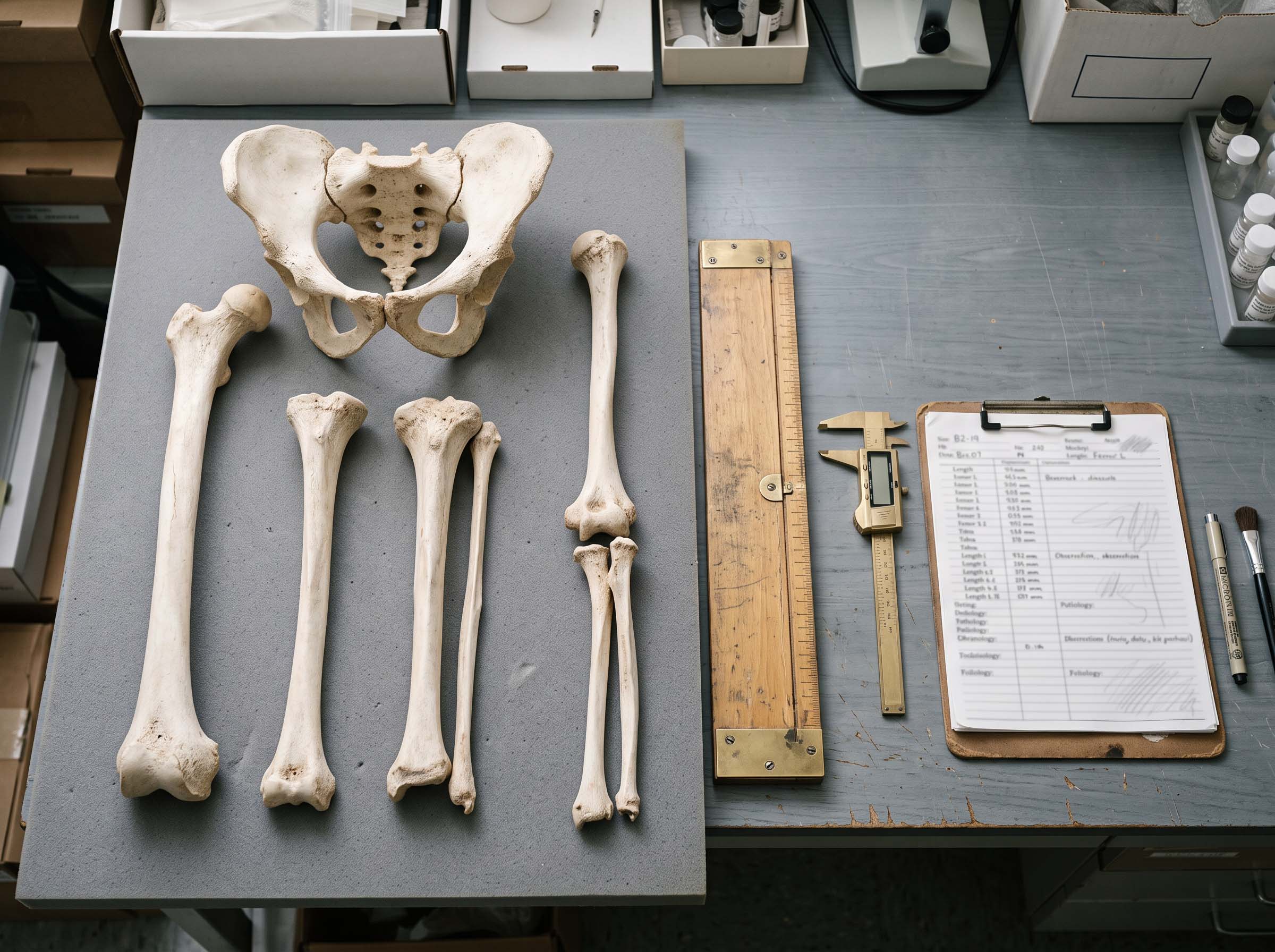
Bone is the most abundant and the least informative for this question. Skeletal remains support careful estimates of stature, age at death, nutritional stress, workload and injury — the whole modern field of bioarchaeology rests on that. They say nothing about external genital dimensions, because that tissue is not bone and does not survive. Humans are also among the small group of mammals that lack a baculum, the penis bone found in most primates and carnivores, as documented in comparative research published in Proceedings of the Royal Society B. Our own site's piece on why humans have no penis bone covers the evolutionary argument. For historical purposes the consequence is blunt: the skeletal record contains no direct genital evidence at all.
Preserved soft tissue is rarer and only slightly more useful. Mummified remains can carry remarkable information — the Horus Study examined 137 mummies from four ancient populations using CT imaging and identified probable or definite atherosclerosis in about a third of them, published in The Lancet in 2013. That is real evidence about ancient arteries. It is not evidence about ancient dimensions, because desiccation, embalming practice and centuries of shrinkage make soft-tissue measurement on a mummy a description of the preservation process as much as the person. And a few dozen elite burials could not produce a population average in any case.
Art records ideals, not averages
Every era left images of the body, and the temptation to read them as data is strong and should be resisted. Artistic depiction encodes what a culture valued, what its workshop conventions permitted and what its patrons commissioned. A Renaissance marble is a statement about proportion, virtue and classical revival; our article on what Michelangelo and his contemporaries were actually depicting traces how deliberate those choices were.
The Greek example in the sidebar makes the point efficiently. If art were a reliable record of bodies, we would have to conclude that Athenian men were unusually small and Roman garden statuary unusually large — two claims that cannot both be true of neighboring Mediterranean populations a few centuries apart. What actually changed between them was the symbolic vocabulary, not the anatomy. Roman phallic imagery, carved into bakery walls and worn as amulets, functioned as protection against misfortune rather than as portraiture.
The honest position is that art is superb evidence for the history of attitudes and useless as evidence for the history of dimensions. Those are two different histories, and this subcategory is one of the few places where both are genuinely interesting.
The record on female anatomy is thinner — but it exists
Historical documentation of female genital anatomy is sparser than the male record, and for a long stretch it was mostly argument rather than observation. Renaissance anatomists in Padua and Rome, including Realdo Colombo and Gabriele Falloppio, published competing accounts and competing claims of priority in the 1550s and 1560s, describing structures that Greek and Arabic medical texts had treated inconsistently for centuries.
Historians disagree sharply about what those texts mean. Thomas Laqueur's influential 1990 book Making Sex argued that pre-modern European medicine understood female anatomy as an inverted version of male anatomy — a "one-sex model" that supposedly gave way to a two-sex view around the eighteenth century. Later historians, notably Katharine Park and Helen King, have argued the model is overstated and that pre-modern writers held a messier mix of positions. Readers should know the thesis is contested rather than settled.
The systematic measurement record is startlingly recent. The first published study describing the range of external genital dimensions in healthy women appeared in BJOG in 2005, and it measured fifty premenopausal women in a single London hospital. A more recent systematic review pooling three studies covering 307 women reported an average labia minora length of 53.23 mm (2.10 in) with wide variation between individuals and considerable statistical heterogeneity between studies. Our article on the documented range in published research sets out those figures in full. There is no temporal analysis for female anatomy comparable to the Belladelli work, for a simple reason: the historical data required to run one does not exist.
Did You Know?
The first published study to systematically describe the range of external genital dimensions in healthy women was released in 2005 — sixty-three years after the earliest study included in the male measurement meta-analysis. Two anatomies, one shared field, and six decades of difference in when researchers started counting.
What could be driving a change — and what does not fit
If reported erect length really is moving, the candidate explanations are the same ones that explain the height data, plus one that does not fit comfortably.
Nutrition and childhood health. The mechanism behind the height trend is well established: better nutrition and lower infectious disease burden in childhood allow more of a population's growth potential to be expressed. Any body dimension that develops under similar conditions is plausibly subject to the same influence. This is the least controversial candidate and also the least specific — no published study has yet demonstrated the link directly for genital measurements.
Endocrine-disrupting exposures. The Belladelli authors placed environmental chemical exposure among the possible causes worth investigating, and two of them are based in an environmental health department. The surrounding literature is substantial: a meta-regression of 185 studies published in Human Reproduction Update reported that sperm concentration among men in North America, Europe and Australia unselected for fertility fell 52.4% between 1973 and 2011, with no sign of leveling off. Research has also reported declining serum testosterone concentrations among young American men.
Here is the awkward part, and the reason to be cautious. Those trends point downward while the length trend points upward. A simple story in which industrial chemicals suppress male development does not predict longer erect measurements; if anything it predicts the opposite. Either different exposures act on different tissues at different developmental windows, or one of these trends is partly a measurement artifact. Both possibilities are live, and the honest summary is that nobody has reconciled them yet.
Urbanization and earlier puberty. Age at pubertal onset has shifted in many populations, and the meta-analysis found the erect length trend held across all age groups, which makes a simple "men are measured younger now" explanation less likely.
Genetics and ancestry. Population differences in body measurements are real and documented across every anthropometric variable studied, and the 2023 review found regional variation in all three of its measures. But genetic change does not operate on a 29-year timescale in a way that would produce this trend. What can change that fast is which populations get studied — and given the shifting geographic mix of the source studies, some of the trend may be exactly that.
What would actually settle it
The Belladelli analysis is the best available starting point and it is doing work no other study has done. What it cannot do is stand in for a definitive answer, and treating it that way does the research a disservice.
Settling the question would require something the literature does not yet have: standardized measurement protocol, defined and representative sampling across world regions, measurement date recorded rather than inferred from publication date, and repeated waves across decades — the design that made the height data trustworthy. Until something like that exists, the accurate statement is that reported erect length appears to have risen in the published record over recent decades, that the cause is unknown, and that the men behind the number were never a fair sample of the world's population.
Which leaves the older question standing where it has always stood. For every period before the mid-twentieth century, we can describe with real confidence what people believed, admired, feared and carved into their walls. What their bodies actually measured is not recoverable, and any source that claims otherwise is selling something.
Reader Questions
Sources & Further Reading
- Belladelli F, Del Giudice F, Glover F, et al. Worldwide Temporal Trends in Penile Length: A Systematic Review and Meta-Analysis. The World Journal of Men's Health, 2023;41(4):848–860.
- NCD Risk Factor Collaboration. A century of trends in adult human height. eLife, 2016;5:e13410.
- Levine H, Jørgensen N, Martino-Andrade A, et al. Temporal trends in sperm count: a systematic review and meta-regression analysis. Human Reproduction Update, 2017;23(6):646–659.
- Thompson RC, Allam AH, Lombardi GP, et al. Atherosclerosis across 4,000 years of human history: the Horus study of four ancient populations. The Lancet, 2013;381(9873):1211–1222.
- Brindle M, Opie C. Postcopulatory sexual selection influences baculum evolution in primates and carnivores. Proceedings of the Royal Society B, 2016;283:20161736.
- Lloyd J, Crouch NS, Minto CL, Liao LM, Creighton SM. Female genital appearance. BJOG, 2005;112(5):643–646.
- Dover KJ. Greek Homosexuality. Harvard University Press, 1978.
- Laqueur T. Making Sex: Body and Gender from the Greeks to Freud. Harvard University Press, 1990; and Park K, Secrets of Women, Zone Books, 2006, for the counter-argument.
GenitalSize.com publishes educational reference content on human body measurement science. Nothing here is medical advice.
Disclaimer
- All content on this website—including articles, educational materials, and interactive calculators—is for informational, educational, and entertainment purposes only. The calculations, percentiles, and outputs generated by tools on this site are based on general statistical data and mathematical models; they do not constitute medical data, a clinical assessment, or a diagnosis.
- Nothing contained on this website is a substitute for professional medical advice, diagnosis, or treatment. Always seek the guidance of a qualified healthcare professional or urologist with any questions you have regarding physical development, anatomy, or health conditions. Reliance on any information or tools provided by this website is solely at your own risk.


