


 English
 Español


Walk the classical galleries of any large museum and a pattern surfaces within a few minutes. The standing male figures share a build: broad across the shoulders, narrow at the waist, muscles described in clean geometric blocks, the head sitting at a repeatable fraction of the total height.
The female figures, mostly draped, share their own set of ratios. The repetition is not a coincidence of taste. It was a rule system, written down, taught in workshops and argued about by the people who used it.
That system is the reason this subject rewards careful reading. Ancient art tells us what a culture considered excellent. It does not tell us what a culture looked like. Once those two questions are separated, a great deal of what modern readers assume about the ancient body — including the persistent modern habit of reading physical scale as a claim to authority — starts to look like a much later invention layered over much older evidence.
In Brief
- Greek sculptural proportion was a written rule system called the kanon, not a record of how people were built.
- Skeletal series from Greek cemeteries give a different picture of typical stature than marble does.
- Philosophical and medical writers judged the body by balance and restraint, not by measurement.
- Egypt, India, China and the Maya lowlands each developed their own body ideology, on their own terms.
- Texts, art and archaeology frequently disagree — and the disagreement is the useful part.
The Canon: Beauty Defined as Measurement
Around 440 BCE, the sculptor Polykleitos of Argos did something unusual for a craftsman. He wrote a book. The treatise, called the Kanon (the "rule" or "measuring rod"), set out the proportional relationships he believed produced a beautiful figure, and he cast a bronze statue — known to us as the Doryphoros, or spear-bearer — as a working demonstration of the text.
Neither the book nor the original bronze survives. What survives is a quotation. The physician Galen, writing some six centuries later, preserved the core of the argument: beauty, Polykleitos held, resides not in any single element but in the commensurability of the parts — of finger to finger, of the fingers to the hand and wrist, of those to the forearm, of the forearm to the upper arm, and of every part to every other part (Galen, On the Doctrines of Hippocrates and Plato 5.3; translated and discussed in J. J. Pollitt, The Art of Ancient Greece: Sources and Documents, Cambridge University Press, 1990).
The Greek word at the centre of this is symmetria. It did not mean mirror-image balance, which is the modern English sense. It meant "measured together" — a shared unit running through the whole. Andrew Stewart's standard survey of the field describes the Polykleitan project as an attempt to make sculpture behave like architecture, where a single module governs the entire building (Andrew Stewart, Greek Sculpture: An Exploration, Yale University Press, 1990). Research on this material suggests something worth pausing on: the Greeks were not chasing an average. They were chasing a ratio.
What Vitruvius Preserved — and What He Did Not
The most quoted ancient statement of human proportion is not Greek at all. The Roman architect Vitruvius, writing in the first century BCE, devoted the opening of his third book to the human figure, on the grounds that a temple should be proportioned the way a well-made body is. His figures are specific: the face measures one-tenth of the total height, the head one-eighth, the foot one-sixth, the forearm one-quarter. He then places the figure inside a circle and a square — the passage that Leonardo da Vinci would illustrate some fifteen centuries later (Vitruvius, De Architectura 3.1).
Two cautions belong here. Vitruvius was a Roman describing what he understood of earlier Greek practice, at a distance of roughly four hundred years. And his numbers do not match the surviving sculpture especially well; measured against the Doryphoros copies, the head reads closer to one-seventh of the height than one-eighth. Historians of ancient art generally treat the Vitruvian scheme as a literary tidying-up of a workshop tradition rather than a transcription of it.
| Tradition | Module used | Approximate date | Primary source |
|---|---|---|---|
| Egyptian (Old to Middle Kingdom) | Squared grid; 18 squares from sole to hairline | c. 2600–1650 BCE | Grid lines surviving on unfinished tomb walls |
| Egyptian (Late Period) | Revised grid; 21 squares to the eyeline | c. 664–332 BCE | Robins, Proportion and Style in Ancient Egyptian Art (1994) |
| Greek (Classical) | Interlocking part-to-part ratios; head roughly one-seventh of height | c. 440 BCE | Polykleitos, Kanon, quoted in Galen 5.3 |
| Roman (literary) | Head one-eighth, face one-tenth, foot one-sixth of height | 1st century BCE | Vitruvius, De Architectura 3.1 |
| South Asian (tala system) | Navatala — nine face-lengths for a divine figure, fewer for lesser beings | c. 6th century CE onward | Vishnudharmottara Purana, Part III |
Ideal Against Typical: What the Bones Say
Marble is a claim. Bone is a sample. Reading them together is where classical studies and anthropometrics meet.
The best-known skeletal figures come from the anthropologist J. Lawrence Angel, who estimated a mean stature of 170.5 cm (5 ft 7.1 in) for Classical-period Greek males from a series of 58 individuals, and 171.9 cm (5 ft 7.7 in) for Hellenistic males from 28 individuals (Angel, "Ecology and Population in the Eastern Mediterranean," World Archaeology 4, 1972). Those samples are small, and half a century of subsequent work has refined them. A 2023 study in Archaeological and Anthropological Sciences applied population-specific stature equations across roughly 10,000 years of Greek skeletal material and reported male stature ranging from 159.7 to 170.6 cm (62.9 to 67.2 in) and female stature from 153.1 to 160.4 cm (60.3 to 63.1 in) across the whole sequence, with a rise through the Archaic and Classical periods (population-specific stature equations for ancient Greece, Archaeological and Anthropological Sciences, 2023).
Set that against the sculpture and the gap is obvious. The Doryphoros copies stand around 2 m (6 ft 7 in) at full scale. Cult statues were larger again. Nobody in Classical Athens mistook a temple figure for a neighbour, any more than a modern reader mistakes a cathedral for a house. The scale was part of the message.
"Ancient art records what a society honoured. Cemeteries record who actually lived there. Reading one as evidence for the other is the single most common error in popular accounts of the ancient body."
The Philosophers, the Physicians, and a Different Standard
Sculptors measured. Writers did not. When Greek philosophical and medical texts discuss the excellent body, the vocabulary shifts away from ratio entirely and toward balance, restraint and function.
The Hippocratic writings frame health as krasis — a good mixture of the body's constituent qualities, disturbed by excess in any direction. Galen later made the point explicitly in his short essay On the Best Constitution of Our Body, where the ideal is the eukratos body, the well-blended one, evenly balanced between hot and cold, wet and dry. This is a framework, not a diagnosis, and it maps onto nothing in modern physiology; it is quoted here as intellectual history rather than as any kind of health information.
The same preference for restraint shows up in the visual record and in comedy. Kenneth Dover's foundational study of Athenian visual and literary evidence documented a consistent convention: a compact, understated physique — the genitals included — was associated with sophrosyne, the self-command expected of a citizen, while exaggerated proportions were assigned to satyrs, comic slaves and the god Priapos, characters defined by an absence of control (K. J. Dover, Greek Homosexuality, Harvard University Press, 1978; see also Robin Osborne, The History Written on the Classical Greek Body, Cambridge University Press, 2011). Aristophanes plays the convention for laughs in Clouds, where an old-fashioned education is advertised as producing a gleaming chest and broad shoulders (Aristophanes, Clouds 1009–1019).
Aristotle approached the question from natural philosophy, arguing in Generation of Animals that a shorter passage was better suited to generation because the seed cooled over distance (Aristotle, Generation of Animals 1.7, 718a). The reasoning is entirely wrong by any modern standard, and no part of it should be read as information about the human body. It is valuable for a different reason: it shows a leading ancient thinker treating the question as one of function and fertility, with the aesthetic conclusion following from the physiological argument rather than the other way round. Readers following this thread will find the same logic running through how ancient cultures constructed the idea of male desire in myth.
Four Other Civilisations, Four Other Rule Books
Treating Greece as the origin of body ideology is a habit of nineteenth-century European scholarship, not a finding. Comparable systems were worked out independently, and several are documented at least as well.
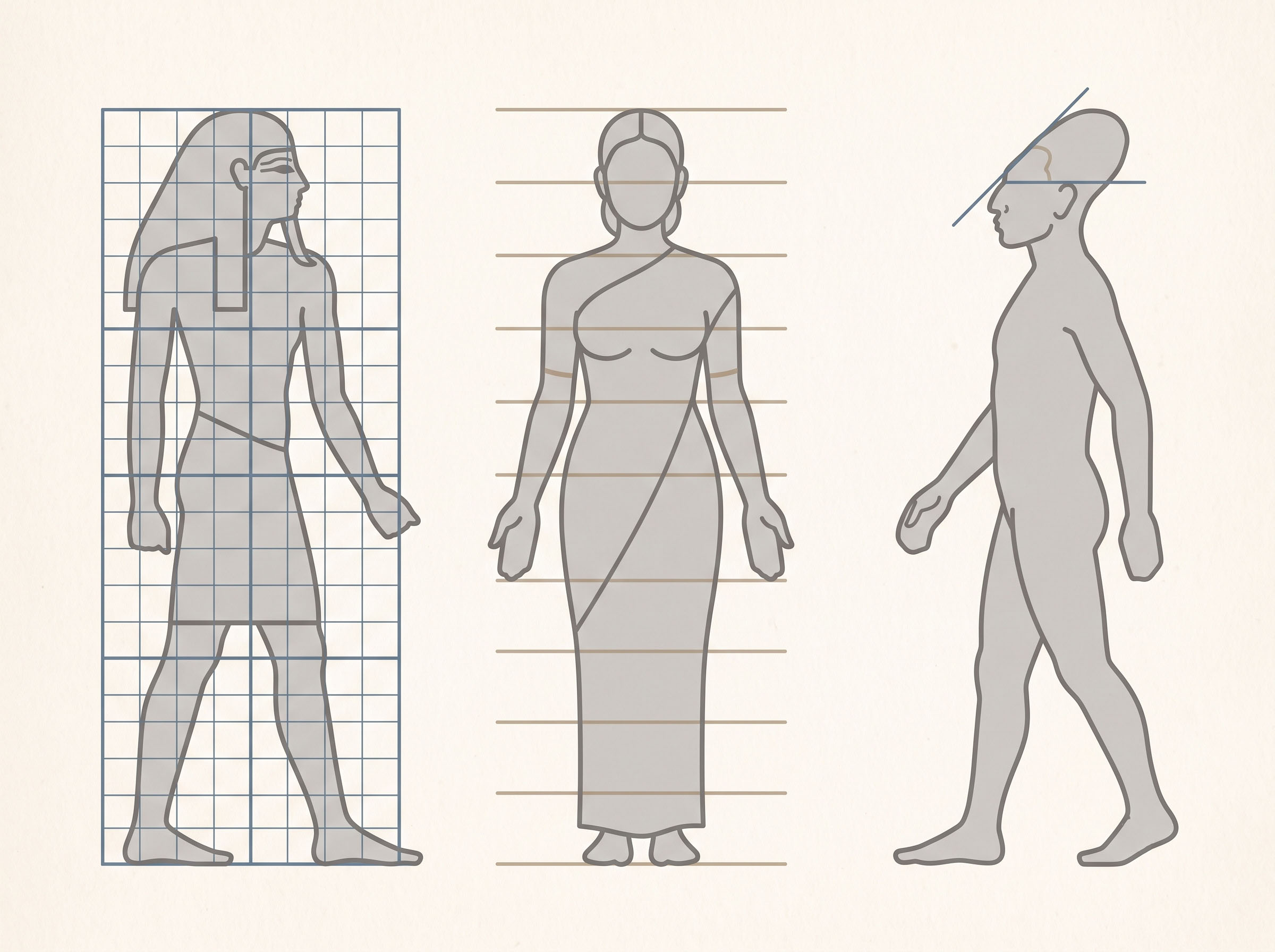
Egypt. Egyptian artists used a squared grid, drawn on the wall before the figure. Gay Robins reconstructed the system from grid lines surviving on unfinished tombs: for most of the pharaonic period the standing figure occupied 18 squares from sole to hairline, with the knee, elbow and shoulder falling on fixed lines. In the Late Period the grid was revised to 21 squares measured to the eyeline (Robins, Proportion and Style in Ancient Egyptian Art, University of Texas Press, 1994). Egyptian art also insisted on eternal youth for its subjects — while the mummies of the same individuals record ageing, dental wear and injury. Ideal and typical, preserved side by side in the same tomb. The Met's account of Greek sculpture of the Archaic period and its Egyptian debt traces how the grid tradition travelled into the early kouros figures.
South Asia. The Shilpa Shastra texts specify the tala system, in which the face-length is the module. A major deity is built to navatala, nine face-lengths; lesser and demonic figures receive fewer. The Vishnudharmottara Purana treats these as ritual requirements — an incorrectly proportioned image was not merely ugly but unfit for worship. Separately, the Kamasutra of Vatsyayana opens with a classification of men and women into three physical types each, named for animals, and discusses the pairing of those types (Vatsyayana, Kamasutra 1.2; Doniger and Kakar translation, Oxford University Press, 2002). It is a taxonomy of compatibility rather than a ranking, and it belongs to a religious-philosophical literature on the well-ordered life.
China. Early Chinese sources approach the body from an entirely different direction. The silk manuscripts recovered from the Mawangdui tombs, sealed around 168 BCE, are concerned with yangsheng — nurturing life through breath, movement, diet and timing (Donald Harper, Early Chinese Medical Literature, Kegan Paul, 1998). No proportional canon for the nude figure developed, because the nude figure was not a subject of Chinese art. The ideal body is described in terms of circulation and vitality, and is read through complexion and bearing rather than through measurement. This is a case where the absence of an artistic tradition tells you something real about the intellectual one.
Mesoamerica. Classic Maya body ideology is documented in monumental art, painted ceramics and hieroglyphic texts, and the standard scholarly treatment reconstructs a coherent aesthetic: a sloping forehead, an elongated cranial profile, inlaid teeth, and a youthful physique modelled on the Maize God (Stephen Houston, David Stuart and Karl Taube, The Memory of Bones: Body, Being and Experience among the Classic Maya, University of Texas Press, 2006). Bioarchaeology confirms this was acted upon: Vera Tiesler's survey of artificial cranial modification across Mesoamerica documents the practice in infancy across social ranks and regions (Tiesler, The Bioarchaeology of Artificial Cranial Modifications, Springer, 2014). Here, unusually, art and skeleton agree — because the population was physically shaped toward the ideal.
Fertility Symbolism, Read in Its Own Frame
Fertility imagery is one of the best-attested categories in the archaeological record, and one of the most consistently misread. Ancient sexuality was rarely a private matter of taste; it was embedded in agricultural cycles, household protection and state religion.
The Egyptian god Min was depicted ithyphallic across three thousand years of temple art, as a deity of harvest and generative power whose festival opened the growing season (Richard Wilkinson, The Complete Gods and Goddesses of Ancient Egypt, Thames & Hudson, 2003). In Shaiva tradition, the lingam functions as an aniconic sign of divine presence rather than an erotic image, and Wendy Doniger's work on the Shiva corpus traces how the symbol carries meanings of ascetic withdrawal at least as strongly as generative ones (Doniger, Śiva: The Erotic Ascetic, Oxford University Press, 1973). In each case the image sits inside a religious grammar that has to be reconstructed before the object makes sense.
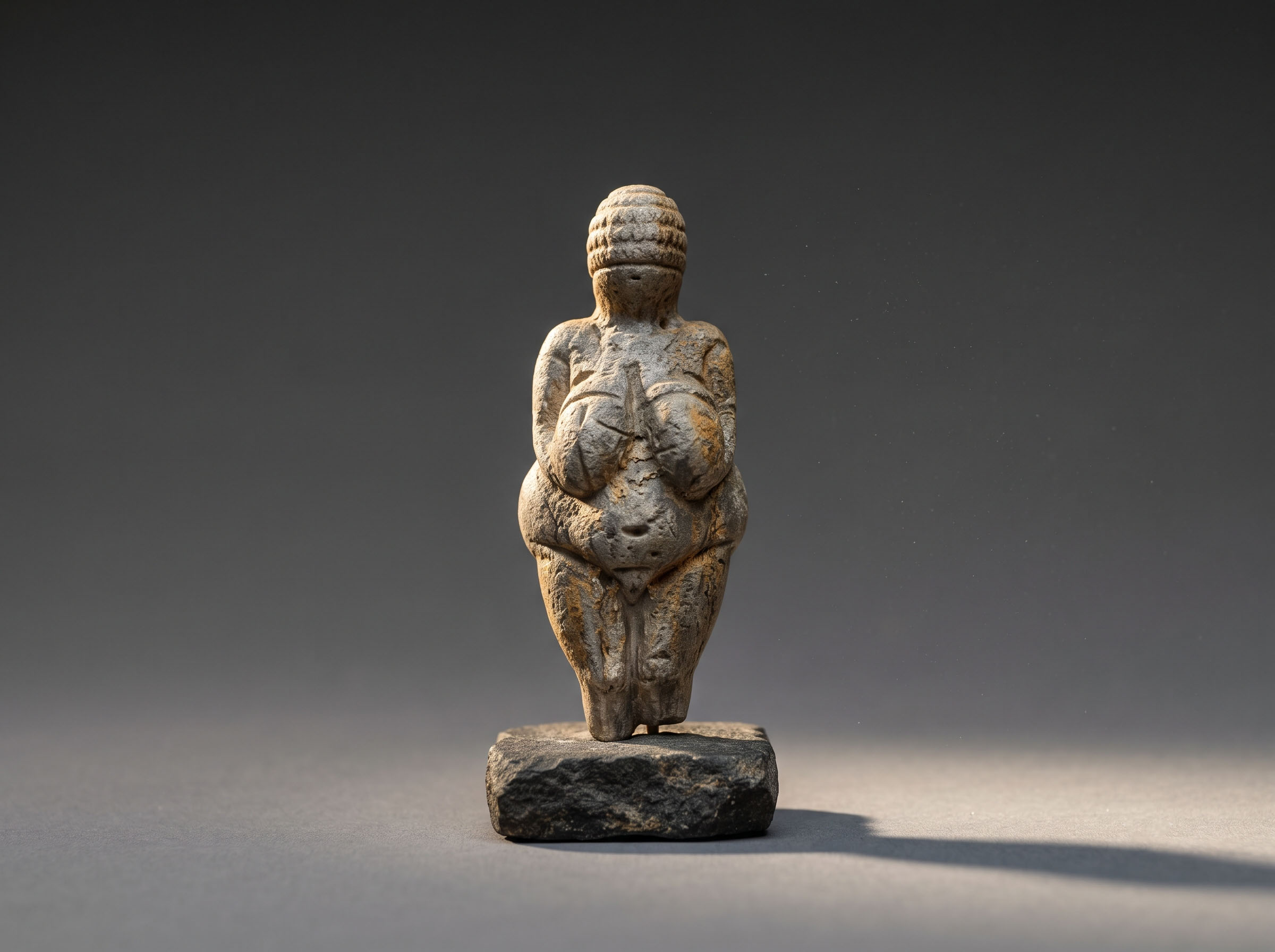
The Upper Palaeolithic figurines conventionally labelled "Venus" figures make the interpretive problem sharpest. The Willendorf figure, carved roughly 25,000 years ago and standing about 11 cm (4.3 in) tall, has been read as a fertility idol, a self-portrait, a doll and a piece of ritual equipment. Soffer, Adovasio and Hyland argued from the carved surface detail that several figurines depict woven textiles — string skirts, netted caps — which shifts the reading toward status and craft rather than body worship (Soffer, Adovasio and Hyland, "The 'Venus' Figurines," Current Anthropology 41, 2000). There is no text from that period. Interpretation is inference all the way down, and honest scholarship says so.
Did You Know?
Almost no original Greek bronze sculpture survives. Bronze was valuable and was melted down for reuse throughout antiquity and the Middle Ages, so most "Greek" statues in museums are Roman marble copies made centuries later, sometimes from other copies. Brunilde Ridgway's study of the copying industry (Roman Copies of Greek Sculpture, University of Michigan Press, 1984) showed that copyists routinely adjusted scale, added supporting struts and altered surface finish. The proportions modern viewers admire have passed through several hands before reaching the gallery.
Three Kinds of Evidence, Three Different Answers
The useful discipline in this subject is keeping the sources separate.
Texts tell us what educated men argued about, in a literary register, usually for an audience of their peers. They are opinion, and often prescriptive opinion — a writer telling readers what they ought to admire is evidence that some readers admired something else.
Art tells us what a workshop was commissioned to produce, filtered through a rule system, material constraints and the tastes of whoever paid. Greek sculpture was also painted, a fact recovered by pigment analysis and now well established, which means even the surfaces are not what they appear.
Archaeology — bone, grave goods, settlement debris — gives us a sample of a population, with all the sampling problems that implies. Cemeteries over-represent some groups and under-represent others; preservation favours certain soils; stature equations depend on which reference population is chosen.
Where these three agree, confidence is reasonable. Where they diverge, the divergence is the finding. Classical Athens produced statues far larger and more regular than the men buried in its own cemetery at the Kerameikos — and understanding why a society builds an image of itself that no member of it resembles is a more interesting question than the measurements ever were. The people who commissioned those figures were not confused about their own bodies. They were describing something they valued, in the only language available to them: proportion, scale and stone.
Editorial Glossary
- Kanon
- Greek for "rule" or "measuring rod" — the title of Polykleitos' treatise and the name given to his proportion system.
- Symmetria
- "Measured together." A shared unit running through every part of a figure, not mirror-image balance.
- Sophrosyne
- Self-command and moderation; the civic virtue Athenian art associated with an understated physique.
- Tala
- The face-length module used in South Asian image-making; navatala means nine face-lengths.
- Kouros
- An Archaic Greek standing male figure, set up as a grave marker or sanctuary dedication.
Reader Questions
Sources & Further Reading
- Angel, J. L. "Ecology and Population in the Eastern Mediterranean." World Archaeology 4 (1972).
- Dover, K. J. Greek Homosexuality. Harvard University Press, 1978.
- Harper, D. Early Chinese Medical Literature: The Mawangdui Medical Manuscripts. Kegan Paul, 1998.
- Houston, S., Stuart, D. and Taube, K. The Memory of Bones. University of Texas Press, 2006.
- Osborne, R. The History Written on the Classical Greek Body. Cambridge University Press, 2011.
- Pollitt, J. J. The Art of Ancient Greece: Sources and Documents. Cambridge University Press, 1990.
- Ridgway, B. S. Roman Copies of Greek Sculpture. University of Michigan Press, 1984.
- Robins, G. Proportion and Style in Ancient Egyptian Art. University of Texas Press, 1994.
- Soffer, O., Adovasio, J. and Hyland, D. "The 'Venus' Figurines." Current Anthropology 41 (2000).
- Stewart, A. Greek Sculpture: An Exploration. Yale University Press, 1990.
- Tiesler, V. The Bioarchaeology of Artificial Cranial Modifications. Springer, 2014.
This article is historical and anthropological in scope. Ancient physiological theories are described as intellectual history and are not accurate accounts of the human body.
Disclaimer
- All content on this website—including articles, educational materials, and interactive calculators—is for informational, educational, and entertainment purposes only. The calculations, percentiles, and outputs generated by tools on this site are based on general statistical data and mathematical models; they do not constitute medical data, a clinical assessment, or a diagnosis.
- Nothing contained on this website is a substitute for professional medical advice, diagnosis, or treatment. Always seek the guidance of a qualified healthcare professional or urologist with any questions you have regarding physical development, anatomy, or health conditions. Reliance on any information or tools provided by this website is solely at your own risk.


