


 English
 Español


Walk down almost any street in Roman Pompeii and you would meet the same image again and again — carved above a doorway, set into a paving stone, cast in bronze and hung at a shop's entrance. To a Roman eye, the phallus was not primarily an erotic picture. It sat closer to a road sign, a lucky charm, and a small act of worship all at once.
Reading these objects means setting modern assumptions aside and rebuilding the logic Romans themselves used, drawn from three kinds of evidence that do not always agree: what writers said, what artists made, and what excavation actually turns up. The same symbol ran through Greek religion in forms worth reading alongside this one, as explored in the sacred body of Dionysus and the herms.
What follows is an account of what the phallus meant in Roman culture — its protective role, its link to fertility, and the caution any student of the ancient body has to keep in mind when a work of art is mistaken for a record of ordinary life.
A God Named Fascinus
The Latin word fascinum carried a double sense. It named the phallus as an object, and it named the invisible force believed to live in it. Personified, that force became a minor deity, Fascinus. Our fullest early source is Pliny the Elder, whose Natural History (Book 28) records that the Vestal Virgins — Rome's most senior priestesses — tended the cult of Fascinus, and that an image of the god was fixed beneath the chariot of a general celebrating a triumph. Its job there was blunt and specific: Pliny calls it a remedy against envy, a medicus invidiae, guarding a man at his proudest moment against the harm that admiration itself might bring.
That protective purpose is what scholars call apotropaic — from a Greek word meaning "to turn away." An apotropaic object is designed to turn harm aside. The same instinct reached ordinary households. Freeborn Roman boys wore a locket called a bulla, which could hold a small phallic charm, worn until a boy formally came of age. Protective amulets of this kind survive in quantity; many are held in the British Museum's collection of Roman amulets and protective charms.
Did You Know?
The English word fascinate descends directly from the Latin fascinum, by way of the verb fascinare, "to bewitch." To be fascinated once meant, quite literally, to be placed under the spell the phallic charm was meant to break.
The Evil Eye and the Logic of Protection
Behind the charm sat a genuine fear. Many Romans held that envy — invidia — could be carried in a glance and could blight what it fell upon: a healthy child, a good harvest, a run of success. Protection worked by catching the dangerous gaze first. A startling or comic image drew the eye and, in doing so, drained the look of its power, sometimes by provoking laughter.
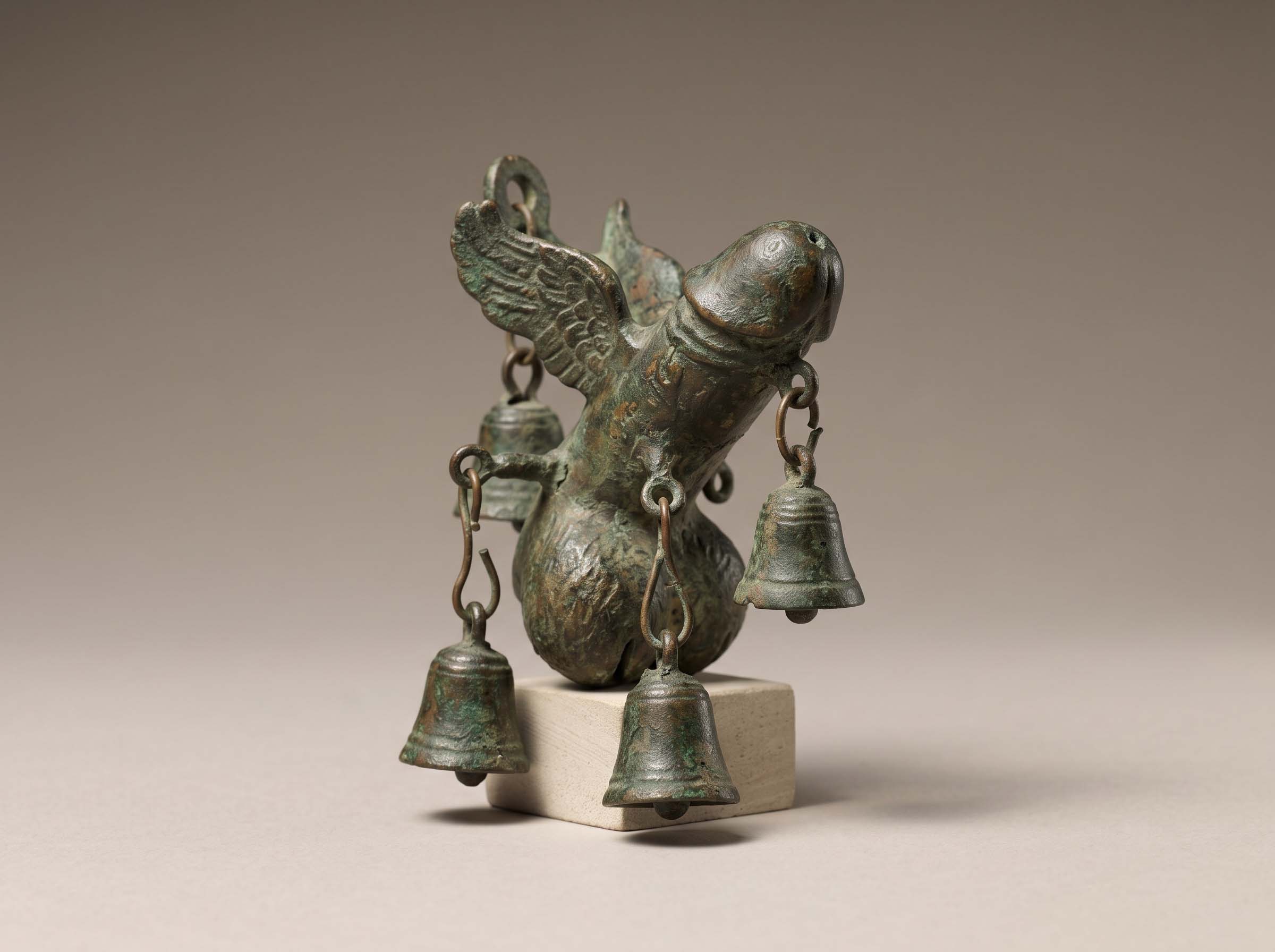
Archaeology shows how ordinary this was. Bronze wind-chimes known as tintinnabula, built around phallic figures and hung with small bells, were suspended in doorways and gardens; the sound and the image were thought to work together to keep harm out. Many were recovered from Pompeii and Herculaneum and are now held at the National Archaeological Museum in Naples. Carved phalli also appear on street corners and building walls across Pompeii. A popular claim that these pointed the way to brothels is a modern misreading — the consensus among archaeologists is that their function was protective, marking and guarding a threshold rather than advertising anything.
"The phallus over a Roman doorway was less about the body than about the boundary — a guard posted at the edge of the household against the harm a jealous eye could do."
Priapus and the Fertile Field
Protection was only one half of the picture. The other documented role was fertility and abundance, and it centered on a rustic god named Priapus. Set up in gardens as a carved guardian, Priapus was cast as both a fertility spirit and a comic scarecrow who threatened would-be thieves. A collection of anonymous Latin poems, the Priapeia, was written in his voice — bawdy, satirical, and entirely at home in Roman garden culture.
The link to prosperity is drawn plainly in the art. At the entrance of the House of the Vettii in Pompeii, a fresco shows Priapus weighing his own oversized member against a bag of money on a set of scales. Read in context, this was a greeting to visitors: a promise of wealth and plenty, placed where guests would see it first. The exaggeration is symbolic, not anatomical — a point worth holding onto.
Fertility symbolism also lived in public ritual, and here the religious framing matters most. Drawing on the earlier scholar Varro, Augustine (in The City of God, Book 7) describes a rite in central Italy honoring the god Liber, in which a phallus was carried in procession through the countryside and ceremonially crowned to secure the fertility of the fields and turn blight away from the crops. To modern readers this can look shocking; to those taking part, it was an act of worship, embedded in a religious world where sexuality and the growth of the land were understood as parts of the same divine order. Ancient sexuality nearly always sat inside a religious frame of this kind, a pattern traced across cultures in how ancient cultures constructed the idea of male desire.

Ideal Versus Typical: Reading Bodies in Ancient Art
This is where a careful reader has to slow down. Ancient art records what a culture valued, not what was measured across its population — and the two are easily confused.
Classical Greek sculpture, which Rome inherited and adapted, idealized a small, neat male form. As the classicist Kenneth Dover set out in his study of Greek attitudes, restrained genitals were associated with self-mastery and reason, captured in the Greek ideal of sophrosyne, or self-control. Large and erect forms were reserved for a different register altogether: the comic stage, satyrs, figures marked as foreign or lower in status, and Priapus himself. So the ancient record hands us two opposite conventions — the modest classical nude and the exaggerated phallic charm — and neither was ever meant as a report on the bodies of ordinary men. Both are symbolic languages. Treating a carved amulet or a temple statue as anthropometric data mistakes a value for a measurement, a distinction examined further in what Greek sculpture, philosophy, and medical texts actually say.
A Note on Method
Ancient depictions of the body — whether idealized as small or exaggerated as large — are cultural statements about status, virtue, and fortune. They cannot be read as evidence of what was typical within any ancient population. When art and measurement are confused, myth follows.
Two Functions, Side by Side
| Culture | Form or Object | Documented Purpose | Main Evidence |
|---|---|---|---|
| Rome | Fascinum amulet, tintinnabulum | Protection against envy and the evil eye | Text (Pliny) + excavated objects |
| Rome | Priapus statue, Liber procession | Fertility of fields, abundance, prosperity | Text (Augustine/Varro) + frescoes |
| India | Shiva linga with yoni base | Devotional symbol of generative, creative power | Textual (Puranas) + temple sculpture |
| Egypt | The god Min, shown ithyphallic | Harvest fertility and royal virility | Reliefs, temple records |
Beyond Rome: A Wider Pattern
Rome was not unusual in giving the phallus religious meaning, and setting it beside other ancient cultures sharpens what was specifically Roman about it.
In India, the Shaiva Hindu tradition centers on the linga, an aniconic — that is, non-representational — sign of the god Shiva, typically paired with a base called the yoni. Within its own devotional setting it stands for generative and creative power and for the formless nature of the divine; reading it as erotica misses the religious point entirely. Whether certain Indus Valley objects were early forerunners of linga worship remains debated among scholars, and the honest answer is that the archaeology is not settled. In ancient Egypt, the god Min was shown ithyphallic and honored at a harvest festival, his image tied to the fertility of the land and the vigor of the king. In parts of Mesoamerica, particularly the Puuc region of the Yucatán, carved stone phalli survive and are generally connected to fertility and rain, though with far less supporting text than Rome offers, their precise meaning stays open.
Other traditions expressed the same underlying concerns — descendants, harvest, continuity — with far less overt phallic imagery, which is itself a useful reminder. Absence of a symbol in the archaeological record is not absence of the idea; it may simply mean the idea was carried in perishable materials, in ritual, or in words that did not survive. The comparison has to respect what each culture actually left behind, referenced in the Metropolitan Museum of Art's Heilbrunn Timeline of Art History.
When the Evidence Disagrees
One habit separates good ancient history from guesswork: keeping the three kinds of evidence distinct. Written sources come mostly from the educated elite and often carry a moralizing or comic slant. Art follows conventions of the ideal and the grotesque. Archaeology shows where objects actually sat in daily life. These do not always line up.
The Roman phallus is a clean example. Surviving literature says relatively little about the humble charms hung over shop doors, yet excavation shows they were nearly everywhere. If we trusted the texts alone, we would badly underestimate how ordinary this practice was. The material record corrects the written one. Read together, the picture becomes coherent: for Romans, the phallus was a guard against envy and a blessing on fields, households, and children — a working part of religion and daily life, not the scandal a modern glance might assume.
Seen on its own terms, it tells us less about ancient bodies than about ancient fears and hopes: the wish to hold onto good fortune, and the belief that the right symbol, in the right place, could help.
Common Questions
Disclaimer
- All content on this website—including articles, educational materials, and interactive calculators—is for informational, educational, and entertainment purposes only. The calculations, percentiles, and outputs generated by tools on this site are based on general statistical data and mathematical models; they do not constitute medical data, a clinical assessment, or a diagnosis.
- Nothing contained on this website is a substitute for professional medical advice, diagnosis, or treatment. Always seek the guidance of a qualified healthcare professional or urologist with any questions you have regarding physical development, anatomy, or health conditions. Reliance on any information or tools provided by this website is solely at your own risk.


