


 English
 Español


Most ancient civilizations hand historians one kind of evidence and expect them to make do. Sometimes it is a wall of images with no explanatory text. Sometimes it is a body of literature with almost no surviving artwork.
Egypt is the rare case where three separate archives survive side by side: written documents on papyrus, a rigidly standardized artistic system, and tens of thousands of preserved human bodies. That combination allows a question that is usually unanswerable — did the bodies Egyptian artists drew have anything to do with the bodies Egyptians actually had?
The short answer, established across decades of Egyptological work, is that they did not, and were never meant to. Egyptian figure drawing was a system of meaning rather than a record of appearance (Robins 1994). The same gap appears in Greek sculpture and its accompanying medical texts, but Egypt is where researchers can actually test the gap against skeletal remains. What follows is a walk through all three archives, and through the places where they contradict one another.
In Brief
- Egyptian artists worked from a measured grid system, not from live models, for roughly 3,000 years (Robins 1994).
- Skeletal studies give stature ranges for the studied populations that sit well below the elongated proportions shown on tomb walls (Zakrzewski 2003).
- Body imagery was governed by religion and rank, so a figure's size on a wall often signals status rather than physical dimensions (Baines 2007).
- Written papyri, painted art, and physical remains regularly disagree — and the disagreements are the most informative part.
Three archives, three different kinds of truth
Each of Egypt's evidence streams was produced for a purpose that had nothing to do with informing later historians, and each carries its own distortions.
The papyri are administrative, religious, and practical documents. The Ebers Papyrus (circa 1550 BCE, held at Leipzig University Library) and the Edwin Smith Papyrus (circa 1600 BCE, translated by James Henry Breasted in 1930) record how educated Egyptians described and categorized the human body. The Kahun Papyrus, dated to roughly 1825 BCE and held in the Petrie Museum at University College London, is the oldest known document dealing specifically with women's bodies (Nunn 1996). These texts tell researchers what Egyptians thought a body was made of. They say almost nothing about what a typical body looked like.
The artwork is the opposite. It survives in enormous quantity and is visually explicit about proportion, but it was produced under strict conventions that scholars call decorum — a set of rules about who could be shown, in what posture, at what scale, and in what setting (Baines 2007). Tomb art was not documentary. It was a functioning piece of religious equipment intended to secure an eternal existence for its owner.
The human remains are the only stream that records actual bodies, and they carry the heaviest sampling bias of all. Mummification was expensive. The preserved population skews toward those who could afford it, though large cemetery excavations of working populations at sites such as Giza and Amarna have improved the picture considerably (Zakrzewski 2003).
| Evidence stream | Answers well | Answers poorly |
|---|---|---|
| Written papyri | How the body was described, named, and understood by literate specialists | Population-level dimensions; the views of the non-literate majority |
| Tomb and temple art | The ideal form, social rank, and religious meaning attached to the body | Individual likeness; typical proportions of living Egyptians |
| Mummies and skeletons | Stature, build, age at death, physical wear from labor | What Egyptians believed about those bodies; soft-tissue detail in poorly preserved remains |
The grid behind every figure
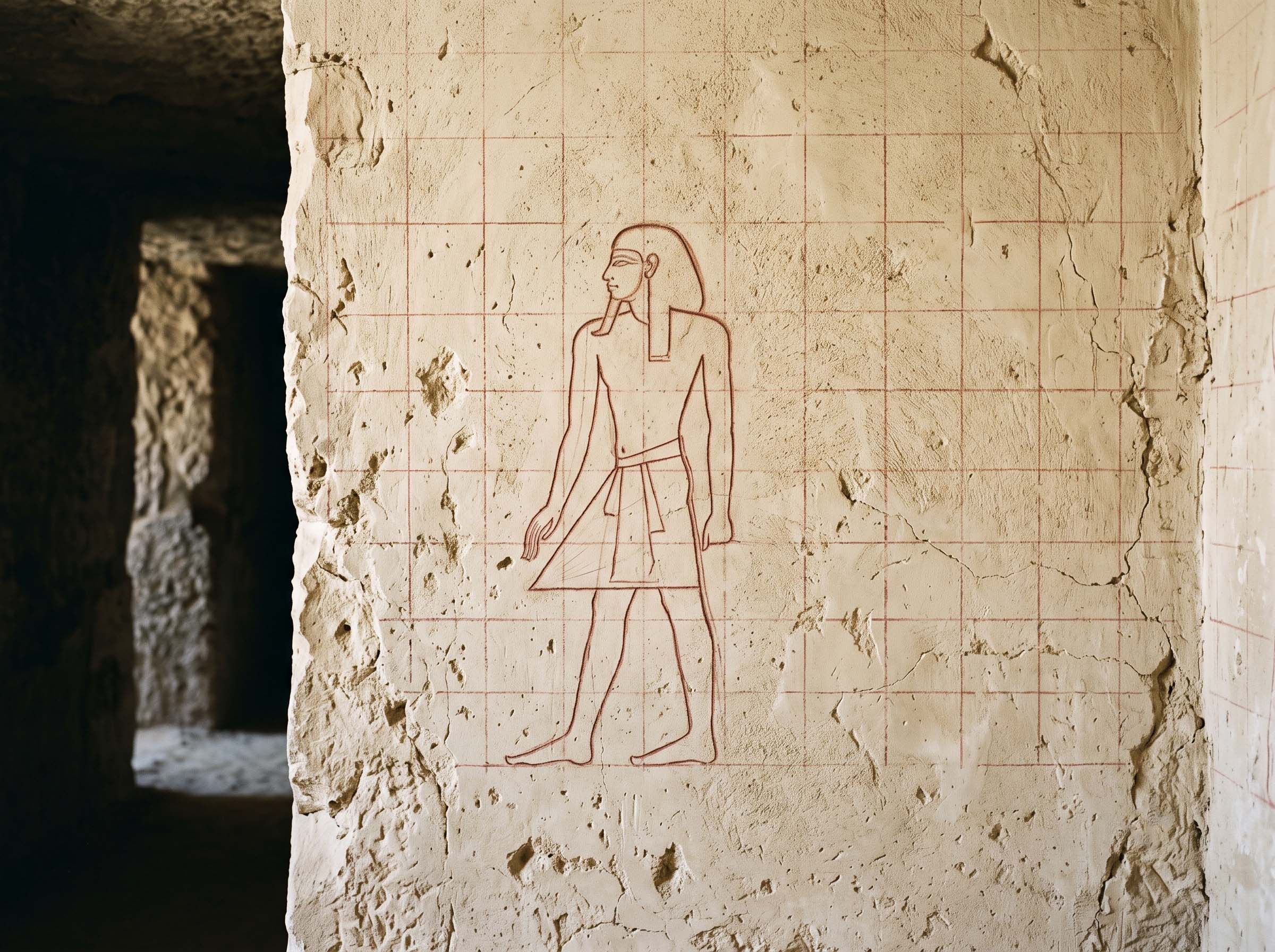
Anyone asking how ancient Egyptians measured the human body arrives quickly at one of the most durable design systems in history. From the Old Kingdom onward, artists laid a squared grid over a prepared wall surface and positioned anatomical landmarks on fixed grid lines. In the standard canon, a standing figure occupied eighteen squares from the soles of the feet to the hairline, with the knee at square six, the small of the back at eleven, and the junction of the neck and shoulders at sixteen (Robins 1994). The grid unit itself corresponded roughly to the width of a closed fist.
The consequences were profound. Two artists working generations apart in different workshops could produce nearly identical figures, which is precisely why Egyptian art looks so consistent across three millennia. It also means the proportions on a tomb wall are a mathematical construct. During the Twenty-Sixth Dynasty the system was revised to a twenty-one square grid, altering the proportions of every figure produced afterward (Robins 1994). Bodies did not change. The drawing rules did.
The 18-square canon — where the landmarks fell
Landmark positions after Robins, Proportion and Style in Ancient Egyptian Art (1994). The crown of the head sat above the grid and was not used as a reference line.
What the remains record
Skeletal research provides the reality check. Analyses of ancient Egyptian stature and body proportions across Predynastic through Old Kingdom samples report mean statures for men clustering around 165 to 170 cm (roughly 65 to 67 in) and for women around 155 to 160 cm (roughly 61 to 63 in), with meaningful variation between sites and periods (Zakrzewski 2003). Those figures sit within the studied range for other Mediterranean and North African populations of the era. They are not the long-limbed, narrow-waisted figures of the tomb walls.
Imaging technology has widened what remains can tell us. A study published in The Lancet examined 137 mummies from four ancient cultures using computed tomography, including 76 from Egypt, and documented arterial calcification in a substantial share of them (Thompson et al. 2013). Whatever else that research demonstrated, it established that non-destructive scanning can retrieve fine anatomical detail from bodies that excavators once had to cut open.
Flesh, age, and rank
One of the clearest demonstrations that Egyptian art encoded status rather than appearance involves body fat. The Old Kingdom seated statue of Hemiunu, the official who oversaw construction at Giza and now held in the Roemer- und Pelizaeus-Museum in Hildesheim, shows a heavy torso with a soft chest and a folded abdomen. The famous Louvre Seated Scribe shows something similar. These were not unflattering accidents. Visible flesh on a senior administrator communicated prosperity, a life free of manual labor, and the maturity that Egyptian society associated with sound judgment (Robins 1997).
Meanwhile the same tomb walls show laborers, foreigners, and servants with bent backs, thinning hair, and asymmetrical bodies — details the canon otherwise forbade. Deviation from the ideal form was itself a social marker, reserved for those outside the elite (Baines 2007). Historians tracing how societies have linked physical dimensions to social power tend to treat Egypt as the earliest fully documented example of the pattern.
A tomb wall was not a mirror. It was a set of instructions for eternity, and the body drawn on it was the body its owner intended to have forever.
Fertility, gods, and the renewing body
Egyptian thinking about the body cannot be separated from Egyptian religion, and this is where modern readers most often misread the evidence. Imagery that looks provocative to a contemporary eye was, in its own setting, theological.
The god Min was depicted in a permanent state of sexual readiness, standing with one arm raised, and was honored in a major state festival known as the Coming Forth of Min, at which lettuce was offered because of its association with generative power (Wilkinson 2003). No Egyptian would have read that image as erotic in the modern sense. Min represented the renewal of crops, herds, and royal succession — the continuation of life itself.
The Osiris myth carried the same logic further. Osiris is killed and dismembered; his wife Isis reassembles him and conceives their son Horus, who inherits the throne. The full narrative version most people know comes from Plutarch's De Iside et Osiride, written in Greek in the second century CE — nearly two thousand years after the Egyptian Pyramid Texts that contain the earliest fragments of the story (Griffiths 1970). Historians treat Plutarch's account with caution for exactly that reason. It is a late outsider's synthesis, not an Egyptian source.
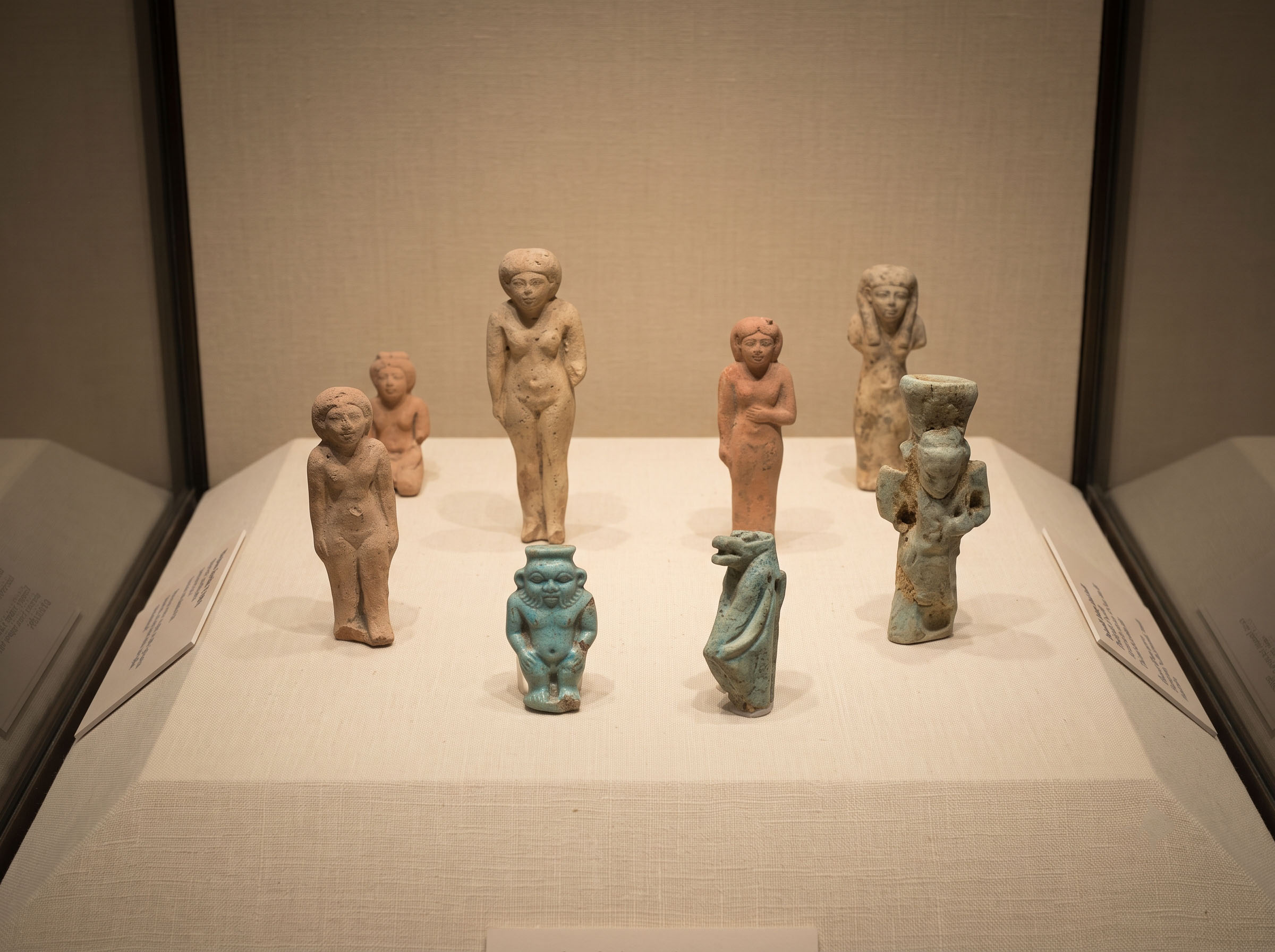
Archaeology has forced revisions of its own here. Thousands of small clay and faience female figurines recovered from temples, settlements, and tombs were labeled for much of the twentieth century as concubine figures intended to serve the male dead. Closer analysis of their find contexts has largely dismantled that reading; the figurines appear across settings that had nothing to do with male burials and served a range of ritual purposes connected to healing, protection, and childbirth (Pinch 1993; Waraksa 2009). Household deities associated with pregnancy, notably Bes and Taweret, appear on furniture, amulets, and cosmetic items throughout the domestic archaeological record (Wilkinson 2003). Fertility was not a private matter to be hidden. It was public, protective, and everywhere.
What the papyri actually record about the body
Read as historical documents rather than manuals, the papyri reveal a culture that had built a detailed vocabulary for the body long before any comparable literature existed elsewhere. The Edwin Smith Papyrus is organized as a systematic sequence of cases, arranged from head to foot, each following a consistent format of examination, assessment, and verdict — including cases the writer explicitly declines to treat (Breasted 1930; Nunn 1996). That structure, several centuries older than any Greek equivalent, tells us Egyptian specialists were categorizing and ranking bodily conditions rather than simply reciting charms.
The Berlin Papyrus records a procedure for predicting pregnancy involving barley and emmer, an example of the way Egyptian documents blended observation, ritual, and analogy without treating them as separate categories (Nunn 1996). Modern readers who sort these texts into "rational" and "magical" columns are applying a division the writers did not recognize.
The cared-for body
Physical remains and grave goods together show a culture attentive to grooming. Wigs of human hair, some elaborately constructed with plant fiber padding and beeswax setting, survive in quantity and were worn by men and women of means (Fletcher 2000). Eye cosmetics were manufactured from galena and other minerals through processes complex enough that chemical analysis identified compounds that do not occur naturally and must have been synthesized deliberately (Walter et al. 1999). Body hair removal implements appear in burials across periods.
Body modification is documented too. A relief in the Sixth Dynasty tomb of Ankhmahor at Saqqara depicts what is generally interpreted as a circumcision scene, accompanied by a short caption, and it remains among the earliest visual records of the practice anywhere (Nunn 1996). Readers interested in how that tradition spread and changed can follow the global distribution and cultural meaning of circumcision across other societies.
Did you know?
Egyptian artists almost never signed their work, and the canon was designed so that several hands could complete a single figure without any visible seam. A wall could be gridded by one craftsman, outlined by a second, carved by a third, and painted by a fourth — and still read as one continuous image (Robins 1994).
Amarna: when belief redrew the human figure
The sharpest test case arrives in the fourteenth century BCE. Under the pharaoh Akhenaten, artistic conventions changed abruptly. Royal figures acquired elongated skulls, narrow shoulders, heavy thighs, and softened abdomens. The style is unmistakable and it appears, disappears, and is deliberately erased within roughly two decades.
For much of the twentieth century, scholars proposed that the king's imagery reflected a physical condition, and various diagnoses were suggested from the artwork alone. That approach has fallen out of favor. Egyptologists now generally read the Amarna style as a theological statement rather than a portrait, connected to the reign's religious reorganization around the sun disk and the king's presentation as the source of life for his people (Robins 1994). Critically, no securely identified remains of Akhenaten have ever been confirmed to settle the question, and diagnosing an individual from stylized wall reliefs is not something the evidence supports.
Amarna is therefore the cleanest possible demonstration of this article's central point. When Egyptian ideas changed, Egyptian bodies on walls changed with them — within a single generation, and without any corresponding change in the population. Anyone studying ancient Egyptian body ideals in art is studying belief, not biology. The same interpretive caution applies to later traditions; see how it plays out in what Renaissance masters were actually depicting.
Reading Egypt on its own terms
The temptation with a civilization this well documented is to ask it modern questions: what did Egyptians consider attractive, how did they feel about their bodies, what were their standards. Those questions assume categories — individual body image, personal aesthetic preference, sexuality as an identity — that developed in specific historical circumstances and cannot be exported backward. Egyptian sources do not answer them because Egyptian writers were not thinking in those terms.
What the three archives do reveal is a society that treated the body as something to be measured, ordered, ranked, preserved, and made permanent. The grid on the wall, the cubit rod in the tomb, the careful wrapping of the dead, and the case-by-case organization of the Edwin Smith Papyrus all express the same impulse. Egypt did not idealize the body the way later cultures would. It systematized it. Three thousand years on, the system is still legible — which is more than most civilizations managed to leave behind.
Questions readers ask
Sources and further reading
- Baines, J. (2007). Visual and Written Culture in Ancient Egypt. Oxford University Press.
- Breasted, J. H. (1930). The Edwin Smith Surgical Papyrus. University of Chicago Press.
- Clagett, M. (1999). Ancient Egyptian Science, Vol. III: Ancient Egyptian Mathematics. American Philosophical Society.
- Fletcher, J. (2000). "Hair," in Nicholson, P. & Shaw, I. (eds.), Ancient Egyptian Materials and Technology. Cambridge University Press.
- Griffiths, J. G. (1970). Plutarch's De Iside et Osiride. University of Wales Press.
- Nunn, J. F. (1996). Ancient Egyptian Medicine. British Museum Press.
- Pinch, G. (1993). Votive Offerings to Hathor. Griffith Institute.
- Robins, G. (1994). Proportion and Style in Ancient Egyptian Art. University of Texas Press.
- Robins, G. (1997). The Art of Ancient Egypt. Harvard University Press.
- Thompson, R. C., et al. (2013). "Atherosclerosis across 4000 years of human history." The Lancet, 381(9873), 1211–1222.
- Walter, P., et al. (1999). "Making make-up in Ancient Egypt." Nature, 397, 483–484.
- Waraksa, E. A. (2009). Female Figurines from the Mut Precinct. Academic Press Fribourg.
- Wilkinson, R. H. (2003). The Complete Gods and Goddesses of Ancient Egypt. Thames & Hudson.
- Zakrzewski, S. R. (2003). "Variation in ancient Egyptian stature and body proportions." American Journal of Physical Anthropology, 121(3), 219–229.
- Collection references: the British Museum online collection and the Metropolitan Museum of Art's Heilbrunn Timeline of Art History.
Disclaimer
- All content on this website—including articles, educational materials, and interactive calculators—is for informational, educational, and entertainment purposes only. The calculations, percentiles, and outputs generated by tools on this site are based on general statistical data and mathematical models; they do not constitute medical data, a clinical assessment, or a diagnosis.
- Nothing contained on this website is a substitute for professional medical advice, diagnosis, or treatment. Always seek the guidance of a qualified healthcare professional or urologist with any questions you have regarding physical development, anatomy, or health conditions. Reliance on any information or tools provided by this website is solely at your own risk.


