



 English
 Español


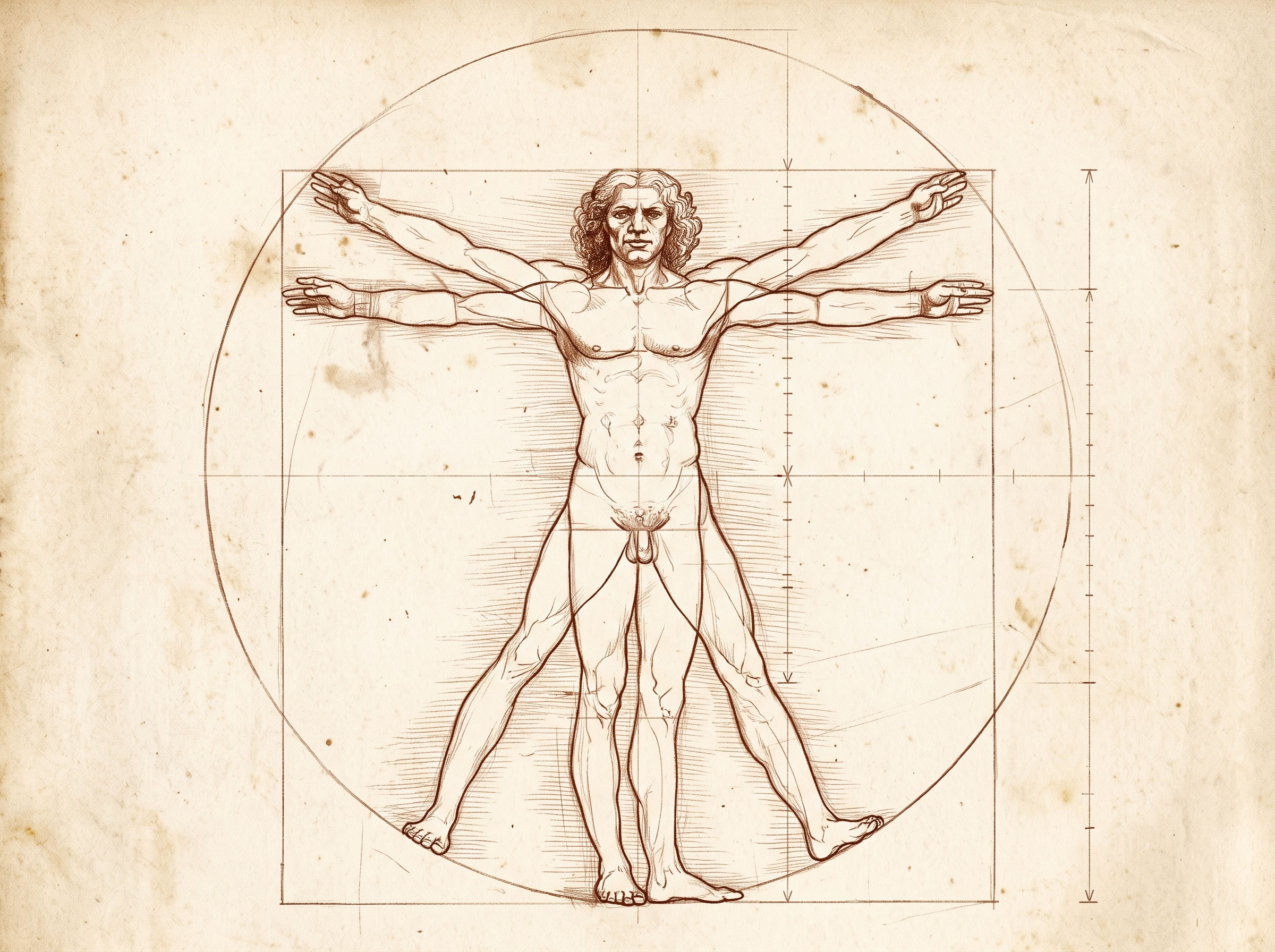
Almost everyone recognizes the drawing: a man with four arms and four legs, stretched inside a circle and a square, staring out from posters, textbooks, and the Italian one-euro coin. Far fewer people know what Leonardo's Vitruvian Man was for — or what it was, and was not, claiming about the human body.
It is not a portrait. It is not a survey of how men in fifteenth-century Italy were actually shaped. It is a diagram of an ideal: a proposal about how a perfectly proportioned figure ought to sit inside geometry.
That single distinction — between the ideal a work of art constructs and the typical body of the society that produced it — sits at the heart of Renaissance body ideals in art history. It is worth following through Leonardo, Michelangelo, and the sculptors and painters around them, because it also connects directly to how the ancient Greeks idealized the human form — the tradition the Renaissance believed it was reviving. Keep the distinction in view and the famous works stop being a mystery and start being an argument.
A drawing about geometry, not anatomy
The Vitruvian Man, drawn in pen and brown ink around 1490 and measuring just 34.4 by 24.5 centimeters (13.5 by 9.6 inches), takes its name from Vitruvius, the Roman architect whose treatise De architectura proposed in its third book that a well-built man could fit inside both a circle and a square. Vitruvius wanted the human figure as a source of proportion for buildings; he set the ideal body at eight head-lengths tall. Several Renaissance artists — Francesco di Giorgio Martini and Giacomo Andrea da Ferrara among them — tried to picture that idea and produced awkward results. Leonardo solved it by quietly shifting the center of the circle to the navel and the center of the square to the groin, so one figure could occupy both shapes.
Here is the part most reproductions never mention. According to the Gallerie dell'Accademia in Venice, which has held the sheet since the nineteenth century, Leonardo's actual measurements follow Leon Battista Alberti's treatise De statua more closely than Vitruvius's Latin, which Leonardo probably could not read directly. In other words, the drawing everyone treats as a fixed law of nature is a scholar's synthesis — Vitruvius, Alberti, and Leonardo's own observation, blended into a rule. It is a canon: a proposal about ideal proportion, not a measurement of real men. Because the sheet is so sensitive to light, it is rarely put on display, which has only added to its aura.
"A canon is a picture of the perfect body a culture wanted. It is never a headcount of the bodies it actually had."
The ideal had a pedigree
Leonardo was not inventing the idea of a perfect body; he was joining a very old argument. In fifth-century-BCE Greece, the sculptor Polykleitos wrote a lost treatise called the Kanon ("rule") and carved a bronze statue, the Doryphoros or Spear-Bearer, around 440 BCE to demonstrate it. The original bronze is gone, known only through Roman marble copies, but the point survives in the ancient sources: the Doryphoros was never meant to depict a particular man. Scholars describe it as an idealized composite of every man — a body built from a single unit of measure, each part in ratio to the next. The Greek word for that harmony was symmetria, and the physician Galen, writing in the second century AD, praised the statue as its perfect expression.
The numbers were never fixed, which is itself instructive. Polykleitos favored a figure of roughly seven heads tall; the later sculptor Lysippos preferred a leaner eight; Vitruvius wrote eight; the ancient Egyptians had used a squared grid for the same purpose centuries earlier. Different cultures kept adjusting the ideal to suit their own taste. When Renaissance Rome began digging antique statues out of its own soil — most famously the Apollo Belvedere — artists absorbed that inheritance directly. Michelangelo's beardless, athletic Christ in the Last Judgment is often traced to the pose and physique of the Apollo Belvedere. So when we ask what these artists were "actually depicting," the honest answer is: a revived classical ideal, wearing Christian and civic clothes.
Cutting to see: Renaissance anatomy
None of this means Renaissance artists ignored real bodies. They studied them intensely — but in service of the ideal, not as a replacement for it. Alberti had told painters in Della pittura (1435) to construct a figure the way nature does: bones first, then muscles, then the skin laid over the top. Leonardo took that instruction further than anyone. He performed his own dissections — by his own account roughly thirty bodies — and left several hundred sheets now kept at Windsor. The most concentrated group, his Anatomical Manuscript A of about 1510, holds some 240 drawings and roughly 13,000 words of notes. You can browse Leonardo's surviving anatomical studies today and see an accuracy that outran the medical texts of his own century.
Michelangelo dissected too, and it shows in the strained, powerful musculature of his figures. Yet here a documented convention exposes the gap between study and reality with unusual clarity: Michelangelo frequently built his female figures on male bodies. The muscular women of the Sistine ceiling — the Libyan Sibyl is the classic example — were drawn from male models and only lightly feminized. Deep anatomical knowledge, in other words, was poured into an idealizing formula, not used to record how women were typically shaped. If you want to know how bodies genuinely vary and develop, that is the province of the science of measuring real bodies — a different enterprise from the art of composing an ideal one.
David: composed, not copied
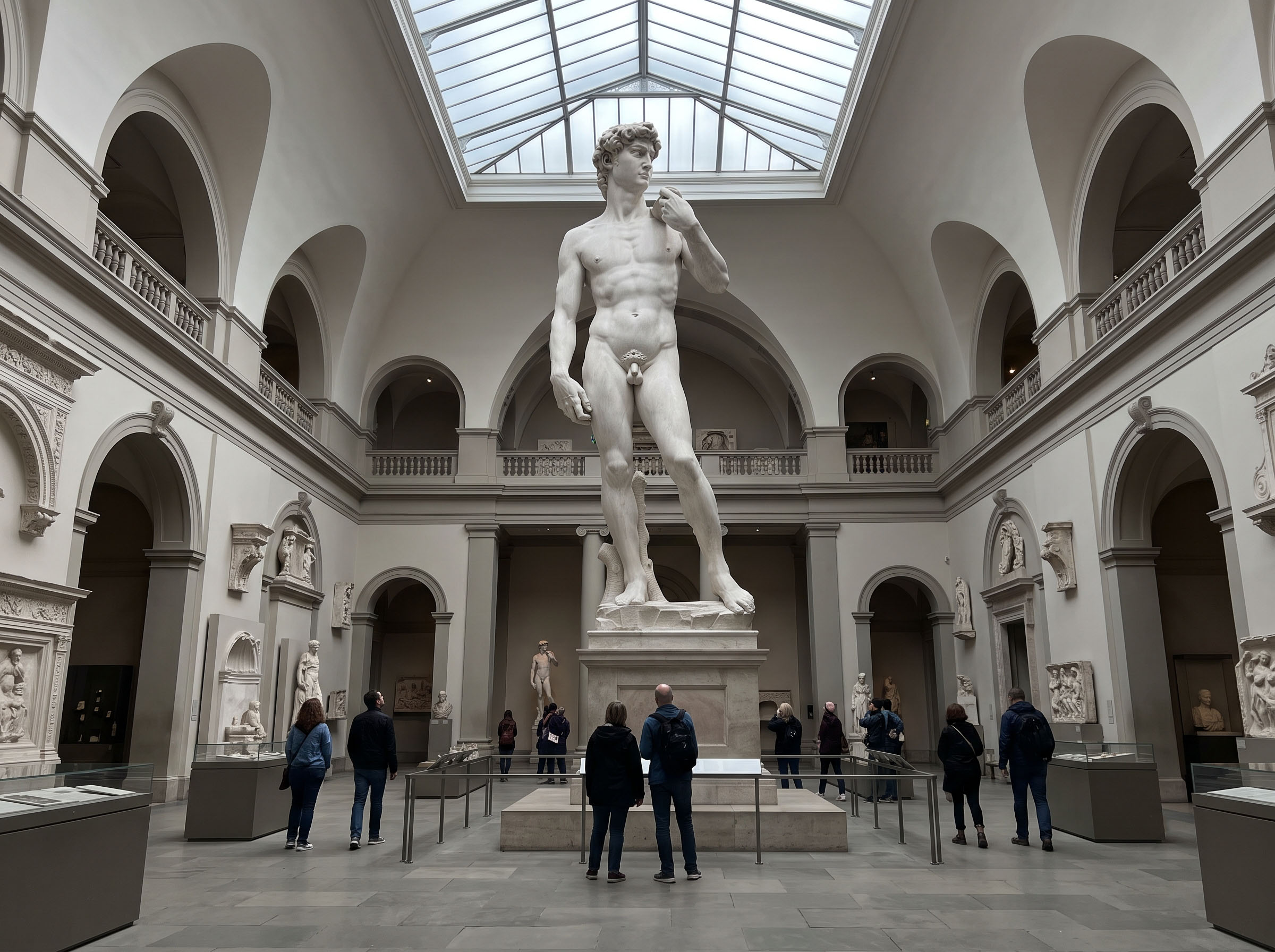
Consider the body most people would name as the perfect one. Michelangelo carved David from a single block of Carrara marble between 1501 and 1504. It stands 5.17 meters tall — nearly 17 feet, a shade under 16 feet 11 inches — and art historians describe it as the first colossal marble figure carved in the High Renaissance, and the first on that scale since antiquity. Since 1873 it has stood under a purpose-built skylight in the Galleria dell'Accademia in Florence.
And it is, on purpose, not anatomically faithful. The head is too large for the body, and the right hand is conspicuously oversized. The Accademia itself notes these departures. The most cited explanations are practical and symbolic at once: the statue was first meant to sit high on the roofline of Florence Cathedral, seen from far below, where a larger head and hand would read correctly; and the enlarged hand — the "hand of action" — carries the meaning of the moment before David strikes. Either way, the lesson holds. The most admired body in Western art is a composed object, adjusted for viewpoint and message. It was never a faithful map of a real young man. That is not a flaw in the work; it is the whole nature of an ideal.
One Species, Many Ideals: How Traditions Have Pictured the Body
| Tradition | Rough period | What the ideal body signified | Anchor work / example |
|---|---|---|---|
| Ancient Egyptian | c. 2600 BCE onward | Order and permanence, set by a squared grid | Tomb and temple relief figures |
| Classical Greek | 5th c. BCE | Mathematical harmony (symmetria); athletic virtue | Doryphoros, Polykleitos |
| Italian Renaissance | c. 1490–1541 | Revived classical proportion joined to Christian and civic meaning | Vitruvian Man; David |
| Chandela India | c. 950–1050 CE | Fertility, abundance, cosmic wholeness | Khajuraho temple sculpture |
| Japanese ukiyo-e | c. 1600–1900 | Elegance drawn through line and pattern rather than modeled volume | Prints by Utamaro, Hokusai |
Periods are approximate and drawn from museum and art-historical sources listed at the foot of this article.
Every culture built its own ideal
Set the traditions side by side and the biggest claim of this piece becomes hard to argue with: there is no single, universal "ideal body." Each culture engineered its own and encoded its own values in it. The Greek ideal prized athletic ratio. The Indian temple ideal, seen across the walls of Khajuraho, prized abundance and fertility, giving its celestial women a fullness the Greek canon would never have chosen. In Japan, the woodblock masters of the ukiyo-e school — Utamaro, Hokusai, Moronobu and their peers — described the body through flowing outline and patterned surface rather than the sculpted muscle of the Mediterranean tradition. Three cultures, three utterly different "correct" bodies, each one certain it had found the right one.
Treating these traditions with equal seriousness matters, because the Western canon can otherwise pass itself off as simple truth. It is not truth; it is a preference — a very sophisticated, very influential preference, but a preference all the same. And nothing exposes a culture's preferences faster than what it later decides to hide.
What gets covered tells its own story
Censorship is a second layer of authorship, and it reveals a society's anxieties as sharply as any commission. The clearest case is Michelangelo's own Last Judgment, painted on the altar wall of the Sistine Chapel between 1536 and 1541. Its mass of nude figures scandalized reformers, and in 1563 the Council of Trent condemned "lasciviousness" in religious art. Within a year of Michelangelo's death, the painter Daniele da Volterra was set to work adding draperies and loincloths over roughly forty figures — earning him the lasting nickname Il Braghettone, "the breeches-maker." Later centuries piled on still more coverings. We know what was lost because Cardinal Farnese had a full copy made by Marcello Venusti in 1549, before the campaign began; it now hangs in Naples. When the chapel was restored between 1980 and 1994, conservators removed about half of the added drapery and deliberately left the rest — a visible record of the censorship itself.
The same pattern repeats across cultures and centuries. In Japan, shunga — the frank "spring pictures" produced by many of the same celebrated print masters — were officially banned in 1722, yet circulated for generations with the authorities mostly looking away. The heavier suppression came in the twentieth century, partly out of a wish not to look permissive to Western eyes; only in 2013 did the British Museum give the genre a major scholarly exhibition and restore its standing as art. What a society covers, and when, maps its shifting boundaries far more honestly than any official statement of taste.
The same questions, in new media
The idealizing project did not end with marble and fresco; it changed materials. The retouched fashion photograph, the sculpted film hero, the digitally smoothed body on a screen — each is a direct descendant of the Polykleitan canon. They are composed ideals, assembled from choices about lighting, pose, and proportion, presented as if they were ordinary reality. The technology is new; the move is ancient. Seen in that long line, from cave walls to the camera, today's images look less like a modern problem and more like the latest chapter in a very old habit of picturing the body we wish for rather than the one we have. It is the same story traced in how humans have depicted the body from cave art to photography.
Which returns us to where we began, and to the one habit of mind worth carrying out of any museum. A painting or a statue is superb evidence of what a society idealized, argued over, and eventually chose to cover. It is poor evidence of how the people in that society were actually built. For that, you do not look at art — you measure. The Vitruvian Man answers a question about geometry and desire. It was never meant to answer a question about you.
- Canon
- A set of rules for ideal proportion that artists follow — a standard of beauty, not a measurement of real people.
- Symmetria
- The Greek principle of harmony, where every part of a figure relates in ratio to every other part and to the whole.
- Contrapposto
- A relaxed standing pose with the weight on one leg, shifting the hips and shoulders — used to make a still figure look alive.
- Chiaroscuro
- The modeling of form through strong contrasts of light and shadow.
- Ukiyo-e
- "Pictures of the floating world" — the Japanese woodblock print tradition of roughly 1600 to 1900.
Questions Readers Ask
- Gallerie dell'Accademia di Venezia — catalogue entry, Study of the Proportions of the Human Body (Vitruvian Man).
- Encyclopædia Britannica — "Why Is It Called the Vitruvian Man?" and entry on David.
- Galleria dell'Accademia di Firenze — official artwork record for Michelangelo's David.
- Royal Collection Trust — "Leonardo's Study of Anatomy"; and The Metropolitan Museum of Art — Leonardo anatomical drawings catalogue.
- Vatican Museums restoration literature and the Council of Trent (1563) decree on religious imagery; Daniele da Volterra ("Il Braghettone").
- The British Museum — Shunga: Sex and Pleasure in Japanese Art (2013), curated by Tim Clark.
- UNESCO World Heritage Centre — Khajuraho Group of Monuments.
- Victoria and Albert Museum — "The Story of Michelangelo's David" and the "Fig Leaf for David."
- On the classical canon: sources on Polykleitos's Kanon and the Doryphoros, and Galen's second-century account of symmetria.
Disclaimer
- All content on this website—including articles, educational materials, and interactive calculators—is for informational, educational, and entertainment purposes only. The calculations, percentiles, and outputs generated by tools on this site are based on general statistical data and mathematical models; they do not constitute medical data, a clinical assessment, or a diagnosis.
- Nothing contained on this website is a substitute for professional medical advice, diagnosis, or treatment. Always seek the guidance of a qualified healthcare professional or urologist with any questions you have regarding physical development, anatomy, or health conditions. Reliance on any information or tools provided by this website is solely at your own risk.


