


 English
 Español


In a limestone cave in the Swabian Jura of southern Germany, an archaeological team lifted six fragments of carved mammoth ivory out of the dirt in September 2008. Assembled, they formed a female figure roughly 6 cm (2.4 in) tall, headless, with a small carved ring where a head might have been — a loop for a cord.
Nicholas Conard, who published the find in Nature in 2009, dated the carving to at least 35,000 years ago, which made it the oldest known figurative depiction of a human being.
The Venus of Hohle Fels is not a portrait. Nobody looked like that. Its proportions are deliberate, emphatic, and impossible — and that single observation is the most useful tool anyone can carry into a museum. Art tells us what a society wanted to see, admired, feared, or used in ritual. It is a far less reliable guide to what the men and women of that society actually looked like. The gap between those two things is where art history gets interesting, and it is a distinction that runs through every tradition covered here, from Paleolithic ivory to the retouched photograph. Readers who have followed our coverage of how culture shaped the ideal male body will recognise the pattern in a different register.
In Brief
- The oldest known human figure — the Venus of Hohle Fels — is roughly 6 cm (2.4 in) tall and at least 35,000 years old.
- Most historic body imagery follows a canon: a set of proportional rules, not a record of observed anatomy.
- Egypt used a squared grid; Greece used head-height ratios; Indian temple workshops used the Shilpa Shastra texts.
- Censorship history — added draperies, detachable fig leaves, banned prints — reveals as much about viewers as the art reveals about bodies.
- Photography promised objectivity and then produced its own conventions, from Muybridge's grids to digital retouching.
Ice Age Figures and the Problem of Interpretation
The best-known of the Paleolithic figures is the Venus of Willendorf, an oolitic limestone carving about 11 cm (4.3 in) high, held by the Naturhistorisches Museum in Vienna and generally dated to around 30,000 years ago. She has a patterned head covering, no facial features, heavy breasts and abdomen, and legs that taper away without feet. Analysis published in Scientific Reports in 2022 by Gerhard Weber and colleagues, using high-resolution micro-computed tomography, matched her stone to deposits hundreds of kilometres away in northern Italy — evidence that the object, or the people carrying it, travelled a long way.
What the figure meant is still argued. The nineteenth-century assumption that these were fertility idols has been challenged repeatedly. In a much-discussed 1996 paper in Current Anthropology, LeRoy McDermott proposed that the distortions match what a woman sees when she looks down at her own body — foreshortened chest, prominent abdomen, vanishing feet — suggesting self-representation rather than an external ideal. Other researchers have argued for ritual objects, teaching aids, or personal charms. The honest position is that a small carved object without written context supports several readings and confirms none.
What we can say is narrower and more useful: the carvers were selecting. Faces are omitted, torsos are amplified. Selection is the signature of convention, and convention is the thread that connects a 35,000-year-old ivory pendant to a fashion photograph.
Egypt: The Body as a Grid
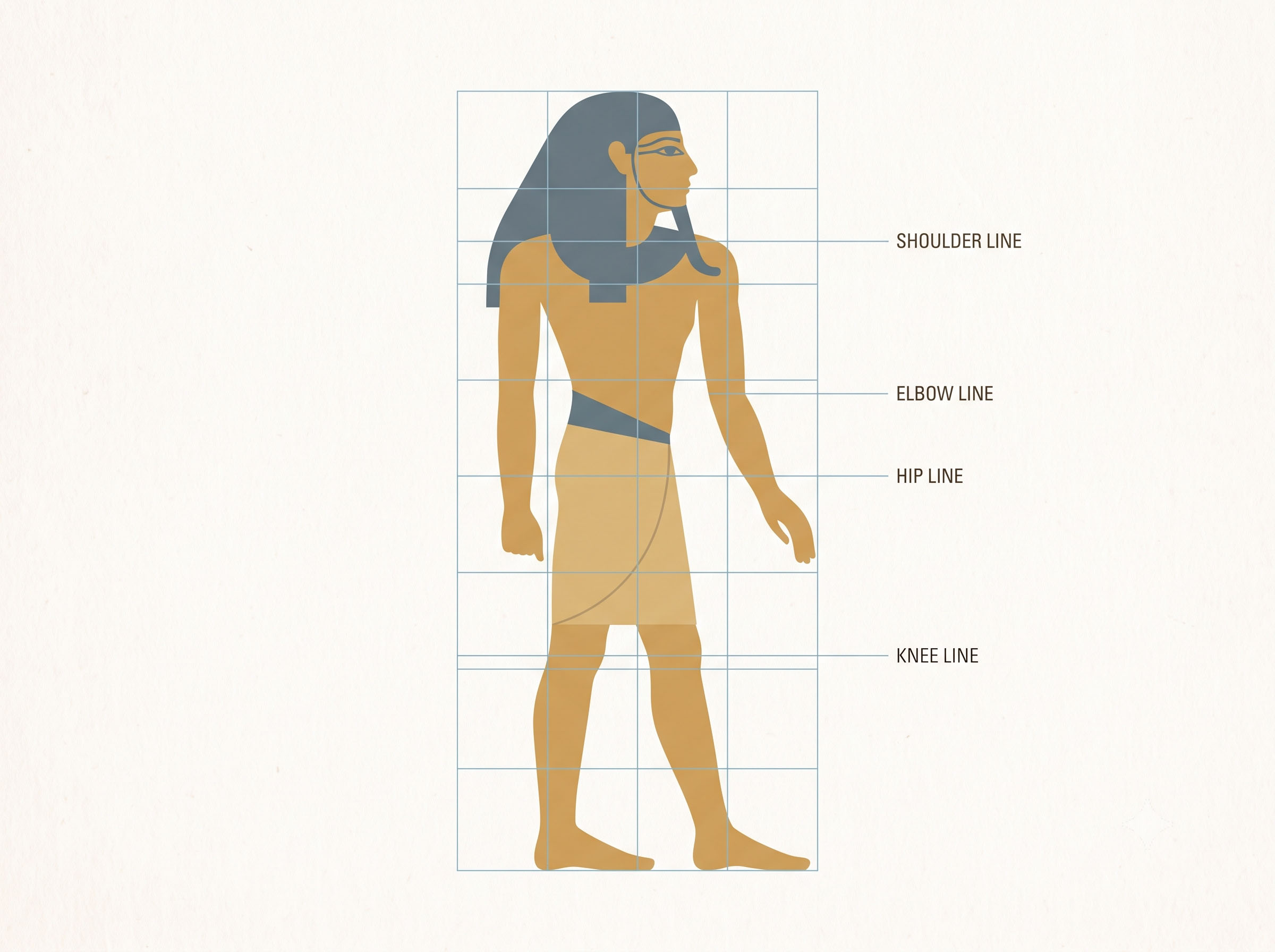
By the Old Kingdom, Egyptian workshops had turned proportion into arithmetic. Gay Robins, in Proportion and Style in Ancient Egyptian Art (1994), documents the squared grid drawn onto tomb walls before figures were painted: eighteen squares from the soles of the feet to the hairline for a standing figure, with the knee, the buttock, the elbow and the shoulder each assigned to a fixed line. In the Late Period the system was revised to twenty-one squares, a change visible on unfinished walls where the grid survives beneath the paint.
The consequence is that an Egyptian noble and an Egyptian labourer are drawn from the same template, differentiated by dress, scale and gesture rather than by build. Where variation does appear — the folded rolls of an ageing scribe, the exaggerated bodies of foreign captives — it is doing rhetorical work. It signals status, age or otherness. It is not life drawing.
Greece and the Invention of the Ideal
The Greek achievement was to make the constructed body look observed. Polykleitos of Argos, working around 440 BCE, produced both a bronze statue and a written treatise, each called the Kanon. The treatise is lost and survives only through later quotation, including by the physician Galen; the statue survives through Roman marble copies, the best known being the Doryphoros in the Museo Archeologico Nazionale in Naples. Andrew Stewart's Greek Sculpture: An Exploration (1990) sets out how the figure's weight-shift — one leg engaged, one relaxed, hip and shoulder answering each other in opposite diagonals — produces an effect of unforced life while every measurement is governed by ratio.
Kenneth Clark drew the distinction that art historians still use in The Nude: A Study in Ideal Form (1956): the naked body is the body deprived of clothes, while the nude is a form of art, a body reorganised into an image. The Doryphoros is emphatically a nude. His torso carries a musculature that no living athlete presents in repose.
The convention extended to genital representation, and it ran opposite to modern assumption. Kenneth Dover, in Greek Homosexuality (1978), set out the visual grammar clearly: heroic and athletic figures in classical Greek sculpture and vase painting are given small, unaroused genitals, while satyrs, slaves and figures of comic ridicule are given large and prominent ones. Restraint was the aesthetic virtue being depicted. Anyone using classical statuary as a data point about ancient bodies is reading a moral code and mistaking it for a measurement — a confusion we examined at length in our feature on why societies linked size with power.
Classical sculpture does not record what Greek men looked like. It records what Greek viewers thought self-control looked like.
Traditions Outside Europe
The Western canon is one branch among several, and not the oldest or the most systematic. Indian temple workshops worked from the Shilpa Shastra texts, which prescribe measurements in units derived from the figure's own face and finger widths, along with the characteristic three-bend tribhanga posture. The temples at Khajuraho, built by the Chandela dynasty between roughly 950 and 1050 CE and inscribed as a UNESCO World Heritage Site in 1986, carry bands of sculpted figures across their outer walls. Devangana Desai, in The Religious Imagery of Khajuraho (1996), reads the celebrated erotic panels not as social documentary but as placed imagery — positioned at junctions in the temple structure, doing symbolic and protective work within a religious scheme.
In Japan, the woodblock genre known as shunga flourished from the seventeenth to the nineteenth century, produced by the same artists who made landscapes and actor prints, including Utamaro and Hokusai. The 2013 British Museum exhibition catalogue edited by Timothy Clark, Shunga: Sex and Pleasure in Japanese Art, makes the interpretive point plainly: the anatomical exaggeration in these prints is pictorial emphasis, a compositional device for directing the eye, in the same family as the oversized hands and faces used elsewhere in the tradition. Reading shunga as anatomical reportage is a category error.
African figurative sculpture works with a different set of ratios again. Nok terracottas from central Nigeria, dated from around 500 BCE to 200 CE, and many later West and Central African wood sculptures, render the head at roughly a quarter to a third of the total figure height. Curatorial scholarship at institutions including the Metropolitan Museum of Art treats this as a conceptual proportion — the head as the seat of identity, destiny and thought — rather than a failure of observation. Every one of these traditions had access to the same reference material as every other: living human beings. Each chose to depart from it in a specific, learnable direction.
Table 1. What each tradition depicts — and what it does not tell us
| Tradition & period | Governing rule | What the image asserts | Evidential limit |
|---|---|---|---|
| Upper Paleolithic Europe, c. 35,000–25,000 BP | Selective amplification; faces omitted | Emphasis on torso and reproductive form | No written context; several readings remain open |
| Dynastic Egypt, c. 2600 BCE onward | 18-square grid (later 21 squares) | Order, rank, permanence | Build is templated; deviation signals status, not physique |
| Classical Greece, 5th–4th c. BCE | Head-height ratios; the lost Kanon | Athletic restraint and civic virtue | Genital convention is moral code, not measurement |
| Central India, c. 950–1050 CE | Shilpa Shastra units; tribhanga posture | Sacred symbolism at structural junctions | Panels are placed by scheme, not drawn from life |
| Edo Japan, 17th–19th c. | Pictorial emphasis within woodblock design | Direction of the viewer's eye; humour; narrative | Exaggeration is compositional, not descriptive |
| Nok & later West African sculpture | Head at c. one quarter to one third of height | Head as seat of identity and destiny | Conceptual ratio; carries no anthropometric content |
| Moche Peru, c. 100–800 CE | Modelled vessel types for burial | Ancestry, fluids, ritual time | Made for the grave; not a portrait of the living |
| Photography, 1839–present | Lens choice, pose, lighting, retouching | Apparent objectivity | Every stage of production is a set of decisions |
The Renaissance Argument About Measurement
Two figures define the period's approach, and they disagreed. Leonardo's pen-and-ink Vitruvian Man, drawn around 1490 and held by the Gallerie dell'Accademia in Venice, is an illustration of a passage in Vitruvius's De architectura, Book III, which claims that a well-proportioned man fits both a circle and a square. Leonardo made the geometry work by shifting the centres — the square is centred on the groin, the circle on the navel. The drawing is an argument about cosmic order expressed through anatomy.
Michelangelo's David, carved between 1501 and 1504 and now in the Galleria dell'Accademia in Florence, stands 5.17 m (17 ft) tall, with hands and head enlarged relative to the body — a correction for a figure originally intended to sit high on the cathedral roofline. It is an ideal engineered for a viewing angle.
Albrecht Dürer went the other way. His Four Books on Human Proportion, published in Nuremberg in 1528, the year after his death, abandoned the search for a single perfect figure and instead catalogued a range of body types — short, tall, heavy, slight — each with its own worked-out set of measurements. Erwin Panofsky, in his study of Dürer, treated this as the moment the ideal fractured into a survey. It is the closest the pre-modern period comes to anthropometric thinking, and it sits directly upstream of the measurement practices covered in our material on developmental anatomy and growth.
Infographic
One body, five rulers
How many head-heights tall is a figure? Each tradition answered differently — and none of the answers came from measuring a population.
Head-height ratios are drawing conventions recorded in treatises and studio manuals. They describe how figures were constructed on the page, not the stature of any studied population.
What Got Covered Up, and Why It Matters
Censorship leaves a documentary trail, and that trail is often more informative than the artwork it targeted. After the Council of Trent issued its decree on sacred images in 1563, the painter Daniele da Volterra was commissioned to add draperies to figures in Michelangelo's Last Judgment in the Sistine Chapel, work that earned him the nickname Il Braghettone — the breeches-maker. The alterations were the Church's, not the artist's, and later restorations have removed some but not all of them.
Three centuries on, the same instinct produced a smaller and stranger object. The V&A's plaster cast of Michelangelo's David, given to Queen Victoria in 1856 by Leopold II of Tuscany and passed to the South Kensington Museum in 1857, was fitted with a detachable plaster fig leaf, hung on two hooks for visits by royal women and last used in the time of Queen Mary. It survives in the museum's collection with its own accession number and its own catalogue entry at the Victoria and Albert Museum.
Japan produced its own version of the same story. Erotic woodblock books were restricted under the Kyōhō-era publishing edicts of the 1720s and again under the Tenpō Reforms of the 1840s, which pushed production underground without ending it. In the United States, the Comstock Act of 1873 made it a federal offence to send obscene material through the mail, a definition broad enough to reach anatomical texts and reproductions of paintings.
Did you know?
The V&A's fig leaf was never attached permanently. It hung from two hooks set into the cast, was kept in storage between uses, and is now displayed in a case at the back of David's plinth — an exhibit about Victorian viewing habits rather than about Michelangelo. The museum records it as made in about 1857, probably by the London cast-makers D. Brucciani & Co.
The Camera Promised Objectivity
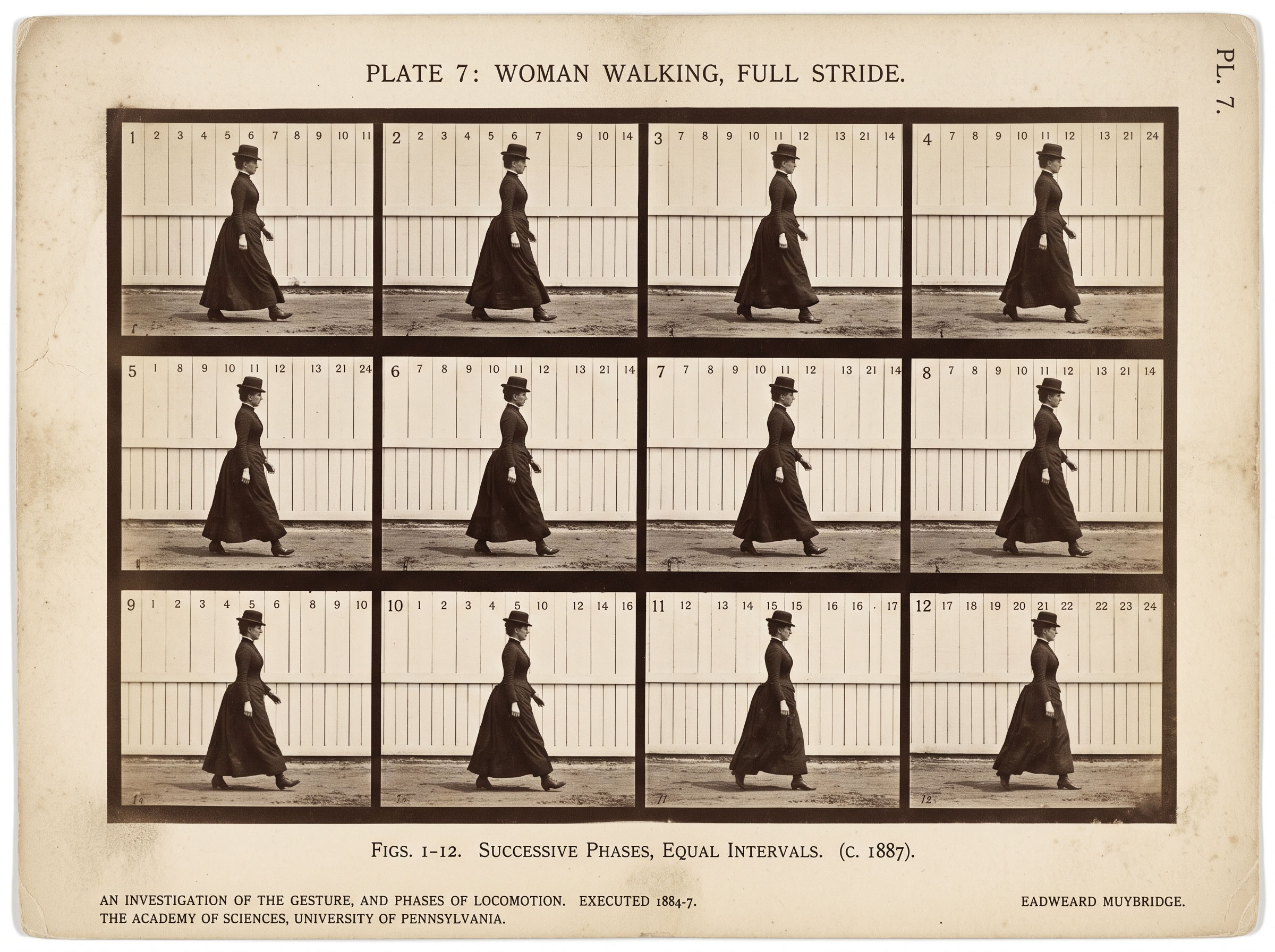
Photography arrived in 1839 with the implicit claim that it would settle the question. A lens does not idealise. Eadweard Muybridge tested that claim at the University of Pennsylvania, publishing Animal Locomotion in 1887: 781 collotype plates of humans and animals in sequential motion, men and women walking, lifting, climbing and throwing, most of them photographed against a measured grid backdrop. Marta Braun's Picturing Time (1992) demonstrated that Muybridge nonetheless edited — selecting, reordering and occasionally substituting frames to produce sequences that read more cleanly than the originals. The grid behind the figures announced measurement while the darkroom quietly restored composition.
Thomas Eakins, painting The Swimming Hole in 1885 from his own photographic studies, is the transitional case: a painter using the camera as a notebook and then composing the finished picture in the older manner. The twentieth century split the difference. Edward Weston's nudes of the late 1920s and 1930s treat the body as pure form. Diane Arbus, working in the 1960s, refused idealisation on principle. Rineke Dijkstra's Beach Portraits, made between 1992 and 1998, photographed adolescents standing at the waterline in a flat, frontal, large-format style whose apparent neutrality is itself a considered choice.
Then retouching went digital, and the constructed body returned with a speed the fig-leaf makers would have envied. Several governments have since legislated in response: Israel passed a law in 2012 restricting the use of underweight models and requiring disclosure of digital slimming in advertising, France introduced a requirement in 2017 that commercially retouched images be labelled photographie retouchée, and Norway amended its Marketing Act in 2021 to require disclosure on retouched advertising. The wheel closes. An image culture that began with an ivory carving whose proportions no one possessed now regulates the labelling of photographs whose proportions no one possesses.
How to read a body in art
Four questions that separate what an artwork depicts from what it can tell us about the men and women who made it:
- What was it for? A burial vessel, a temple wall and an advertisement have different obligations to accuracy — which is to say, none of them have any.
- Is there a canon behind it? Grids, ratios and treatise-based rules mean the figure was generated before it was observed.
- Who was allowed to see it? Restricted viewing changes what an artist can put in the frame.
- What survived, and why? Durable materials and protected collections skew the record toward elite and ritual objects.
The Same Question, Still Open
Across forty thousand years, four continents and every available medium, the pattern holds. Human beings have never simply recorded bodies. They have edited them — through grids, ratios, sacred texts, studio conventions, draperies, fig leaves, darkroom selection and retouching software — and they have done it consistently enough that the editing itself becomes the historical evidence. A carved figurine, a temple panel, a woodblock print and a magazine cover all answer the same question: what should a body look like in an image? None of them answers the different question of what bodies actually looked like. Holding those two questions apart is the whole discipline in a sentence, and it is worth carrying into the next gallery you walk through.
Reader Questions
Sources & further reading
- Conard, N. J. "A female figurine from the basal Aurignacian of Hohle Fels Cave in southwestern Germany," Nature 459 (2009): 248–252.
- Weber, G. W. et al. "The microstructure and the origin of the Venus from Willendorf," Scientific Reports 12 (2022).
- McDermott, L. "Self-Representation in Upper Paleolithic Female Figurines," Current Anthropology 37, no. 2 (1996).
- Robins, G. Proportion and Style in Ancient Egyptian Art. University of Texas Press, 1994.
- Stewart, A. Greek Sculpture: An Exploration. Yale University Press, 1990.
- Clark, K. The Nude: A Study in Ideal Form. Bollingen / Princeton University Press, 1956.
- Dover, K. J. Greek Homosexuality. Duckworth, 1978.
- Desai, D. The Religious Imagery of Khajuraho. Franco-Indian Research, 1996.
- Clark, T. et al., eds. Shunga: Sex and Pleasure in Japanese Art. British Museum Press, 2013.
- Weismantel, M. "Moche Sex Pots: Reproduction and Temporality in Ancient South America," American Anthropologist 106, no. 3 (2004).
- Panofsky, E. The Life and Art of Albrecht Dürer. Princeton University Press, 1943.
- Braun, M. Picturing Time: The Work of Etienne-Jules Marey. University of Chicago Press, 1992.
- Victoria and Albert Museum, "Fig Leaf for David," museum no. REPRO.1857-161:A.
Disclaimer
- All content on this website—including articles, educational materials, and interactive calculators—is for informational, educational, and entertainment purposes only. The calculations, percentiles, and outputs generated by tools on this site are based on general statistical data and mathematical models; they do not constitute medical data, a clinical assessment, or a diagnosis.
- Nothing contained on this website is a substitute for professional medical advice, diagnosis, or treatment. Always seek the guidance of a qualified healthcare professional or urologist with any questions you have regarding physical development, anatomy, or health conditions. Reliance on any information or tools provided by this website is solely at your own risk.


