



 English
 Español


In February 1838, a young officer of the Bengal Engineers named T. S. Burt left his assigned route in central India because the men carrying his palanquin told him there was something worth seeing in the forest. What he found, and reported later that year to the Asiatic Society of Bengal, was a group of abandoned sandstone temples whose outer walls were covered from plinth to spire in carved human figures.
Burt was impressed by the architecture and unsettled by the sculpture. The account he published set the terms of the conversation for the next century and a half — a conversation about a religious monument that has been conducted, more often than not, in the vocabulary of scandal.
That reception history is worth pausing on, because it repeats. The same nineteenth-century reflex that reduced Khajuraho to its most startling panels also shaped how Western collectors first sorted and suppressed the Japanese woodblock tradition of shunga, and the pattern is instructive. What a culture chooses to crop, cover, or catalogue as obscene tells you a great deal — usually more about the cataloguer than the object.
So it is worth setting the scandal aside and asking the art historian's question instead: what were these walls for, who put the figures there, and what did the men who commissioned them think they were doing?
In Brief
- The Khajuraho temples were built by the Chandela dynasty of Bundelkhand at the height of its power, roughly 950 to 1050 CE.
- Around 85 temples once stood on the site; about twenty survive today, spread across three groups and belonging to two religions, Hinduism and Jainism.
- Erotic imagery makes up less than a tenth of the sculptural program, according to the art historian Devangana Desai, who spent a career studying it.
- The figures follow a written proportional canon. They record an ideal of beauty held by a court elite — not a survey of what tenth-century bodies looked like.
What the Chandelas Built, and When
The Chandelas were a regional power in the Bundelkhand region of what is now Madhya Pradesh, rising to independence from the Gurjara-Pratihara overlords they had once served. UNESCO's World Heritage listing dates the dynasty's apogee to the century between 950 and 1050 CE, and records that only about twenty of the temples remain, divided into Western, Eastern and Southern groups and shared between Hindu and Jain dedications. The site was inscribed on the World Heritage List in 1986.
The earliest fully developed temple on the site is the Lakshmana, dedicated to a three-headed form of Vishnu called Vaikuntha. An inscription fixes its dedication to 954 CE. It was commissioned by the Chandela ruler Yashovarman, who died before it was completed; his son Dhanga finished and dedicated it. Art historians read the building as a political document as much as a devotional one — a new dynasty announcing that it now held territory it had recently taken.
The largest of the surviving temples, the Kandariya Mahadeva, was raised roughly a century later under the ruler Vidyadhara and dedicated to Shiva. Britannica describes it as an assembly of porches and turrets standing about 31 metres (102 feet) high, its principal spire supported by dozens of smaller ones stepping up around it. The original temple town covered somewhere near 21 square kilometres (8 square miles).
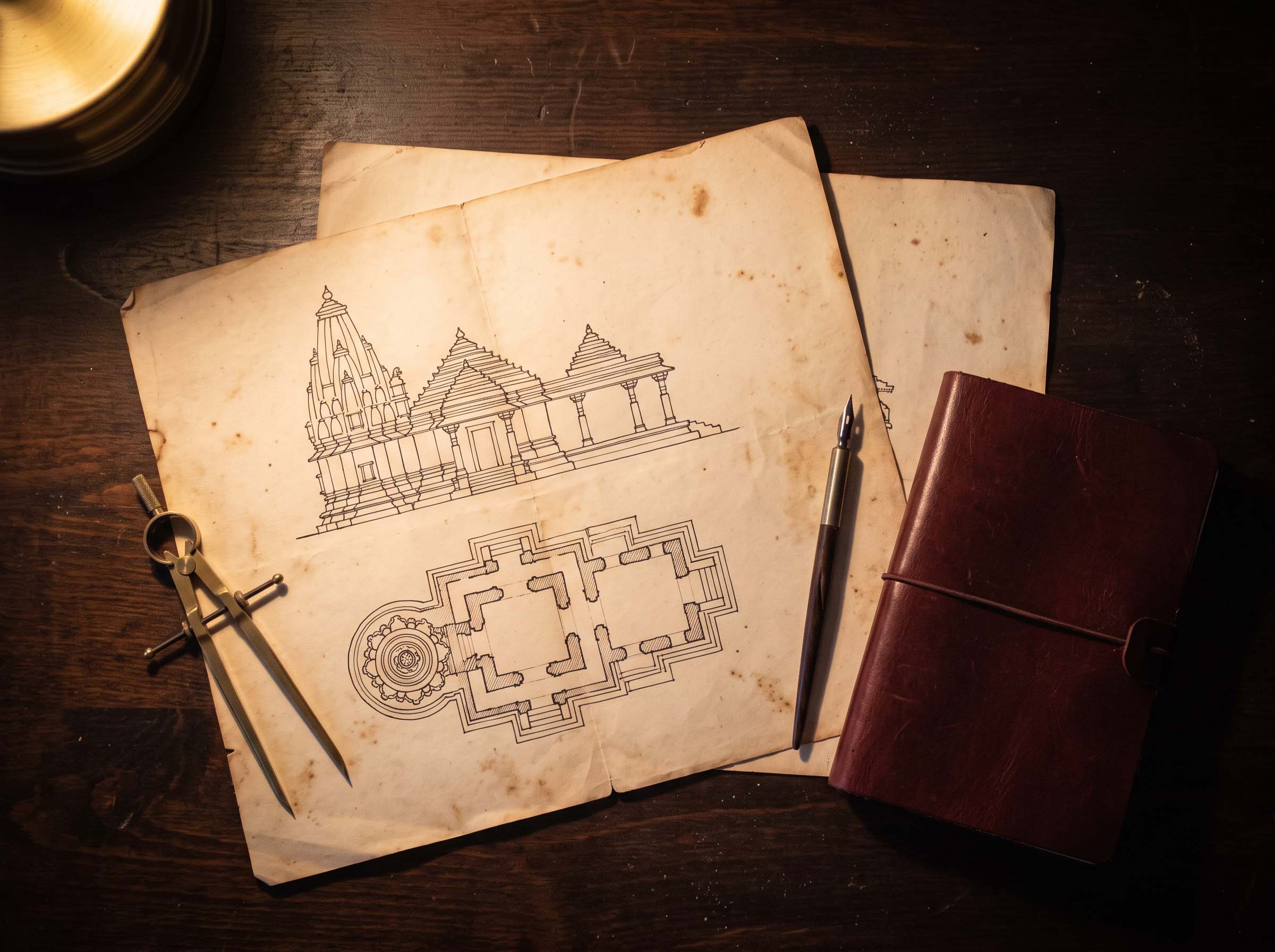
Architecturally these are Nagara temples, the northern Indian type. The vocabulary is worth learning, because the placement of sculpture on the building is the whole argument. A Nagara temple has a garbha griha — literally a womb chamber — a small, dark, windowless sanctuary holding the principal image. Above it rises the shikhara, the spire, named for a mountain peak. In front of it sit one or more mandapas, pillared halls that the worshipper passes through on the way in. The whole structure stands on a high plinth, and worshippers circle it clockwise before entering.
The Canon Came First, the Body Second
Here the methodological point that governs this entire subcategory has to be made plainly, because Khajuraho is the site where readers are most tempted to forget it.
Indian temple sculpture of this period was produced under written instruction. The shilpa shastras — treatises on making — laid out proportional systems for the human figure, prescriptions for the face, the torso, the limbs, and rules for what kinds of figures a temple should carry. Vidya Dehejia, in her survey of Indian art for Phaidon, describes these texts as the starting point for an apprentice's training and the guarantee of a consistent workshop standard. Her assessment of what the tradition valued is unambiguous: individual experimentation was discouraged, the repetition of an idealized formula was prized, and naturalism was not a valued concept.
That last clause should be pinned to the wall of every discussion of these carvings. The sculptors were not observing. They were executing a specification.
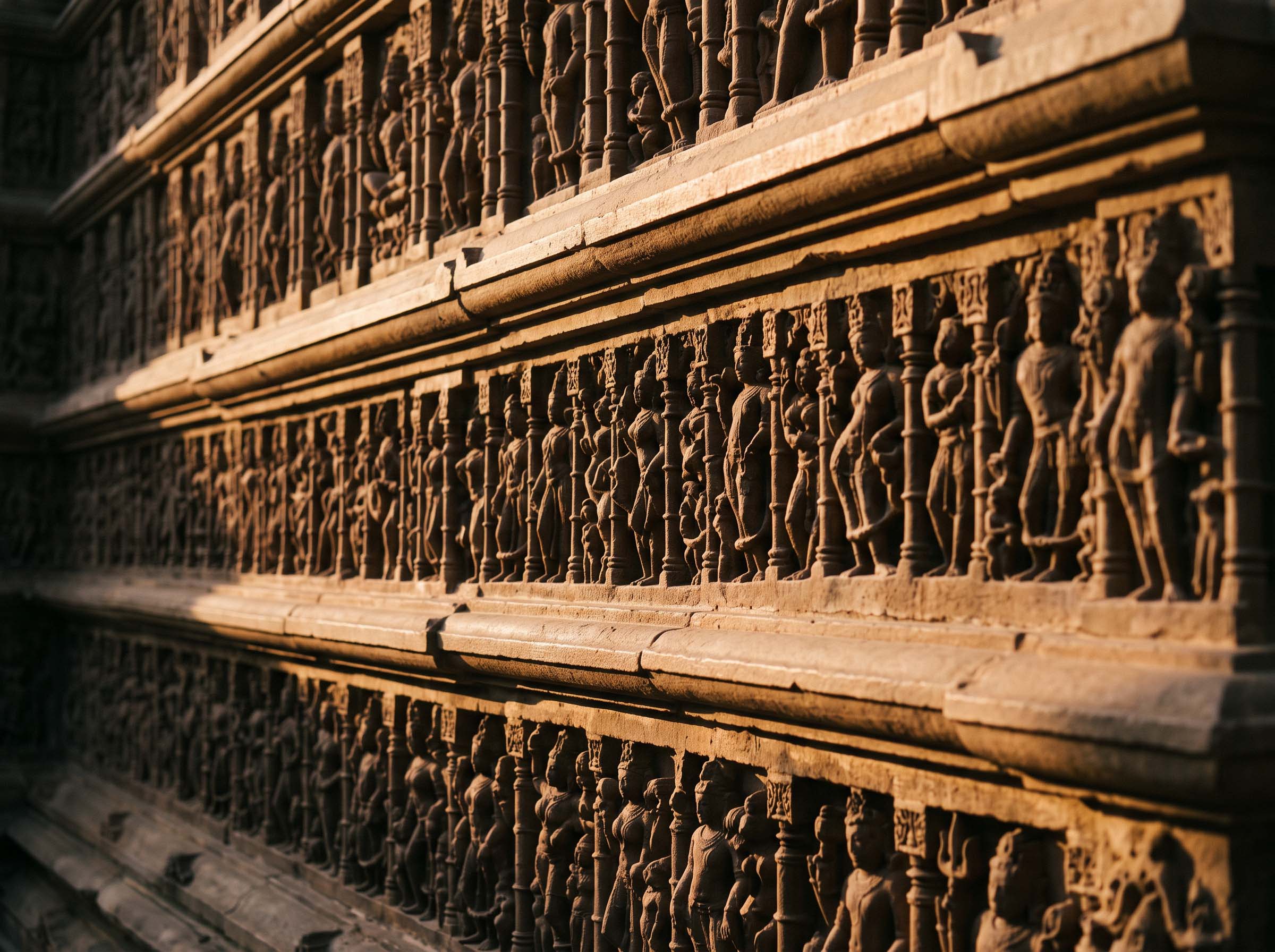
You can see the specification working. The Smarthistory entry on the Lakshmana temple, written by Dr. Cristin McKnight Sethi, describes a celebrated figure on the northwest exterior wall — a woman turning to show a thorn in her foot — and catalogues the conventions her face obeys: a face round like the full moon, a slender nose, arched brows and eyes shaped like lotus petals. Those are not observations of a particular woman. They are the standing similes of Sanskrit court poetry, transposed into stone. The same face appears again and again across the site, and across other temple sites hundreds of miles away, because the workshops were working from the same instructions. Dehejia notes elsewhere that these shared conventions make it frequently impossible to tell one artist's work from another's within a single workshop.
The bodies follow the same logic. The characteristic pose is tribhanga, the triple bend — hip thrust one way, torso the other, head returning — a posture chosen for its rhythm on a wall, not because anyone stood like that. Torsos taper to improbable waists. Shoulders are narrow, limbs long and smooth, musculature suppressed in favor of an unbroken surface. Greek sculptors of the classical period were pursuing a different ideal through a comparable system of proportional rules; readers can follow that thread in our survey of ancient Greek body ideals in sculpture and philosophy. Both traditions produced bodies. Neither produced data.
The Rule We Apply to Every Article in This Section
A carved body is evidence of what a society admired, commissioned and could afford to have made. It is not evidence of what bodies in that society typically looked like. Sculptural canons exaggerate deliberately, and the direction of the exaggeration is the historically interesting part. Khajuraho tells us what the Chandela court considered beautiful and auspicious. It tells us nothing measurable about the men and women of tenth-century Bundelkhand.
What Is Actually on the Walls
The figures on a Khajuraho temple are sorted into types, and the types are named. Deities occupy the cardinal niches. Guardians of the directions hold the corners. Below and around them come the surasundaris — celestial women — and their variants: apsaras, the dancers of heaven; salabhanjikas, women entwined with trees; nayikas, women of the mortal world. Along the plinth run narrative friezes of processions, hunts, armies, musicians and workshops, some of which appear to record Chandela-period events.
And then there are the mithunas — amorous couples — and the smaller number of maithuna panels showing sexual union. These are the carvings that made the site famous, and the proportion matters. Devangana Desai, whose Religious Imagery of Khajuraho (1996) remains the standard scholarly account, states in her Oxford University Press volume on the site that the erotic images, powerful as they are, constitute less than one-tenth of the sculpture found there.
Nine-tenths of Khajuraho is gods, guardians, dancers, animals, foliage, soldiers and cooks. The visitor who comes for one thing looks past almost all of it.
Composition of the Khajuraho Sculptural Program
Scholarly estimate, not a panel-by-panel count. After Devangana Desai, Khajuraho (Oxford University Press, Monumental Legacy series).
Placement Is the Argument
Where a figure sits on the building carries meaning, and this is where the scholarship gets genuinely interesting.
The erotic panels are not scattered at random. On the Lakshmana temple they cluster on the exterior juncture wall — the seam where the sanctuary block meets the hall block. The architectural historian Michael Meister argued in a 1979 article in Artibus Asiae that this placement is a visual pun: the joint in the building is marked by joined figures. Sanskrit court culture of the period was saturated in double meaning, and Desai's central argument in Religious Imagery of Khajuraho is that the temples were built by and for an elite that delighted in exactly this kind of encoded wordplay, with the sculpture operating on the same register as the punning verse of the temple inscriptions themselves.
The celestial women had a stated function too. The Shilpa Prakasha, a ninth-century architectural treatise, goes so far as to declare a monument without a surasundari inferior and fruitless. A later text instructs that these figures be shown with the gaze cast downward rather than meeting anyone's eye. Beautiful women on a temple wall were understood as auspicious and protective, associated with fertility, growth and prosperity — architectural insurance, in effect, rather than ornament.
Not every interpretation has survived scrutiny equally well. A long-running reading connects the erotic panels to Kapalika Tantric practice, which was present in the region during Chandela rule and which held that a practitioner could pass through the appetites of the senses rather than around them. Smarthistory raises the obvious objection: those practices were esoteric, disapproved of by wider society, and generally conducted in secret — which sits awkwardly with the idea that their central imagery would be carved on the outside of a building for every passing pilgrim to see. Other scholars read the panels through the four aims of Hindu life, the purusharthas, in which kama — desire — is one legitimate stage among four, positioned on the outer wall precisely because the worshipper walks past it on the way to the dark sanctuary at the center.
Art history is argument, not caption-writing. The honest position is that competent scholars disagree, that the material supports more than one reading, and that the single reading we can rule out is the one Burt reached for first: that the sculpture is there to titillate.
The sculptors were not observing. They were executing a specification — and the specification is the historical evidence.
Reading the Wall: A Field Guide
| Figure type | Where it sits | Understood function |
|---|---|---|
| Principal deity (e.g. Vaikuntha Vishnu, Shiva) | Inside the garbha griha, the dark sanctuary | The object of worship; the physical and symbolic core of the building |
| Subsidiary deities and guardians of the directions | Cardinal niches and corners of the exterior | Orientation and protection; Ganesha marks the correct start of the clockwise circuit |
| Surasundari / apsara / salabhanjika | Wall recesses, pillar brackets, register bands | Auspiciousness, fertility, prosperity; required by treatise, not optional decoration |
| Mithuna and maithuna panels | Concentrated on the juncture wall between sanctuary and hall | Contested. Read variously as architectural punning, symbol of union and release, or Tantric reference |
| Narrative friezes | Along the plinth, at the level of the approaching worshipper | Processions, armies, hunts, daily life; some appear to record Chandela-period events |
What Censorship Recorded
The reception history of Khajuraho is a case study in how obscenity judgments preserve their own moment.
Burt's 1838 report was followed by repairs commissioned by the local maharaja of Chhatarpur in the 1840s, and then by the systematic surveys of Alexander Cunningham, later the first director-general of the Archaeological Survey of India, who visited from 1852 onward, produced the first detailed plans, and drew the distinction between the western and eastern groups that guidebooks still use. Cunningham's archaeology was rigorous. His aesthetic verdict was not: he judged the sculptures indecent and, for the most part, disgustingly obscene.
Cunningham was recording a Victorian response, not a property of the stone. The temples had been visited continuously by local worshippers throughout their supposed period of oblivion — Cunningham himself reported that yogis were still using them and that thousands arrived on pilgrimage for the spring festival of Shivaratri. Nobody in that congregation appears to have needed the walls explained or apologized for.
The twentieth century inverted the judgment without necessarily improving the analysis. Indian nationalist writers reclaimed the temples as proof of a confident pre-colonial civilization, and the site became a point of pride rather than embarrassment. Tapati Guha-Thakurta has traced how these arguments about art, obscenity and the nude carried forward into contemporary Indian cultural debate, where the same monuments get cited by opposing sides. Meanwhile the tourist economy has done its own quiet editing, selling the site on the strength of the tenth of it that sells.
Each of those framings tells you about the framer. None of them changes what is carved on the wall.
Did You Know?
The name Khajuraho is generally derived from the Sanskrit kharjura, date palm, and vahaka, one who carries — a reference to the date-palm trees said to have stood at the gate. And the temples were never entirely forgotten: the traveller Ibn Battuta recorded a visit in 1335, some five centuries before Burt reported his "discovery" to the Asiatic Society.
The Same Questions, Still Open
The interpretive problem Khajuraho poses has not gone away; it has changed medium. Every photograph, film frame and edited image of a body circulating now is the product of a selection process — of lighting, posture, casting, retouching, and of what an audience is assumed to want. The conventions are less explicitly written down than the shilpa shastras were, but they are just as real, and a future historian will read our images the way we read the Chandelas': as evidence of an ideal, not an inventory. Our longer survey of how humans have depicted the body from cave art to contemporary photography follows that continuity across the full span.
What makes Khajuraho worth the journey is not its reputation. It is the density of the thinking on those walls — a building conceived as a body, ordered by written rule, layered so that a worshipper walking clockwise around it moves through the whole world of desire and event before entering a small dark room at the center. That is an idea about human life expressed in sandstone by people who had access to no other medium capable of holding it. It deserves better than a raised eyebrow.
Go and look at the nine-tenths.
Editorial Glossary
- Nagara
- The northern Indian temple type, identified by its curved, mountain-like spire.
- Garbha griha
- "Womb chamber" — the small, dark inner sanctuary holding the principal image.
- Shikhara
- The temple spire, named after a mountain peak.
- Mandapa
- A pillared hall preceding the sanctuary, passed through on the way in.
- Shilpa shastra
- A treatise on making — the written rules governing proportion, posture and subject in sculpture and architecture.
- Surasundari
- A celestial woman; a category of auspicious figure required on temple walls by treatise.
- Tribhanga
- The "triple bend" pose — hip, torso and head each turned in a different direction.
- Mithuna
- An amorous couple, a long-standing motif on South Asian religious buildings.
- Purusharthas
- The four aims of Hindu life: duty, prosperity, desire and release.
Reader Questions
Disclaimer
- All content on this website—including articles, educational materials, and interactive calculators—is for informational, educational, and entertainment purposes only. The calculations, percentiles, and outputs generated by tools on this site are based on general statistical data and mathematical models; they do not constitute medical data, a clinical assessment, or a diagnosis.
- Nothing contained on this website is a substitute for professional medical advice, diagnosis, or treatment. Always seek the guidance of a qualified healthcare professional or urologist with any questions you have regarding physical development, anatomy, or health conditions. Reliance on any information or tools provided by this website is solely at your own risk.


