


 English
 Español


In October 2013 the British Museum opened Shunga: Sex and Pleasure in Japanese Art, a survey of Japanese woodblock prints, paintings and illustrated books produced roughly between 1600 and 1900. It ran until 5 January 2014 and was curated by Timothy Clark, head of the museum's Japanese section, with a 560-page scholarly catalogue drawing on more than thirty contributors.
Visitors under sixteen had to be accompanied by an adult — the first time the museum had applied an age restriction of that kind. Two years later the same material was offered to museum after museum in Japan, and turned down repeatedly, before the Eisei-Bunko Museum in Tokyo agreed to host the country's first large-scale public shunga exhibition in September 2015.
That sequence — enormous scholarly attention abroad, prolonged institutional discomfort at home — is the shortest possible summary of why shunga is worth studying carefully. But there is a second reason, and it is the one this article is built around. Shunga contains some of the most stylized depictions of the human body in the history of world art, and those depictions are routinely misread as reportage. They are not. Like Renaissance depictions of the male body, shunga tells us a great deal about the visual conventions of the society that made it, and almost nothing about the bodies of the men and women who lived there.
"Spring pictures": what the genre actually is
Shunga is a subject category within ukiyo-e — "pictures of the floating world" — the commercial print culture that grew up around the theatre districts, teahouses and pleasure quarters of Edo, Osaka and Kyoto. The same artists who designed portraits of kabuki actors and studies of fashionable women produced shunga, and it is a commonplace in the field that scarcely any significant ukiyo-e designer avoided the genre entirely. Hishikawa Moronobu, Suzuki Harunobu, Torii Kiyonaga, Kitagawa Utamaro, Katsushika Hokusai, Keisai Eisen and Utagawa Kuniyoshi all worked in it.
The vocabulary is worth getting right, because the terms carry the social context with them. Enpon is the album or bound-book format, conventionally twelve images, a structure inherited from Chinese erotic albums. Makura-e — "pillow pictures" — points to where the books were kept. Warai-e — "laughing pictures" — points to how they were used: shared, joked over, passed around a room. That second term is the one most often lost in translation, and it changes how the images read. A great deal of shunga is comic. Utagawa Kuniyoshi produced a design around 1833 in which a landscape composition — lake, temple, pine, sailing boat — is assembled out of anatomical forms, a visual pun that only works if the viewer is expected to laugh.
The technical setting matters too. Suzuki Harunobu's full-colour nishiki-e or "brocade print" method, developed around 1765, made multi-block colour printing commercially viable, and shunga benefited from it immediately. Utamaro's album Utamakura ("Poem of the Pillow"), published in 1788 by Tsutaya Jūzaburō, is generally treated as one of the technical high points of the genre; the tenth sheet, showing a couple in an upstairs teahouse room, is held by the British Museum's collection of Japanese prints and albums. Its preface plays on classical poetic conventions — utamakura is also a technical term in Japanese verse for place-names loaded with literary association. Buyers were expected to catch the joke.
Who bought it, and what that tells us
The audience question has produced one of the liveliest arguments in the field, and it is worth presenting as an argument rather than a settled fact. Timon Screech, in Sex and the Floating World (1999, revised 2009), reads shunga primarily as material made for solitary male use, and grounds that reading in the economics and circulation of the prints. Against this, Timothy Clark, C. Andrew Gerstle, Aki Ishigami and Akiko Yano — the editors of the 2013 British Museum catalogue — together with Monta Hayakawa, argue for a much broader readership that included women, married couples and households, pointing to the literary sophistication of the prefaces, the frequency with which the couples depicted are spouses rather than professionals, and the documented practice of giving albums as marriage gifts.
Both readings agree on something that surprises most first-time viewers: the commercial sex trade of the pleasure quarters, which was enormous in Edo, is comparatively under-represented in shunga. The couples are more often husbands and wives, neighbours, or lovers in domestic rooms. Curatorial commentary on the British Museum exhibition made the point directly — mutual pleasure functions as the genre's default assumption, and women's desire is treated as a given rather than a problem.
That is a claim about the values encoded in a body of pictures. It is not a claim about how Edo households actually behaved, and the distinction holds in both directions. Tokugawa Japan was governed by Confucian codes emphasising duty and restraint, adultery laws were severe, and the pleasure quarters were an exploitative industry by any reading. A society's most permissive pictures and its most restrictive statutes routinely coexist. Shunga is evidence of a fantasy that circulated widely — nothing more, and nothing less.
The conventions of the body
Three features define how shunga renders the human figure, and each has a documented purpose.
The figures are clothed. Near-total nudity is rare. Scholars connect this to bathing culture — mixed public bathing meant the unclothed body was not, in itself, a charged sight — and to the practical work that textiles do in a print. A kimono pattern tells the viewer the season, the wearer's rank, whether she is a townsman's wife or a professional, whether the scene is Edo or a provincial road. Robes are rendered with a care that many viewers only notice on a second look: stylized fold structures, precisely observed weaves, gold and silver in the painted albums. In compositional terms, the fabric is also what frames and directs attention.
The poses are anatomically impossible. Limbs are arranged to open the composition outward toward the viewer rather than to record how bodies fold. This is a design decision of the same order as the flattened perspective and hard contour line that characterise ukiyo-e generally.
The genitalia are drawn far larger than life. This is the convention that dominates modern responses, and the scholarly literature offers several overlapping explanations. The simplest is legibility: in a small printed sheet, the narrative subject has to be readable at a glance. The second is compositional — an enlarged form gives the design a fixed focal point, much as a saint anchors an altarpiece. The third, and the most discussed, is interpretive: a reading circulated widely since the mid-twentieth century treats the genitals as a "second face," expressing the appetites that the social face, bound by giri (obligation), is required to conceal. On this account, the form is drawn at roughly head scale and placed unnaturally close to the head because it is functioning as a second head.
Every one of these explanations is an argument about pictorial function. Not one of them is an argument about the bodies of Edo-period men and women.
Reading convention as convention
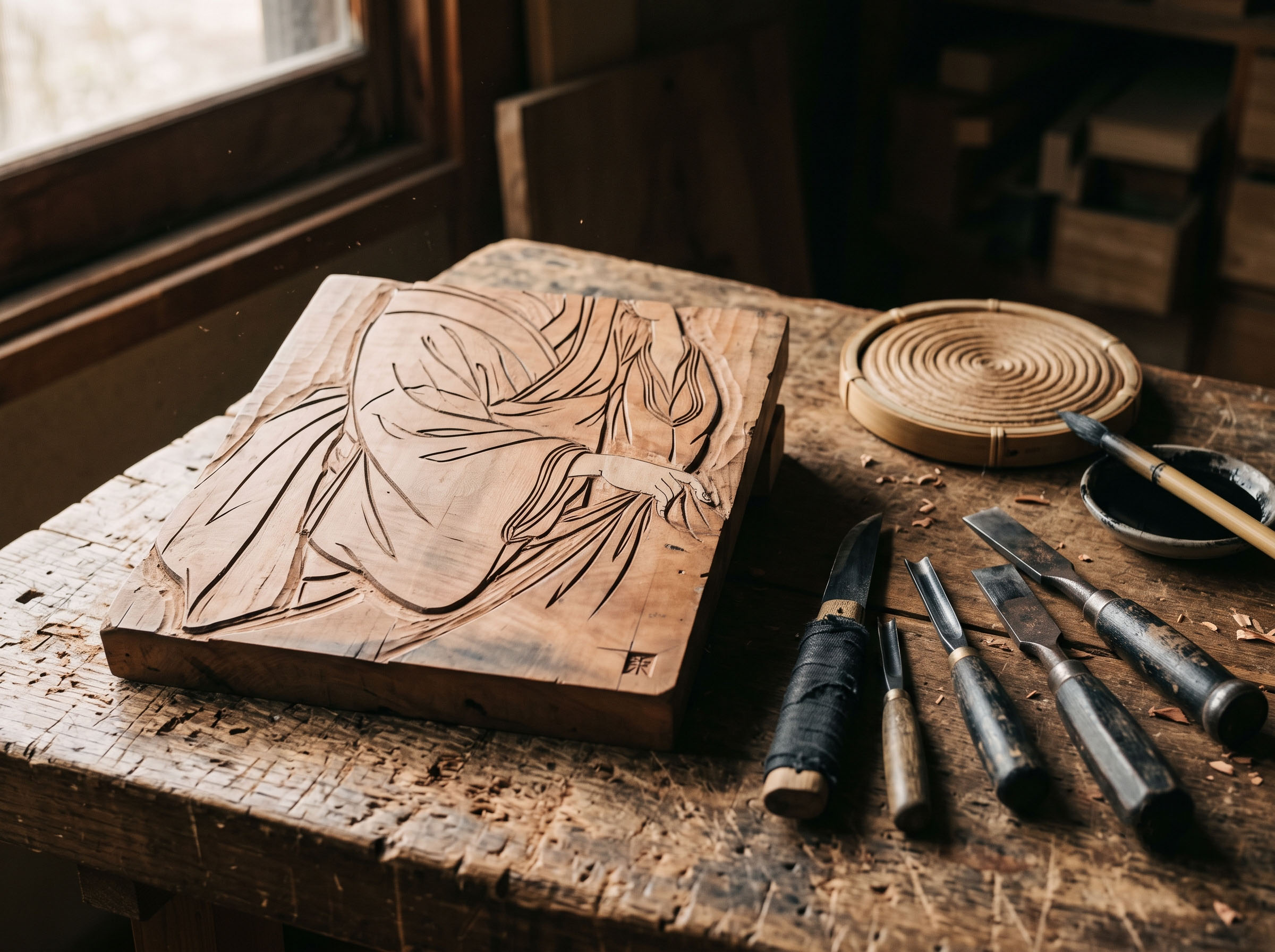
That is the methodological point, and it is worth stating flatly because the error is so common. The enlarged form in a shunga print occupies the same category as the elongated neck in a Mannerist portrait or the seven-and-a-half-head proportion of a Greek kouros. It is a rule of the picture, learned by artists from other pictures.
Ideal, not inventory
Set the pictorial convention beside the measurement literature and the gap is not subtle. The most widely cited systematic review of adult male measurement, published by David Veale and colleagues in BJU International in 2015, pooled data from seventeen studies covering up to 15,521 men, all measured by health professionals under a standard procedure. It reported a mean flaccid length of 9.16 cm (3.61 in), a mean stretched length of 13.24 cm (5.21 in) and a mean erect length of 13.12 cm (5.16 in), with a mean erect circumference of 11.66 cm (4.59 in). You can read the full nomogram study in BJU International, and our own critical summary of what the largest pooled measurement study actually found covers its sampling limits in detail.
Shunga depicts nothing within that range, and no serious art historian has ever suggested it does. What the comparison usefully establishes is the size of the interpretive distance — a distance the genre's own audience would have understood without needing it explained. Edo townsmen who bathed communally were in no doubt about what typical bodies looked like. The exaggeration was legible to them as exaggeration, in the same way that a caricaturist's enlarged nose is legible today.
Table 1 — Reading the conventions: what each feature is evidence of
| Feature of the image | Documented purpose | What it is evidence of |
|---|---|---|
| Figures remain clothed | Identifies rank, season, occupation; frames the composition | Edo dress codes and textile design — a reliable historical record |
| Anatomically impossible poses | Opens the design outward toward the viewer | Ukiyo-e compositional practice — nothing about human movement |
| Enlarged genitalia | Legibility at small scale; focal anchor; the "second face" reading | A pictorial rule — not a record of typical bodies |
| Literary prefaces and puns | Signals an educated readership; supplies parody (mitate) | Literacy levels and reading habits among Edo townspeople |
| Domestic settings, married couples | Establishes the genre's default social scenario | Values the pictures promoted — contested as a record of behaviour |
What was censored — and what the censorship reveals
The regulatory history is more interesting than a simple story of prohibition, and it maps closely onto how societies decide what counts as forbidden. The Tokugawa shogunate first moved against erotic books — kōshokubon — in 1661. The Kyōhō Reforms of 1722, under Tokugawa Yoshimune, went considerably further, requiring that no new publication appear without the city commissioner's permission and that artist and publisher be named on the print. Further restrictions followed with the Kansei Reforms of the 1790s.
The visible effect on the objects themselves is that after 1722 most artists stopped signing shunga. The invisible effect is close to nil. Publishing guilds went on issuing reminders to their members not to sell erotica for decades afterwards — which is the clearest evidence available that members were still selling it. Production continued; the lending networks were never regulated; paintings were never covered by the edicts at all.
The decisive rupture came later, and came from outside. Attitudes shifted sharply in the late nineteenth century as Meiji Japan reorganised itself in accordance with European and American moral expectations. Shunga became taboo domestically for most of the twentieth century, and Japanese obscenity provisions restricting the depiction of genitalia kept a significant body of the country's own art history out of its own museums. Western institutions were no more comfortable: shunga sat in restricted collections, and researchers were sometimes told the material did not exist. The 1613 anecdote is a useful bookend — English East India Company officials are recorded burning "lascivious" pictures brought back from Japan by Captain John Saris. Shunga was not publicly displayed in London until a 1973 Victoria and Albert Museum print exhibition.
Did You Know?
When the 2015 Tokyo exhibition was being organised, the material had already been a critical success in London — and organisers were still reportedly refused by a long series of Japanese venues before the Eisei-Bunko Museum agreed to take it. The show ran across two parts from 19 September to 23 December 2015, admitted only visitors aged eighteen and over, and drew a reported attendance in the region of 200,000 over its run. A second staging followed at Kyoto's Hosomi Museum in early 2016.
Shunga in the wider field
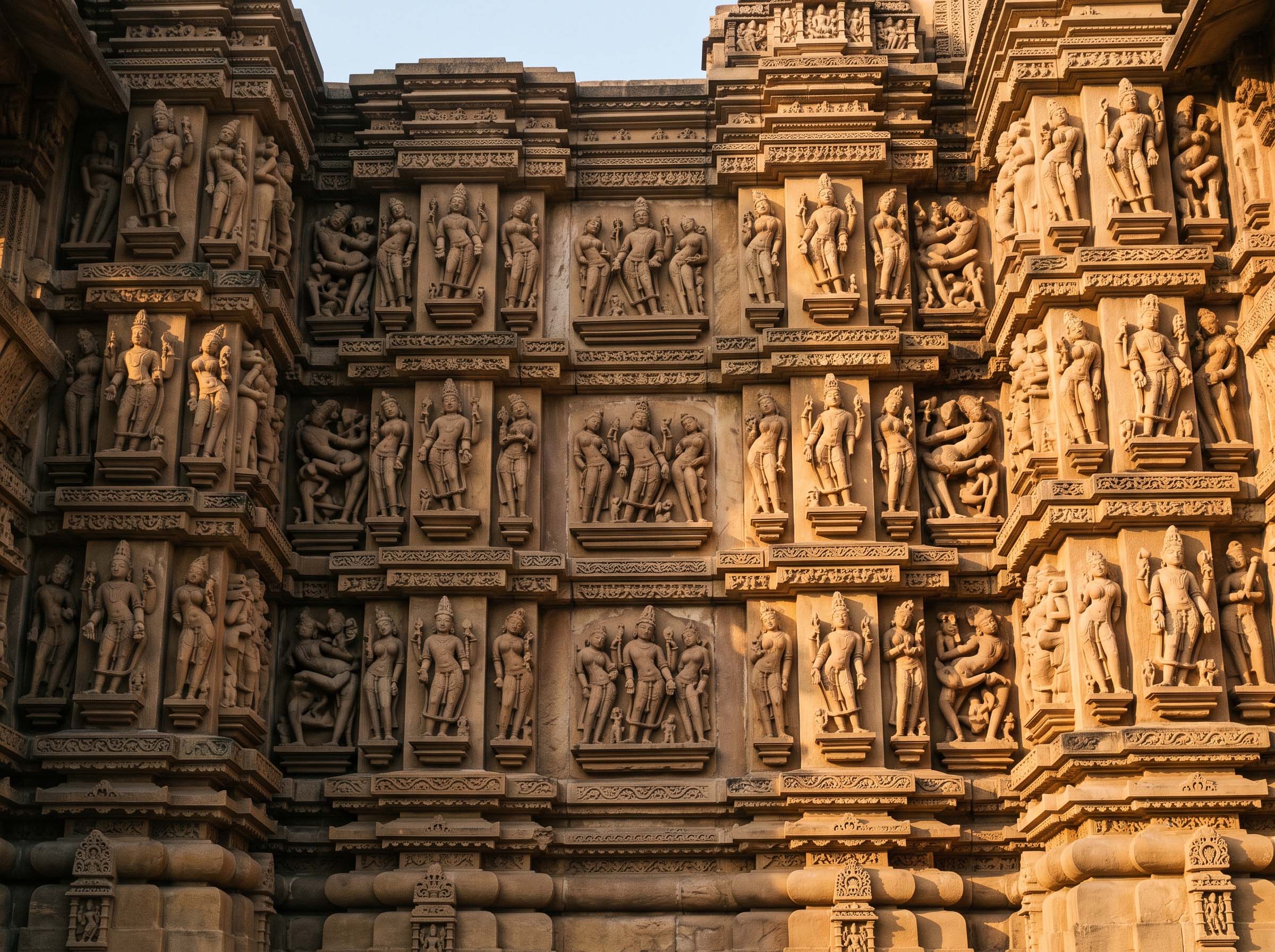
Reading shunga alongside other traditions makes the ideal-versus-record distinction easier to hold onto, because different societies exaggerate in different directions. Classical Greek sculpture runs the convention in reverse: the athletic male ideal is rendered with deliberately modest genitals, a formal choice tied to ideas about self-command rather than to Greek bodies. The temple sculpture of Khajuraho in Madhya Pradesh, built under the Chandela dynasty between roughly the tenth and twelfth centuries, and of Konark in Odisha, works to yet another set of proportional rules with religious and cosmological content behind them. Moche ceramic vessels from the north coast of Peru, produced between roughly 100 and 800 CE and held in quantity at the Museo Larco in Lima, exaggerate again — and to a different purpose, tied to ritual and funerary practice.
Four traditions, four conventions, four sets of reasons. What none of them supplies is anthropometric data. The consistent finding across the comparison is that art tells us what a society wanted to look at, which is a genuinely valuable historical record, and simply is not a measurement of anything. Our survey of how humans have depicted the body from cave art to photography follows that thread across the full historical span.
The line that runs to the present
Shunga did not so much end as get displaced. Erotic photography arrived in the Meiji period and competed directly with a hand-carved medium on price and speed, and the print genre declined. But the visual habits persisted. Curators and scholars connect shunga conventions — the hard contour line, the comic register, the compositional priorities — to later Japanese manga, anime and tattoo design, and the genre's admirers in Europe included Toulouse-Lautrec, Rodin and Picasso.
The methodological question travels just as well. A contemporary photograph, a film frame and a digitally retouched image are all made objects, produced under conventions, for markets, by people making choices about what to enlarge and what to leave out. Two centuries from now, an art historian looking at today's imagery will need to ask exactly what we ask of Utamaro: what was the rule of this picture, who was it made for, and what did it want its viewer to feel? The answer, then as now, will describe a culture rather than a population.
Editorial Glossary
- Ukiyo-e
- "Pictures of the floating world" — the commercial print and painting culture of Edo-period urban Japan.
- Shunga
- "Spring pictures." The erotic subject category within ukiyo-e.
- Enpon
- The bound album format, conventionally twelve images.
- Warai-e
- "Laughing pictures" — an alternative period term that records the genre's comic use.
- Nishiki-e
- "Brocade pictures" — full-colour printing using one block per colour, developed around 1765.
- Mitate
- Visual parody or substitution: staging a classical subject in contemporary dress, expecting the viewer to catch the reference.
- Kakemono-e
- The hand-painted hanging-scroll format — more costly than prints, and never subject to the publication edicts.
- Chōnin
- The urban merchant and artisan class whose spending built the ukiyo-e market.
Common Questions About Shunga
Sources & Further Reading
- Clark, T., Gerstle, C. A., Ishigami, A. and Yano, A. (eds.), Shunga: Sex and Pleasure in Japanese Art, British Museum Press, 2013.
- Screech, T., Sex and the Floating World: Erotic Images in Japan 1700–1820, Reaktion Books, 1999 (rev. 2009).
- British Museum, Shunga: Sex and Pleasure in Japanese Art, exhibition, 3 October 2013 – 5 January 2014, curated by Timothy Clark.
- Eisei-Bunko Museum, Tokyo, Shunga Exhibition, 19 September – 23 December 2015.
- Veale, D., Miles, S., Bramley, S., Muir, G. and Hodsoll, J., "Am I normal? A systematic review and construction of nomograms for flaccid and erect penis length and circumference in up to 15,521 men", BJU International 115(6), 2015, pp. 978–986.
Disclaimer
- All content on this website—including articles, educational materials, and interactive calculators—is for informational, educational, and entertainment purposes only. The calculations, percentiles, and outputs generated by tools on this site are based on general statistical data and mathematical models; they do not constitute medical data, a clinical assessment, or a diagnosis.
- Nothing contained on this website is a substitute for professional medical advice, diagnosis, or treatment. Always seek the guidance of a qualified healthcare professional or urologist with any questions you have regarding physical development, anatomy, or health conditions. Reliance on any information or tools provided by this website is solely at your own risk.


