


 English
 Español


Humans are odd apes. But the popular version of how we are odd gets the details wrong in ways that are more interesting than the myth.
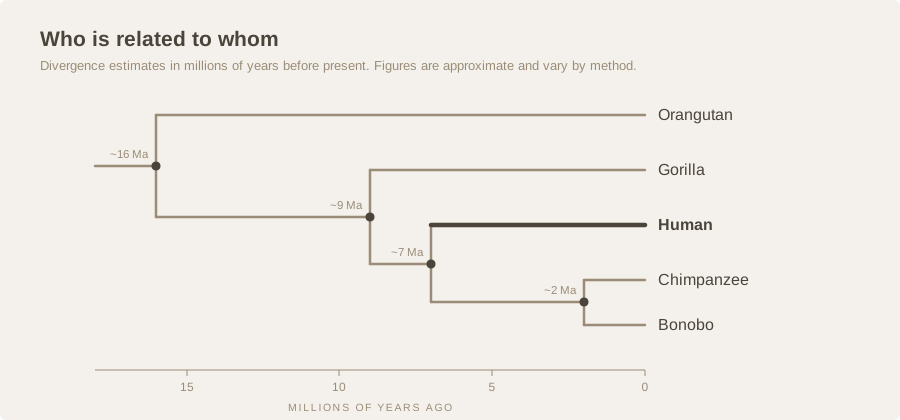
You have probably seen the chart. Four silhouettes, four apes, one conspicuously larger than the rest, usually captioned with something smug about human exceptionalism. It circulates every few years and it is built on a measurement error: the human figure is drawn erect and the ape figures are drawn flaccid. Correct that, and the comparison becomes far stranger and far more useful. Human males do carry unusual genital anatomy for a great ape, but almost none of it is about length. Once you know what the published clinical measurement data on human dimensions actually says, the comparative picture reorganizes itself around three genuinely distinctive traits: girth, a flared glans, and two things humans are missing that nearly every other primate has.
This is one of the most argued-over corners of evolutionary biology, and the arguments are worth following, because comparative anatomy is one of the few windows we have into the mating behavior of ancestors who left no diaries.
In Brief
- Human erect length sits close to the chimpanzee range. Girth and glans shape are where the real difference shows.
- Testis size relative to body mass tracks mating system across primates. Humans land in the middle, nearer the low end.
- Humans lack a baculum (penis bone) and keratinized penile spines. Most primates have both.
- Female genital variation across mammals is greater than male variation, and far less studied.
First, the vocabulary
Four terms do most of the work in this field, and all four are simpler than they sound.
Sexual selection is Charles Darwin's 1871 idea that some traits spread not because they help an animal survive, but because they help it reproduce. It runs on two engines: competition between males, and choice by females.
Sperm competition is what happens when a female mates with more than one male in a short window, so that sperm from different males end up competing inside her reproductive tract. The concept was formalized by entomologist Geoff Parker in 1970 and has since been applied across the animal kingdom.
Operational sex ratio is the ratio of males ready to mate to females who are actually fertile at a given moment. Skew it hard enough toward males, and competition between them intensifies.
Cryptic female choice is the possibility that a female's reproductive anatomy and physiology influence which sperm succeed after mating, not just which male she accepts before it. William Eberhard laid out the case for this in 1996, and it reframed a great deal of comparative work.
Start with the testicles, not the penis
The single most productive comparison in this field has nothing to do with penises. In 1981, A. H. Harcourt, Paul Harvey, Susan Larson and Roger Short published a short paper in Nature comparing testis weight against body weight across primate species. The pattern they found has held up for four decades and has since been replicated in bats, birds, fish and butterflies.
Male gorillas and orangutans mate infrequently, and a female in oestrus typically mates with one male. Male chimpanzees mate often, with many partners, and a female may carry sperm from several males at once. If the male who deposits the most sperm has the best odds of fertilization, then chimpanzees should have far more sperm-producing tissue than gorillas relative to body mass — and they do, dramatically so, despite a gorilla being roughly three times heavier. You can read the original 1981 Nature analysis of testis weight and breeding system in full.
Humans sit between the two, and closer to the gorilla end. That is not a moral statement about human behavior. It is a statement about the selective environment our ancestors were in: enough multi-male mating over evolutionary time to keep human testes well above gorilla proportions, nowhere near enough to push them toward chimpanzee proportions.
Combined testes mass as a share of body mass
Approximate values compiled from published comparative datasets. Individual and source variation is substantial; read the ranking, not the decimals.
The penis question, handled honestly
Here the popular story needs surgery. The claim that the human penis is enormous for a primate comes largely from comparisons restricted to the four great apes. Primatologist Alan Dixson, whose Primate Sexuality is the standard reference in this area, has argued that widening the comparison to all primates deflates the claim considerably. A hamadryas baboon carries an erect penis of roughly 14 cm (5.5 in) at about a third of human body mass.
The measured figures make the point. A 2015 systematic review of 15,521 men reported a mean erect length of 13.12 cm (5.17 in) and mean erect circumference of 11.66 cm (4.59 in). Dixson and Nick Mundy's 1994 study of eleven adult chimpanzees found erect lengths of 10.0–18.0 cm (3.9–7.1 in), averaging 14.4 cm (5.7 in). Chimpanzees, in other words, are not obviously behind.
What separates humans is shape. The chimpanzee and bonobo penis is filiform — narrow and tapering to a point. Orangutans (roughly 8.5 cm / 3.3 in erect) and gorillas (roughly 6 cm / 2.4 in erect, with older sources reporting smaller figures still) are shorter but likewise unornamented. The human organ is comparatively thick, and it terminates in a broad flared glans. If you want the structural detail on how that erectile tissue is arranged, our guide to how the penis works anatomically covers it.
There is a second oddity that cuts against the sperm-competition story. Across primates, elaborate penile ornamentation — ridges, flanges, spines, kinks — tends to appear in species with multi-male, multi-female mating systems, where postcopulatory competition is intense. Human anatomy is conspicuously plain by that standard, which is the pattern associated with pair-bonded species. Yet human males are meaningfully larger than human females, which usually points the other way. The comparative signals do not agree with each other, and honest reviews say so.
Table 1 — Great ape comparative reproductive anatomy at a glance
| Species | Adult male body mass (approx.) | Erect length (published) | Relative testes mass | Typical mating system | Baculum |
|---|---|---|---|---|---|
| Human | 70 kg (154 lb) | 13.1 cm (5.2 in) mean | Intermediate–low | Pair-bonded, some polygyny | Absent |
| Chimpanzee | 45 kg (99 lb) | 14.4 cm (5.7 in) mean, filiform | Very high | Multi-male, multi-female | Present |
| Bonobo | 39 kg (86 lb) | Comparable to chimpanzee, filiform | Very high | Multi-male, multi-female | Present |
| Orangutan | 78 kg (172 lb) | ~8.5 cm (3.3 in) | Low | Dispersed, single-male access | Present |
| Gorilla | 160 kg (353 lb) | ~6 cm (2.4 in) | Very low | Single-male, multi-female group | Present |
Human figures: Veale et al., 2015 (n = 15,521). Chimpanzee: Dixson & Mundy, 1994 (n = 11). Orangutan and gorilla figures follow published comparative summaries; sources differ, and smaller values appear in older literature. Body masses are wild-type approximations.
The comparative signals do not agree with each other. That disagreement is the finding — not a gap waiting for a tidier story.
The bone that went missing
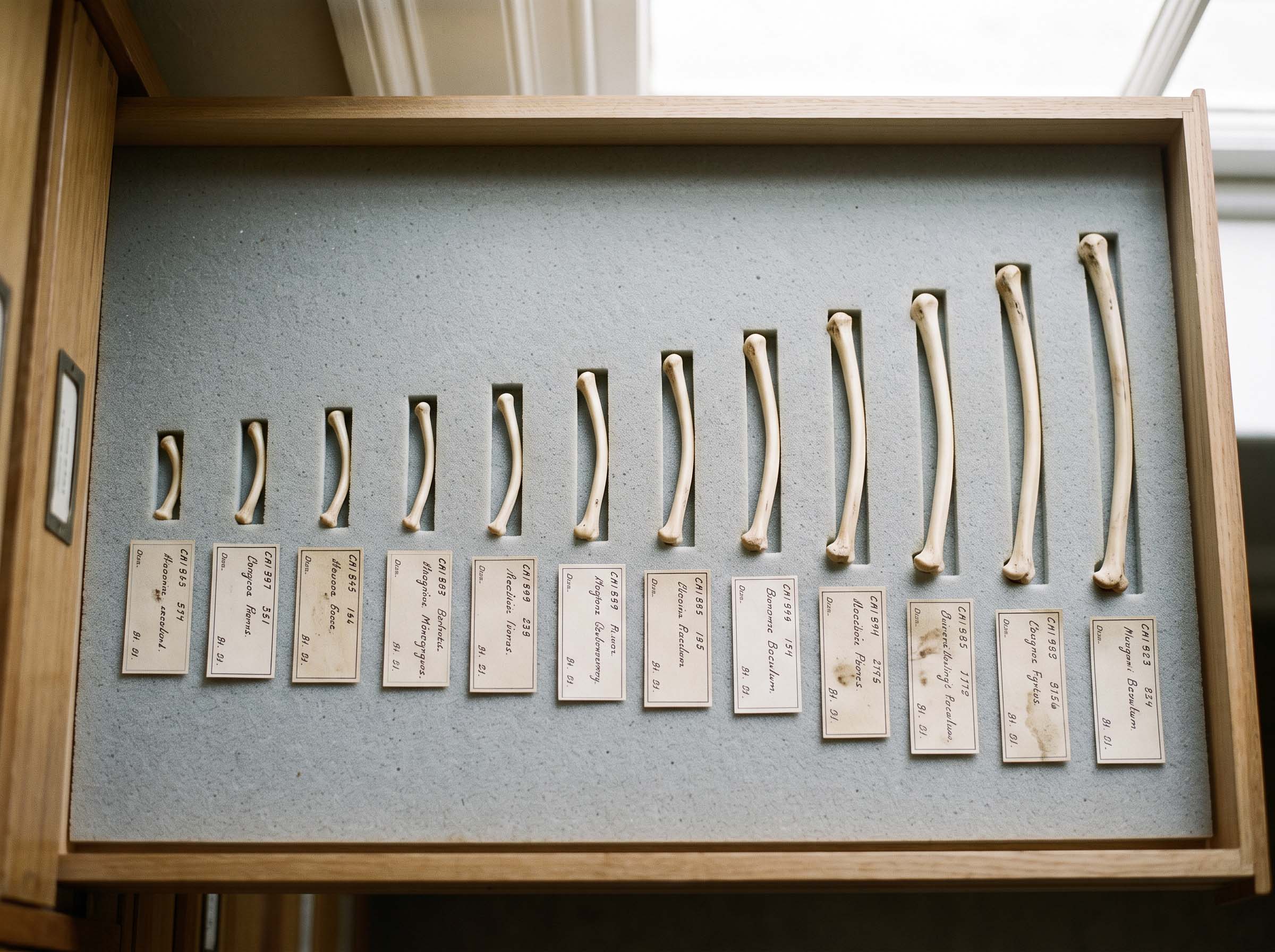
Most male mammals have a bone in the penis. Carnivores have one. Bats, rodents and insectivores have one. Chimpanzees, bonobos, gorillas and orangutans all have one, though in the great apes it is small. Humans do not. Neither do horses, whales, elephants, rabbits, hyenas or spider monkeys — a scattered distribution across the mammal tree that has kept the question alive since Victorian anatomists first noticed it.
The most careful modern attempt to answer it is by Matilda Brindle and Christopher Opie at University College London, who in 2016 reconstructed baculum evolution across the mammal class using Bayesian phylogenetic methods and then tested which reproductive variables predict baculum length. Their phylogenetic reconstruction of baculum evolution in primates and carnivores reported several results worth stating precisely.
The ancestral mammal did not have a baculum. Ancestral primates and ancestral carnivores did — meaning the structure evolved more than once. Testes mass showed no relationship with baculum length in either group, which weakens the simple sperm-competition explanation. What did predict a longer baculum was prolonged intromission: species in which mating lasts a long time have longer penis bones, and the presence of the bone tracked intromission duration across primate evolution. Polygamous and seasonal breeding systems also predicted longer bacula in primates.
The hypothesis that follows is that the baculum supports mechanical stiffness through extended mating, which matters most where a male's best strategy is to occupy the female's reproductive tract for a long time. Human intromission duration is short by primate standards. Researchers have proposed that as human ancestors shifted toward pair bonding and shorter mating episodes, the selective pressure maintaining the bone relaxed and it was lost. That is a hypothesis with supporting comparative data behind it, not a demonstrated fact, and it should be read that way.
A second human loss is better understood at the genetic level, and it is a separate structure — the two should not be run together. Many mammals, including chimpanzees, macaques and mice, have keratinized epidermal spines on the penis. Humans do not. In 2011 a team led by Cory McLean and David Kingsley identified 510 stretches of regulatory DNA that are conserved between chimpanzees and other mammals but deleted in humans. One of them removes an enhancer near the androgen receptor gene that, in transgenic mice, drives expression in developing penile spines and facial whiskers. Follow-up work found the same enhancer missing in Neanderthal and Denisovan genomes but present in chimpanzees, bonobos and other primates that retain spines. That is a specific molecular change matched to a specific anatomical loss — an unusually clean result in a field that rarely gets them.
Did You Know?
The baculum is not a modified part of the pelvis or the spine. It develops separately, within the connective tissue of the penis itself, which is why it can appear and disappear across mammal lineages without disturbing anything else in the skeleton. Brindle and Opie's reconstruction indicates it arose independently in the primate and carnivore lines rather than being inherited from a shared bone-bearing ancestor — a textbook case of analogy rather than homology.
The half of the field nobody funded
For most of the history of this discipline, comparative genital research meant comparative male genital research. Male structures are external, easier to measure and easier to preserve, and a long-standing assumption held that female anatomy was relatively uniform. A 2022 review in Integrative and Comparative Biology put that assumption down firmly: across therian mammals, variation in female genital anatomy exceeds variation in male genital anatomy. The imbalance was in the research, not the animals.
The clitoris is a good demonstration. Greatly enlarged clitoral structures have evolved independently in moles, in some bats, in the spotted hyena, in several lemurs and in New World monkeys — and the anatomy differs in each case. In the spotted hyena, the enlarged clitoris encloses the urogenital sinus. In lemurs, it encloses only the urethra, with the vagina opening separately. In spider monkeys, the elongated clitoral structure encloses neither. Superficially similar organs, three different structural solutions, three separate evolutionary origins. Calling them "the same trait" would be exactly the homology-analogy error the field spent decades correcting.
Among our closest relatives, the bonobo is the instructive case. Female bonobos have a prominent, frontally oriented clitoris and vulva, and bonobos copulate face to face in roughly one encounter in three in the wild — a position almost unrecorded in other non-human primates, including chimpanzees. Primatologists have proposed that anatomy and posture co-evolved here, though which drove which is unsettled.
Then there are sexual swellings: the conspicuous, brightly colored enlargements of anogenital skin that track the ovulatory cycle in many Old World primates. They appear mainly in multi-male, multi-female groups, and they have evolved independently at least three times. Competing hypotheses treat them as honest advertisements of female quality, or as graded signals that make the precise timing of ovulation ambiguous enough to keep several males interested and invested.
Humans have none of this. Human ovulation is not externally advertised, which is unusual for a primate and which every serious model of human sexual evolution has to account for. Anyone comparing across species will also want a clear baseline on female genital anatomy in humans, because the comparative literature assumes that structural vocabulary throughout.
Leaving the primates behind
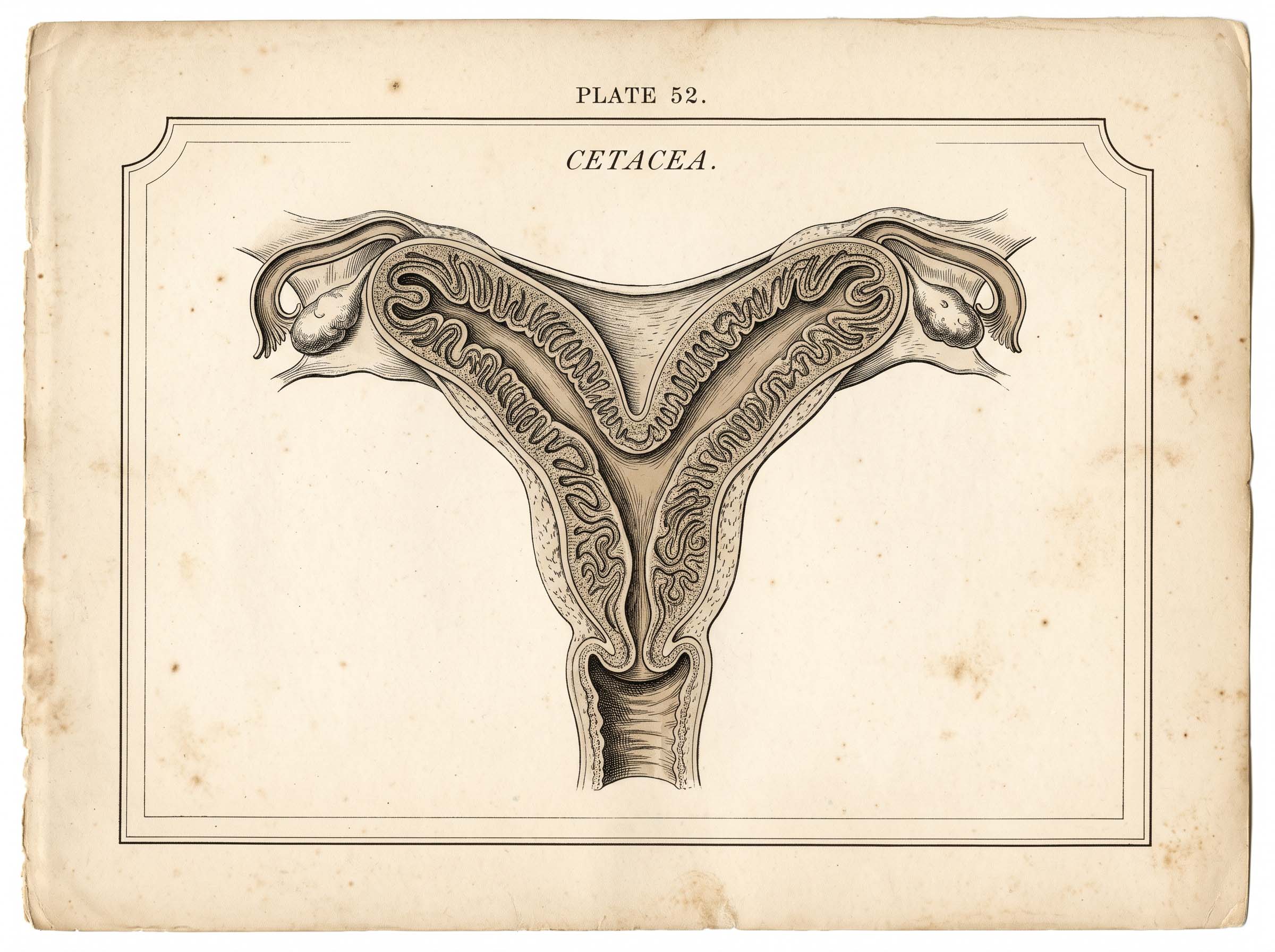
Restricting the comparison to primates leaves out the most informative material. Whales, dolphins and porpoises have folds, flaps and blind sacs in the vaginal wall that vary sharply between species. Dara Orbach and colleagues dissected the reproductive tracts of 59 female cetaceans across 20 species and 6 families and described a level of variation without parallel in any other mammal order.
Nobody knows for certain what the folds do, and the researchers say so. Seawater is lethal to dolphin sperm, so the folds may work with the cervix to keep it out. They may assist gestation or birth. Or they may give females mechanical influence over which sperm reaches the site of fertilization. Orbach's team later used scans of simulated copulation to show that vaginal complexity can physically limit penetration — a result consistent with antagonistic co-evolution between male and female structures, though the paternity data needed to confirm it does not yet exist.
This is the honest shape of the field: a striking anatomical pattern, three or four live hypotheses, and a clear statement of what would settle it. Cetacean structures also come with the standard warning. They are not "like" human anatomy, and describing them in human functional terms imports assumptions the animals never agreed to. They are cetacean solutions to cetacean problems, and their value here is as an independent test of whether sexual-selection models predict anatomy in a lineage with a completely different life history.
What comparative anatomy can and cannot tell you
Take the human evidence together. Testes proportions place our ancestors' mating system between the gorilla and the chimpanzee, closer to the gorilla. Penile ornamentation, or its absence, points toward pair bonding. Body size dimorphism points toward some degree of polygyny. Concealed ovulation points somewhere else again. The loss of the baculum and of penile spines both fit a lineage under reduced postcopulatory competition, and one of those losses now has a candidate genetic mechanism behind it.
What none of it does is prove anything about how any individual man or woman behaves, or should. Comparative anatomy is a record of average selective pressures over hundreds of thousands of generations. It generates hypotheses about ancestral populations. It cannot be run backward into claims about a person, and the researchers producing this work are consistently careful on that point even when the coverage of their work is not.
There is also a real risk in this field of what biologists call just-so stories: plausible adaptive narratives constructed after the fact and never tested. The 1981 testis paper survived because it made a prediction that held across independent lineages. The 2016 baculum paper survived peer review because it tested competing variables and reported that one of them — testes mass — showed no effect. Findings that could have failed and did not are the ones worth trusting. Everything else is a hypothesis wearing good clothes.
How We Handle Evolutionary Evidence
Evolutionary explanations are easy to invent and hard to test. Three rules govern how we report them.
1. A pattern is not a cause. Two traits appearing together across species is a starting point for an explanation, not the explanation itself.
2. Findings that could have failed count for more. A study that tested four variables and reported that one showed no effect is more informative than one that confirmed a single expectation.
3. Population history is not personal description. Nothing in comparative anatomy describes, predicts or prescribes the behavior of any living man or woman. Where a source hedges, we hedge with it.
Questions Readers Ask
Sources
- Darwin, C. (1871). The Descent of Man, and Selection in Relation to Sex. John Murray.
- Parker, G. A. (1970). Sperm competition and its evolutionary consequences in the insects. Biological Reviews, 45(4), 525–567.
- Harcourt, A. H., Harvey, P. H., Larson, S. G., & Short, R. V. (1981). Testis weight, body weight and breeding system in primates. Nature, 293(5827), 55–57.
- Dixson, A. F., & Mundy, N. I. (1994). Sexual behavior, sexual swelling, and penile evolution in chimpanzees (Pan troglodytes). Archives of Sexual Behavior, 23(3), 267–280.
- Eberhard, W. G. (1996). Female Control: Sexual Selection by Cryptic Female Choice. Princeton University Press.
- Dixson, A. F. (2012). Primate Sexuality: Comparative Studies of the Prosimians, Monkeys, Apes, and Humans (2nd ed.). Oxford University Press.
- McLean, C. Y., Reno, P. L., Pollen, A. A., et al. (2011). Human-specific loss of regulatory DNA and the evolution of human-specific traits. Nature, 471(7337), 216–219.
- Mautz, B. S., Wong, B. B. M., Peters, R. A., & Jennions, M. D. (2013). Penis size interacts with body shape and height to influence male attractiveness. PNAS, 110(17), 6925–6930.
- Reno, P. L., McLean, C. Y., Hines, J. E., et al. (2013). A penile spine/vibrissa enhancer sequence is missing in modern and extinct humans but is retained in multiple primates. PLOS ONE, 8(12), e84258.
- Veale, D., Miles, S., Bramley, S., Muir, G., & Hodsoll, J. (2015). Am I normal? A systematic review and construction of nomograms for flaccid and erect penis length and circumference in up to 15,521 men. BJU International, 115(6), 978–986.
- Brindle, M., & Opie, C. (2016). Postcopulatory sexual selection influences baculum evolution in primates and carnivores. Proceedings of the Royal Society B, 283(1844), 20161736.
- Orbach, D. N., Marshall, C. D., Mesnick, S. L., & Würsig, B. (2017). Patterns of cetacean vaginal folds yield insights into functionality. PLOS ONE, 12(3), e0175037.
- Orbach, D. N., Kelly, D. A., Solano, M., & Brennan, P. L. R. (2017). Genital interactions during simulated copulation among marine mammals. Proceedings of the Royal Society B, 284(1864), 20171265.
- Pavličev, M., Herdina, A. N., & Wagner, G. (2022). Female genital variation far exceeds that of male genitalia: A review of comparative anatomy of clitoris and the female lower reproductive tract in Theria. Integrative and Comparative Biology, 62(3), 581–601.
Disclaimer
- All content on this website—including articles, educational materials, and interactive calculators—is for informational, educational, and entertainment purposes only. The calculations, percentiles, and outputs generated by tools on this site are based on general statistical data and mathematical models; they do not constitute medical data, a clinical assessment, or a diagnosis.
- Nothing contained on this website is a substitute for professional medical advice, diagnosis, or treatment. Always seek the guidance of a qualified healthcare professional or urologist with any questions you have regarding physical development, anatomy, or health conditions. Reliance on any information or tools provided by this website is solely at your own risk.


